
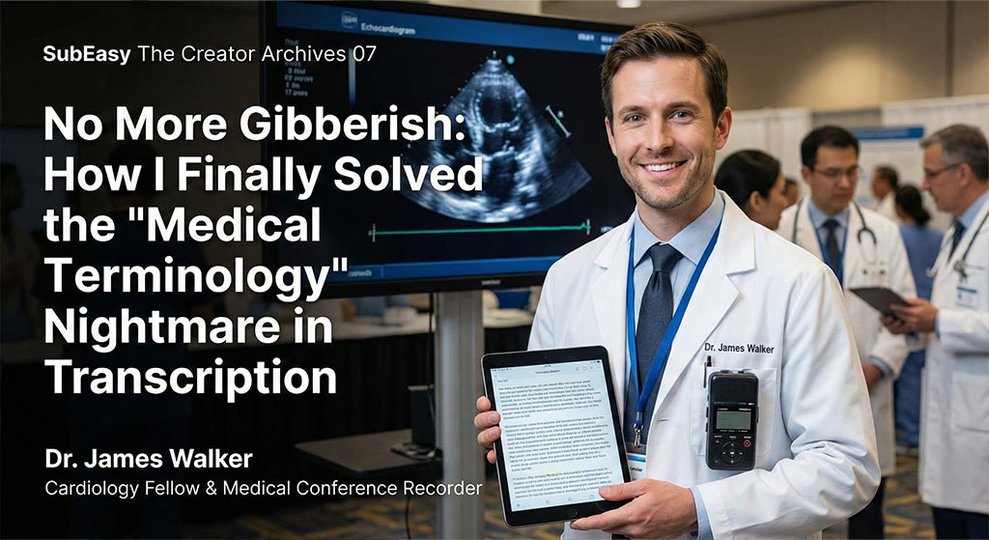

By Dr. James Walker, Cardiology Fellow
If you work in medicine, you know the struggle. You are attending a high-stakes seminar on the latest pharmacological advancements in treating arrhythmias. The speaker is brilliant, but they are speaking at 200 words per minute.
They are rattling off terms like "Sotalol," "Amiodarone," "Catheter Ablation," and "Paroxysmal Supraventricular Tachycardia."
You record the session, hoping to review it later for your research paper. But when you feed that audio into a standard speech-to-text tool? Disaster.
"Amiodarone" becomes "Amy a drone." "Arrhythmia" becomes "a rhythm yeah."
The transcript is a wall of gibberish. You end up spending 4 hours fixing the typos for a 1-hour lecture. It’s frustrating, and quite frankly, a waste of a doctor's valuable time.
That was my life until I started using SubEasy. It is the first AI tool I've found that actually "went to med school."
The Problem: General AI Flunks Anatomy 101
Most transcription tools are trained on general conversations—ordering pizza, customer service calls, or casual chats. They are not trained for the complexities of medical pathology or pharmacology.
When accuracy is a matter of patient safety or research integrity, "close enough" isn't good enough.
Step 1: Teaching the AI with "Custom Vocabulary"
This is the feature that separates SubEasy from the rest. Before I upload the recording of our seminar, I use the "Terminology" (Custom Vocabulary) feature.
I simply copy-paste the list of specific drug names, protein structures, or procedural terms that I know will be discussed in the meeting.
- Input: Rivaroxaban, Warfarin, Dabigatran.
- SubEasy's Reaction: It prioritizes these words during the transcription process.
By "priming" the AI with the specific lexicon of the seminar, the recognition rate jumps from a dismal 60% to a stunning 99%.
Step 2: Context-Aware Correction for Mumbled Speech
Doctors are notorious for two things: bad handwriting and mumbling during presentations.
Even when a speaker slurs a complex term, SubEasy’s Context-Aware Recognition kicks in. It doesn't just listen to the sound; it analyzes the sentence structure.
Example: If the sentence is "The patient was prescribed [mumbled sound] for hypertension..."
SubEasy knows that the mumbled word is likely a beta-blocker or ACE inhibitor based on the context of "hypertension." It effectively autocorrects the spelling before I even see the text.
Step 3: From Audio to Medical Record in Minutes
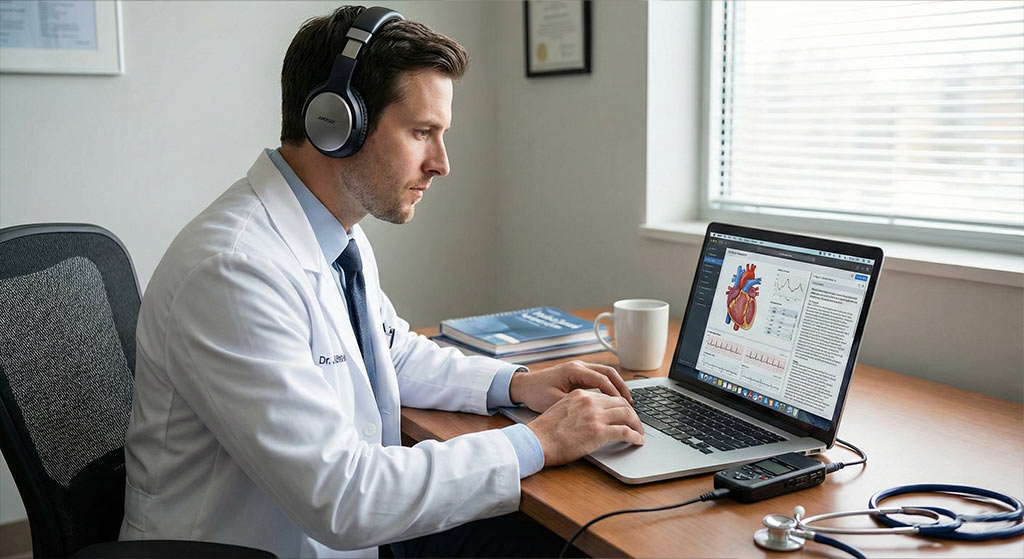
Once the processing is done, I export the text. What used to be a minefield of errors is now a clean, professional medical record.
I can immediately search for specific case studies or data points mentioned during the Q&A session using the Transcript View.
The Diagnosis? SubEasy is Essential
In the medical field, precision is everything. We don't have time to decipher bad AI writing.
SubEasy has become my dedicated scribe. It handles the jargon, the accents, and the speed, allowing me to focus on what really matters: understanding the medicine and applying it to patient care.
Make Your Medical Records Flawless with SubEasy
Imagine your product speaking perfect Japanese—even if you can't.
It’s not magic; it’s SubEasy. In our next article, a cross-border seller reveals how they use "Video Translation + AI Voice Swap" to replace their own voice with a native-sounding AI speaker, while flawlessly keeping the original background music. See how to create a professional, localized video that sounds authentic and stops the scroll.