

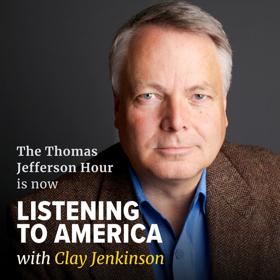
#1559 The Plight of a Secular Society
2023-08-08 00:58:25
Listening to America aims to “light out for the territories,” traveling less visited byways and taking time to see this immense, extraordinary country with fresh eyes while listening to the many voices of America’s past, present, and future. Led by noted historian and humanities scholar Clay Jenkinson, Listening to America travels the country’s less visited byways, from national parks and forests to historic sites to countless under-recognized rural and urban places. Through this exploration, Clay and team find and tell the overlooked historical and contemporary stories that shape America’s people and places. Visit our website at ltamerica.org.
Welcome to the podcast Introduction to Listening to America with Clay Jenkinson. I contacted Bruce, Um, because he has written about narrative.
His concern is that the human beings, the secular world, the first world, doesn't have a narrative of a story of of who we are. How we got here, how the universe was created, what the universe signifies, where we are in it, what our destiny is, why we die, what is it to be human and so on. That that we don't have one anymore, we're just at sea, we're just we, shrug we. There's nothing we can say. You know, Big Bang and multiple universes and and so on, but we don't really have a story to tell. Whereas in the Renaissance, there was a story to tell.
Hamlet is all about this. You know where we are with respect to the the universe. Is God in control? What do we owe God as humans? What happens when we die? What is the meaning of our lives?
What is our responsibility to the community, what are our responsibilities to our fellow human beings? And we take our cues from pop culture, mostly. So I wanted to interview Dr. Ledevitz about this.
Um, and I'm interested more. I'm, of course, I'm interested in that story, but I'm more interested at the so. My view is, we don't have a narrative that the American narrative that we we all thought we had. Which sort of starts with the Pilgrims and Jamestown. And then the lead up to the American Revolution, and then the formulation of a republic in our Bill of Rights, and then the Constitution. Uh, and then the Westring movement and the Frontier Pioneer movement of of Conestoga Wagons and Daniel Boone, and so on. The filling of the continent, uh, in the late 19th century.
And then America's. Under the work of William McKinley, and particularly Theodore Roosevelt, America begins to assert itself in the larger sphere of the world. And almost by accident, in the 20th century, because of the the cataclysmic wars in Europe, America emerges as the hegemon. And we've, on the whole, handled our our dominion of the world with a considerable responsibility and good sense. But not always in colonial wars and economic exploitation, and so on. I thought that was our story, that we were, uh, not a perfect, but a an idealistic and self critical, self-correcting society that fundamentally wanted to do the right thing in the world. That narrative doesn't have any advocates anymore, certainly not any advocates that are widely listened to. The word from the left is it's all been a sham from the beginning.
It's really just about power. And you can talk about justice with the capital J, and truth with the capital T, and beauty with a capital B, and so on, but it's really just about power relations. And and we're no different from anybody else that's ever been. And we should stop pretending that there's an American exceptionalism and so on. And the right view is even the slightest realism about our the mistakes that we have made and make as apologizing for America. And so here we are heading into the 250th birthday without this sense of of what this country signifies, what its story is.
If you don't have a story, you're in real trouble. So I really wanted to talk to Dr. Leibovitz about that. And so we we sort of moved in slightly different directions, uh, but, but it was all good. Um, so please enjoy this program.
I'm so excited about the future. I've been talking with my friends and handlers here about 2024 when I'm going to do this crazy thing, this John Steinbeck tour of the country. Beginning on Long Island at the tip of it and Sag Harbor, and going up to the top of Maine. And then down along the Great Lakes. To Bismarck, North Dakota, where he said the map should be folded. The longest single chapter in Travels With Charlie is set in North Dakota, not because of North Dakota, but because it was the first center of his travels. And then from Bismarck to Seattle, and Seattle to San Francisco and Monterey, and from Monterey to San Diego. And across the bottom of the country, including Route 66 to Texas, to Amarillo, where he spent Thanksgiving.
And then from Texas to New Orleans, where he had the most horrifying experience of his travels. Because he ran into the vicious white supremacists who were trying to prevent the integration of the public school system of New Orleans, the so-called cheerleaders. And then having kind of run out of steam. Both in physical exhaustion, in missing his wife Elaine, no longer really having enough mojo, but also deeply disillusioned by what he saw in New Orleans. Steinbeck sort of raced home and we don't really learn much about the last segment of the trip. I won't do that. I'm going to give it more oomph and more respect than that. And then got home and got lost in the island of Manhattan, which is a kind of a wonderful irony for the great John Steinbeck. So I'm going to be doing that next year.
And of course, there's a lot of planning, there's an airstream and there's a pickup, and there's travel, and there are campgrounds. And there are Steinbeck scholars that I want to meet and places I want to go along the trail, and I'm going to read all of Steinbeck's books during the same period. I'm really looking for America's story, America's narrative. And I'm I'm literally going to ask everyone that I spend any time with. What does America mean? what does America need? What do you love about America? what do you fear? what does what would make America a better place? How proud are you to be an American? You know how? What's the best way for us to observe the 250th birthday of the United States? I'm going to, I'm going to ask these questions in a kind of socratic way. And draw people out and record those who are willing to be recorded and use their their commentary. I'm going out to listen and learn.
I don't know what I'm going to find. I think the country is not as quite as fallen as it appears to be. And yet there are some really terrible and some systemic problems in the United States. So this I'm doing, this warmup and so talking to Bruce Litovitz was was sort of one of the many interviews I'm going to conduct. I'm going to put together a book list of of between 10 and 30 books that I intend to read to try to make sense of our history. So I can tell you a couple of them, I'm going to start with the Federalist papers.
So you could get started there. I'm going to read Tocqueville's democracy in America, Women's rights in America, I'm going to read environmental histories of America. I'm going to read a constitutional history of America. I'm going to read an economic history of America.
So I'm going to read all of those and the the notes and dispatches will appear in our website, LtAmerica.
Org. I can't wait. Frankly, it's going to be one of the greatest adventures of my life. I'm training for this in all sorts of ways, including physically. I think this is the work that I was meant to do. I so love this country.
I love America with a capital A, but I particularly love being out in America. In the national forests, in the national parks. Following the Yellowstone River, and following the Colorado River, and following the Rio Grande River, and following the Ohio River, and following the Hudson River. I want to really give myself to the project of trying to understand America at 250, think about America at 250. And not just kind of tumble into the the the birthday celebration in the spring and summer of 2026. So anyway, thank you everyone, thanks for listening.
Hello everyone and welcome to Listening to America with Clay Jenkinson. Today, my conversation with Bruce Lidovitz, who is a prominent columnist and author associated with Duquesne University, Pennsylvanian. A man of extraordinary culture, trained in the Jewish tradition, left it now. Can't believe in God, but can't not want something of the deep tradition of Judaism and Christianity. That were coordinating energies for the American experiment, and, of course, beyond America, too. Welcome Bruce Lidovitz.
So let's get right to it. The 250th birthday of the United States is upon us. When I think about this, given where we are, and not to put too nice a term on it, I see a storm of cultural warfare coming.
Coming, coming, that's a funny word under the circumstances.
But, I mean, do you agree that this is a nightmare that's about to happen to us?
No, no, no, I don't. I think that the most of the nightmare is over and I see a lot of hopeful signs.
Well, I want to hear all about it. Why do you think it's about over?
My understanding of what the problem has been is getting used to a secular civilization, being born, getting finally used to the idea of the death of God. In a serious way, uh, that's not an easy thing to do. And the United States is a, and the West in general, but the United States in particular, a God. Intoxicated civilization. And the post-war period after World War II, kind of the height of a Protestant civilization in which the mainstream Protestant churches and their spokespeople. They set the course for a very generous and magnanimous winner of World War II. But gradually, that broke down.
I mean, you know, Nietzsche's proclamation was 1882.
It certainly took a long time to take root, but you can see the gradual breakdown. And by the early 2000s, you really have a secular culture in a serious way. And not just one that, you know, has has fights to pick with God. But one that doesn't even know God anymore, doesn't even know that tradition anymore. And you have the, you know, the new atheists coming forth to proclaim it, but they were just they didn't cause it.
They were just, you know, sort of the symbol of what happened. But it's not easy. Clay. There's never been a a civilization that that was secular in human history. And who's to say that it's possible? And so, um, you know, for for 20 or 25 years I've been, you know, ruminating on this. I didn't know whether there could be a solution, I just knew it would be bad.
Because if truth dies, and you know, God was the guarantor of goodness and truth and beauty, and it was all going to come out. And Dr. King? And the arc of the moral universe is all premised on God, if God is real is not real. And it all might be just chaos and accident.
Then why should we not hate each other? Because, after all, we're all, it's all meaningless, and why not grab what we can while we can? And the hell with you? And I think that's what's been working out in various ways in the last 10 or 15 years.
There's so much here, but I think of Reinhold. Niebuhr, who in the midcentury was a major figure, appeared on the cover of the news magazines. He was one of maybe the 10 most prominent cultural spokesmen in the United States. And now the idea that a theologian or a major Christian voice would be central to our national discourse seems impossible.
Seems impossible, and I, I'm not sure your your listeners will even understand what you've just said. Because Reinhold Niebuhr at a certain point, if a national politician had had urged the policy that reinhold Niebuhr said, was simply sinful. That would have created tremendous pushback across the political aisle against that policy. And, of course, that's the reason the United States could be generous after the end of World War II. Because it was the right thing to do, and there were many voices were saying this, this is our obligation. It wasn't as political as people think it must have been.
And it's hard to imagine this country undertaking these efforts today. I mean, I know. Of course, there was plenty of cynicism mixed in. But by and large, the record of the United States after World War II was glorious in terms of human history. It simply is. And we just like we should look at the faults of the United States over time, we should also be able to look at its strengths.
Absolutely, so I'm going to circle back a little bit to the enlightenment and Jefferson. But for the moment, you're saying that we have become that secular society. There are still small enclaves that are resisting and agonizing over this and speaking very loudly, but generally speaking, we're in a post-God secular world. And how did this consolidate itself over the past quarter century?
Well, it did, of course, physically in the collapse of the churches, but it did so also spiritually, in the hardening of the arteries of religious movements. You didn't have much creativity. So you saw, on the liberal side of religion, completely taken over by politics. That the people in the Unitarian church are wonderful, but you cannot be a pro-life Unitarian because it's politicized, it's a politicized church. You see the same thing on the right in a hardening of forms of orthodoxy because orthodoxy. I know the Jewish tradition, which I left, but I know orthodoxy in Judaism very well.
I was raised in the Pasidic movement. I know how creative orthodoxy in Judaism has been in the centuries, it's no longer creative. That's another example of the secularization of society, so that even the religious pockets that exist are no longer in their strong and creative moment.
So if you went around the corner to that unitarian church and they were saying, people who are here not regularly or here for the first time, please introduce yourself. And you said, Hi, I'm Bruce and I'm pro-life. What would happen?
I would get a very cool reception. And it would be an issue, even though in theory, it's a political issue, not a religious one. But it wouldn't just be one of those things, it's a core commitment. You could also go to the Unitarian Church, for example, and this would be even worse. I mean, some people would understand being pro-life, it's a consistent ethic of life. They might groove to that, maybe a little. But if you went and said, Look, there are only two genders, you would at that point really be drummed out of the Unitarian church. I wouldn't go and say that because I don't believe that myself, but that would be even worse today.
If I, I'm a Bill Clinton pro-choice American legal, safe and rare on abortion. If I went into the Catholic Church downtown and said that, I'd be drummed out.
It would be okay that you'd be looked down on. But my real point is that what drives liberal religion in America is politics. Political positions. They're very important, but they certainly don't exhaust what we used to think of as religion. You know, I mean, in Christian or Jewish terms, my relationship with God is not defined by politics. Or, as C.s. Lewis said, You know, politics is the how we do things, and you know, religion's the why we do things, but they're not the same thing.
So how much have we lost in secularizing the culture to this extraordinary degree?
Oh well, at the moment we've lost all depth. That's the way that it manifests, and that's why everything becomes economics, everything becomes materialism, everything becomes, you know, who wins and who loses.
You lose grace, you lose graciousness, you lose hope, you lose all those intangibles. All of which rested on a belief that the, as Dr. King put it, the arc of the moral universe is long, but it bends toward justice. You, you can have a lot of grace if you believe that. Because, after all, you know, history is going to turn out okay. And I can. It's not all on me, it's not all on my dispute with you.
And that gives me a justification for not crushing you. And in any way, today's opponent is tomorrow's ally. You're just mistaken, you're not, you know, bad if you'd have that world view and all that's gone, and so it's all struggle.
And and that's what you hear in identity politics, that it's it's struggle, it's constant struggle, and it's constant manichaeism. You know, the the, the light and the dark, and it's it's absurd, you know? I mean, I have a lot of friends who voted for Donald Trump. And I have a lot of friends who have never spoken to a person who voted for Donald Trump.
I say to my friends who have never spoken to a person who voted for Donald Trump, you know, that's what about 45, something like that of the American people, surely you don't think that they're all crazy and racist? That's 45 of the American population. That can't be true. So how do you justify being in public life and having so little contact with your political opponents?
I don't think we've ever had as little contact since the civil War, the pre-Civil war period. I don't think we've ever had as little contact with the people we disagree with.
How will this impact the 250th birthday of the country?
Well, as I say I, I now see that there are green shoes, and that's that's the hope. In other words, this has been, this has been birth pangs. I think that we've. We've awakened a little bit from the nightmare. Of everything is opinion, and I think the idea that there might be truth, I think is is now reputable again. We've had our experience with the death of truth and it didn't work out very well.
Whatever you think of Donald Trump, even the people who voted for him didn't think highly of him. And you know, if he's nihilism, walking around nihilism doesn't look very good. If I say today, No, no, no, no, there really is truth. We don't know all about it and we never will, but we can approach it. And not everything is up for grabs, and the universe really does mean something.
I get much more of a hearing than I did 10 years ago or 15 years ago. And and also remember that secularism itself as a movement is really divided. Its spokespeople are the people who hate religion and are materialistic and relativistic, and all the rest of it. But most secularists are of the spiritual, but not religious type. Or, you know, the on being radio show on NPR, you know, that's, that's how I refer to it.
But they're not politically organized yet, and but I see much more recognition of that position than they used to be.
So what, I mean, you could say that this that Donald Trump drove a certain point of view right into the ground and therefore exhausted it. And we're kind of pulling back now. Or you could say, or maybe there's another reason why truth is getting a new rootedness in American culture. How do you read it?
It is, as you say, we, we. We had our experience with the death of truth and we didn't like it. Uh, nobody liked it, you know, you know, if I say that, if I say to people, look, you must admit something is wrong, everybody agrees, so nobody liked it. But there's also this.
Uh, people may just be oriented to truth, it may just have been very difficult to take on that idea. And it doesn't wear well. And and I think people are just tired of it, and I think people are tired of the idea that it's all chaos. Um, you can't live, live a life that way.
And so I, I just think it it. It has been an experiment, it hasn't worked out. And, uh, you know, truth never went away. And I think we're just sort of waking up to it again. I think it was inevitable that there would be a kind of movement back.
Bruce We need to take a short break. Uh, when we come back. I want to ask you more about the enlightenment and Jefferson and the secularization of America. You're listening to, listening to America.
Welcome back to Listening to America. I'm talking with Dr. Bruce Led of its columnist, Professor Thinker, who has recently suggested that President Biden pardon Donald Trump. Just to get it over with, in the manner that Gerald Ford did, uh, back in 1974, in September, not afraid to, um, to jump out of of his own party, the Democrats. Somebody worth reading, even if you don't agree with him. So anyway, welcome back Bruce, Bruce. So you would hope, if your thesis is right, that truth is making a rebound. That an election in 2020, 24, 2028 would be decisive on the basis of one party speaks some truth.
The other one doesn't.
I think that's likely, but it's hard to take to make predictions about politics in that about how an election will go. I wrote a column that made predictions about the next year, and a lot of the predictions have turned out very well. But one prediction I made was that it would at the end of the year, it would be Biden versus DeSantis. It never occurred to me that the Republican Party would seriously consider renominating Trump.
The only candidate that Biden can obviously be. I mean, I, I thought, no, they, they would not do that because they would want to win. Everybody would want to win, and so everybody would understand that. You can't renominate Trump, he's the only Republican that Biden could easily be. But I was wrong about that.
How much of the secularization of American culture do we have to place in the enlightenment?
Yeah, the enlightenment is sort of the the intellectual structure of secularism, although the enlightenment figures themselves, for example, were obviously pious men, mostly men, but pious. And you know, they didn't. They set into motion a process, a movement of thinking that led to secularism. It's not that they in any way were secularists, although, you know, they certainly they were. Some of them were skeptical. It was a lot of disagreement in the enlightenment I think about, not about Christianity itself, and not about the Roman Catholic church.
But there was still a lot of support for basic Protestantism in the enlightenment, a lot. And so you could not call the enlightenment a secular movement, but you certainly could call it a movement of free thinking. That ultimately led to skepticism that, a skepticism that they did not manifest in any way. But it led to a skepticism that eventually came to dominate, you know, free thinking became skeptical thinking, and skeptical thinking finally became. Not only is there no God, but there's no truth at all.
So we can argue about anything, everything is your opinion.
Of course, so I think of Jefferson, so let me try to make sense of Jefferson. You tell me if I'm wrong. He was a skeptic, bordering on atheist, but not quite.
He was a deist and a unitarian, and a skeptic but, and he wasn't willing to cut the cord. But. But he was dancing around there and his view was that we can separate these things into separate spheres of life, our religious sphere. Believe what you please. It shouldn't dominate the public square, and the public square should be a secular public square. It might be informed by religious sensibilities, but but it's to all of our advantage. If we kind of move these things apart and put them in separate lanes and and that will really free up a lot of things.
And he seems to, and he. He argued, as you know, based on the Scottish enlightenment, that humans have a mechanism. Don't need religion because we have a moral sense, we're born with it. And he said that God would have been a pitiful bungler had he designed us for social intercourse without giving us the tools of of, so on. And so he thought that you can jettison doctrine and miracles and theology and faith, and keep a kind of a generalized, unitarian reverence for the Great Creator. But that your moral life will be adjusted by tools that that require no doctrine.
Yeah, that I think that's a fair statement about Jefferson. Although he had a very high opinion of Christ. He took everything else out of his New Testament, you know, but. But he left in everything that Jesus said. And that's an important point, you know? And and all the things that you've said is sort of where I am actually, you know, in this day and age. And somehow Jefferson has helped lead us here, but is not of of this, he's not of our time, he's not anyone.
He would be horrified by where we are today.
And I think he would say, but his answers might might not satisfy you, his answer would be. Stay grounded in in in the earth those who labor in the earth of the chosen people of God. And public education, incredibly emphatically, so that we can inculcate the moral sense and give it muscle and, and, and, and, and.
Infrastructure. He would understand the idea that if, if, if I said, financiers, uh, took over and all they wanted was profit, and they didn't care about ordinary working people. He'd say, that's Hamilton, he. He'd understand why some people thought that, um, free trade might've been a mistake. You know, I mean, that whole, the whole, you know, neoliberal approach, that somehow the market was everything.
I mean, they didn't think the market, the Scottish Enlightenment did not think the market was everything, and it invented the market.
Uh, here's how I see it, um, and I, but I'm only saying these things to provoke you. That the enlightenment, uh, dabbled with secularism, or free thinking in a certain way, that that that made it possible inroads for secularism. And Jefferson and the founding fathers separated Church and state Jefferson's Virginia Statute for Religious Liberty, and by doing this, the separation was born. But we were still a very largely Christian country until after World War Two, and then somehow it collapsed, and so how did it collapse after World War Two? There's still a gazillion churches in every town in America.
Oh, no, no, absolutely. It collapsed for the reasons that, um, that Pope Benedict once said, said that whatever your idea of God is, it has to be plausible. It's the same reason I ultimately left Judaism. You cannot really separate the miracle working God from the from the Bible. I mean, the theologians tried to do so, but it is a miracle working God.
It is really the creator of the universe, it really is the one who makes the heavens move or not move. It stops the sun in the sky. It's not just that there are miracles in the Bible, it's all miracle.
I see us, Lewis said that, too. It's a miracle all the way down. And so, I mean, I, you know, the scientific worldview assumes that the world is in fact rational. And so, uh, you know, a theologian like Bernard Lonergan, I've, I've. I've based a lot of my work about, uh, around Bernard Lonergan. Um, because he was. He came from the sciences, even though he was a theologian and a Catholic priest.
And so for him, it was all rational, and that just shows for him. That showed, of course, the glory of God. But, you know, however you put it, you you get. You can go a long way by saying the universe is rational and goodness is a better way to live than any other way. Uh, or the way I sometimes put it is, the Bible may not be true, but most of what it says is true. You know, if you do not care for the poor, your, your society will crumble.
And that turns out to be true. And if you abuse the earth, the rains won't come, which is literally what it says, but now we know the rains won't come if we abuse the earth. The Bible is a great foundation, but it can't be taken literally, it can't be taken, um, in its theological structure. We need to work out a new how to get there, and that's what we've been struggling with. But that? But that's the struggle to the people who say I'm spiritual but not religious.
They're struggling with that.
Indeed, yes, so I, I have good friends who are what I would call mainline Protestant preachers and parishioners. And the view now is that the miracles didn't happen, they can be seen as metaphors.
Any rigorous mind can't accept any of that. Um, and my view is, if you don't accept that, you're done. Uh, because then you're left with kind of a rotary club. That says, be good to other people, you know, be generous, um, forgive your enemies, and so on. I read the Book of Acts recently, Bruce, I hadn't read it in 20 years. A marvelous book. And in it, the author, presumably Luke, points to the miracles and says, No, this is not some sort of metaphor.
This actually happened. This is manifest, it is irrefutable. Explain it as you want. But. But every time that miracles come up in the Book of Acts, the author, or Paul, says, Don't pretend that this is just something that can be seen as kind of truthy.
This is the truth that actually happened you, it cannot be denied, and if you don't believe this, you can't be one of us.
Right, no, that's true. And unfortunately, for years, I tried the route in Judaism of saying, well, I'll translate everything. Finally, my mentor, Robert Taylor, my, you know, he and I started teaching at Duquesne Law School at 1980, and he was a Protestant minister, later converted to Roman Catholicism.
A great, a great mind, a great spirit, who studied with Bart, Carl Bart. But anyway, one he. He once said to me, you know, hearing about how I translated everything and got mad at synagogue, and you know, all that? He said. That's the least religious comportment I've ever heard.
Get out, get out.
You're not doing yourself any good, you're not doing the people around you any good, and it's not easy for a Jew to believe Judaism. Let me tell you why? Well, it's because it's, it's. It's almost a race.
After all, you know, it's not, it's a people. And you know, to leave the Jewish people is a very serious step. And and if you, of course, my friends can't figure it out, because many of them don't believe anything, don't believe in God either. I was invited back to Dor Hadash, one of the three synagogues that where the gunman did the shooting, and not in 2018, that was my synagogue. And I've always been on very good terms. I, I always send in my dues every year because I appreciate them so much, but I'm not a member.
And um, they invited me back to give a talk about my leaving. Judaism, they were curious, and I explained. I no longer believed in God, and I thought Judaism was the history of the relationship of the Jewish people with God. And therefore, I had to leave. Um, and my friends came up afterwards and said, Well, I don't believe that either, but I didn't leave.
Only my Orthodox friends understand why. That is a ground for leaving.
I'm trying to understand your trajectory, so many people have had part of your experience. Which is you grew up in a tradition. And at a certain point in your life, you realize it doesn't work for me, or I don't believe this anymore. My adherence is no longer valid. Most people then wind up being either secularists who have a spiritual life, or just secularists. In other words, they're done, but you, you weren't done.
So what is it in you that gave you the capacity not simply to walk away and make the best of the secular world you live in? With all of its fruits, by the way.
Well, I sort of am doing that, I guess, in a way, but if you, if you mean I really want, want to make it work, um, I have. It's the example of the prophet, and I can't remember which prophet it is, whether it was Ezekiel, Uh, I know it wasn't Isaiah, but one of the prophets in the Bible. Lived out the infidelity of Israel, his wife was unfaithful to him, and he expressed through his relationship with his wife the infidelity of Israel. And it's it's lack of fidelity to God. Um, so, in other words, as above, so below. In a way. I I always thought that I was, I was meant. This is a funny thing to say for somebody who doesn't believe in God.
I was meant to live out the exile, the loneliness, as you call it. Um, and not to be comfortable. Because it would force me to think about forms, social forms, other forms, theological approaches that would be appropriate for a secular age. Uh, if I had been able to stay in Judaism, I wouldn't be driven to be doing the work that I'm doing now. And so I'm sort of living out the exile that everybody is in. All the secularists are in. But they don't have the capacity to think about how to end it, how to, how to come together again and be at home in the universe.
That's my question, why? Why don't they have the capacity to do this? And how can we generate some sort of plausibly consensus? Way to to move back towards lives that have greater depth, as you put it earlier in the conversation?
Well, I mean, it's just very, very hard to do it. Clay. It's never been done without, uh, uh, a basic supernatural structure. All the religions of the world is supernatural, there are, there are none that are not. Uh, I mean, they express it in different ways. But it's not true that Asia Asian Eastern religion is less supernatural than Western religion.
It's no, they're all, it's all, it's God's everywhere. Um, and and so what you're talking about trying to do is just extremely difficult to do. And and and you have also a misunderstanding problem, which is, um. Some people think that the reason science is so successful is that it did did away with teleology and that it did away with. Uh, any kind of idea of the quest for meaning. And Alfred North Whitehead came up, came along in the 20th century and said, No, you misunderstand it, had it was willing to, um, uh, arguendo, uh. Look at physical relationships apart from meaning. And and it did make quite a lot of progress in that regard.
But right now, said Whitehead, it's limiting itself in its understanding because it retains that view. It took, what was it? nothing more than a working experiment, and took it for truth, that the world, the universe, was like this. It was just a chaos. Forces and matter. Um, and Whitehead said, No, no, I mean, and you, you, you are actually undermining science.
If you can, if you take that as ontological rather than simply pragmatic. Um, and and we just have to learn from Whitehead, you know, white, Whitehead managed, uh, Wittgenstein managed, uh, Heidegger managed. I mean, all these great secular thinkers, more or less secular in Whitehead's case, but, you know, all of them not traditionally religious. Uh, they're intoxicated with. And so, you know, we have many models, we just have to learn from them and we have to also understand that this is a task.
Part of the problem is not just that we misunderstand science and think that it it is successful because it's atheistic. But we also have to admit that the death of God is the cause of our troubles before we can get anywhere in doing anything about it. So if you hate religion and think religion is stupid, then you, you, you. It's going to be hard for you to admit that you lost something when when we became not so religious. And and then it's hard for you to come up with an alternative because you, you resolutely say there's no problem. The new atheists thought we'd be liberated in this new era.
You know, I don't know how they explain it now.
I'm sort of with Henry David Thoreau. The mass of men lead lives of quiet desperation. In other words, the secular model is amazingly um productive put a man on the moon, you know? um, solve the code of DNA, cure cancers and so on, um, smartphones. People, of course, love all the things that can be brought about by technology, science, and so on. And so, secularization has been, in one way, liberating in my view, and in another way, deeply destructive.
Uh, and I blame Jefferson in part for this, but leaving him aside for the moment. Don't you think that that the chaos in our world? We could make a long list of what we mean by that? But I think we both understand it in the same way. Don't you think that the chaos of a world leaves a lot of people feeling empty, bewildered, afraid, angry? I mean, don't you think that the the the, the symptoms of our time, or that we haven't yet connected the dot? That this is about secular, secularity? But but most people are are are miserable in some sense of that term.
Yes, and I think this can be described really more simply than you're putting it. We no longer have a story about human existence. You cannot live without a story of human existence. And a lot of cosmologists and others are, are, are, are on that bus talking about story. Uh, Brian swimming, you know, the story of the universe and all that. Uh, that's exactly what is lacking.
Uh, Christianity, or theism, was a story about human existence. And you will, human beings will be miserable if they do not have a story. And I I'm constantly pushing my fellow secularists. What is your story? And the only story that they've come up with so far is the life is shit and then you die, which is not going to cut it.
You know, it's just not going to be. Life is terrible, and, um, there's no meaning, and then you die.
We're sort of it's, we need to take another, uh, short break when we come back. I want to ask you more about how we might possibly recover from this emptying out of the American story. This is a special edition of Listening to America. We'll be back in just a moment.
Welcome back to listening to America Bruce Story Narrative. People needs to understand where we came from, how the universe was created, what is our place in it, what are our responsibilities to each other. Why do we die? What happens after we die? What is the purpose of life?
Do we owe anything beyond our own pursuit of material happiness and pleasure and power? You have two advantages one is that in leaving Judaism, you didn't say it. There's nothing in the older New Testament, it's all crap.
There's nothing to be gained. There I was. I heard a homily last week about the enunciation, and it was so that passage in in in the New Testament. It's so beautiful, so deep, in universal ways that have little or nothing to do with the specifics of that story. And you think of the number of stories in the Old and New Testament that are paradigmatic. In such a way that no human can really understand life without wrestling with those stories. Adam and Eve, Noah and his children, Um, Cain and Abel, et cetera, et cetera.
Lot's wife, you have that. You haven't jettisoned the tradition, you just jettisoned belief because you felt you had to as a man of integrity. And the other thing is, you were well-educated.
So, you know how to maneuver your way around Amazon?
Com or the Harvard Bookstores and find the texts that can help you find meaning. In a. In a fallen secularist world, the average American doesn't know who Karl Barth is, doesn't know who Reinhold Niebuhr was. Couldn't, couldn't do the Apostle's creed, so you have tools, but. But I feel sorry for the 295 million Americans who are just out there, lost and they get that something's lost.
There's an anxiety and an agony in that, but they don't know how to turn, and so they go to escape instead and binge watch stuff.
No, that's right. And without the shepherd, the sheep are lost. The Bible says that too. So yes, what has to these? These forms that are being invented have to be accessible. And I, I'm trying to remember which philosopher it was.
It might have been Hegel, yes, Hegel, who? Who thought that philosophy, people of philosophy, didn't need religion, but religion was kind of philosophy in pictures, and therefore it was good for people. And and and it's true, it's simply true that you know that the conversation that we're having is not. You know, the conversation that you and I are having is certainly accessible to you know, most, most, everybody.
But on the other hand, people have to have enough education to think about thinking in these ways, you know? And that's, of course, the crisis of the liberal arts, which is another example of what we've lost.
The death of the humanities is is, for me, what, the gravest crisis that we have. Because, if we, if we had a reason, if if we had the culture of Reinhold Niebuhr, if we had education as it looked as it existed, say, in 1952, Trump would not have survived either of the impeachment trials. In other words, we lack the civic understanding of what virtue is, what civic engagement is, what norms are. We just no longer have any basis with which to judge behavior in any meaningful way.
Well, that's, it's the same problem that we've been talking about. It's all part of the death of God and the decline of that tradition. And we didn't see the need to replace it. I believe it can be replaced. Because, after all, with God all things are possible, with truth, all things are possible.
If the universe is is in fact a good thing, and if we are well-designed, then it's impossible to say that. Our knowledge brought us to a point where we have to destroy ourselves. It must be true that we can replace. We can take all the best parts of this and and and tell a new story about it that will be accessible in the way the old story was. But, you know, it could take, you know, 150 years. The Death of God is new on the scene. 1882 was its first announcement.
I want to go back to narrative for just a minute, because that's actually. I've loved this conversation, by the way, and I won't keep you much longer. I really respect your time, but I contacted you because of narrative, so it wasn't the big narrative that you're talking about. Like, who are we?
Where did we come from, and what does this all mean? What's our story? For me, as I look at the 250th birthday of the United States, I believe we don't have a narrative, we don't have a narrative of America anymore.
So, you know, when I grew up, it was the founding fathers, followed by the West Wing movement and the pioneers and the Conestoga wagons. And you prove up civilization, and yes, you do a lot of damage to Indigenous cultures, but you're still kind of a self-correcting society. And look, what you've done, it was worth it.
It was worth the displacement of all of this and so on today. If I mentioned if I, if I gave a much more eloquent version of that at Columbia, I'd be. I'd be thrown off the campus by the intellectuals because they don't believe any of that anymore. And so we don't have a narrative, the left left, the left is deliberately anti-narrative, or if they have a narrative, it's 1619..
That's been oppression right from the beginning. And you can dress it up with any lipstick you want. And the right, far right, the evangelical right, doesn't want to. You know, if you so much as say we shouldn't have done that to the Sioux, they're saying, you're apologizing for America. And so we don't have a narrative that we can agree on, and I think a country without a narrative that it can agree upon is a dying country.
I don't know how you feel.
Well, I don't feel that we're a dying country. I mean, we're having a problem, a big one, but you're quite right in describing the symptoms. But I don't think that this is fatal. In fact, I think, I think when I look at what I look at France and their struggle with diversity right now, with their Muslim population, in which they believe that. This is a story today in the New York Times, the French seem to believe that if you talk, if you talk about the problem of religious discrimination, you'll make it worse.
But Americans don't think that Americans think we should talk about our problems all the time, and that's great.
That's a good sign for you, Pardon, you regard that as a good sign.
That's a good sign, that's a great sign, and I want to be. And it was funny. You told the story about how the anti-narrative people came up with 1619. A grand narrative which just shows how difficult it is to live without truth. You know, obviously, one narrative to replace another.
But the Narrative of America and Reinhold Niebuhr would have agreed with the narrative. America has to include sin because we're human, and so we have the greatness of America, and we have the fundamental sin of America. They always go hand in hand and you don't have to deny the sin. And I always thought it was funny. When I think about Critical Race theory, Critical race theory is simply the view that racism infused American history from the beginning.
And today, there is structural racism in many, many institutions in society. And when I was, when that was explained to me that that's what race theory is, I said, Oh, I thought that was American history.
Right, duh?
That's us, you know? I mean, I can't, you can't teach that, but that doesn't cancel. All men are created. no, all men are created equal with the death knell of slavery.
And Lincoln knew it, and you see the hope, the hopefulness that I'm suggesting. Because the attack on Lincoln as a mere racist apologist failed, and the counter movement to resuscitate Lincoln with all its flaws is very strong. Even even in the New York review of books. So the same thing is going to happen in general. No, the genocide against Native peoples is the great sin of America.
Slavery, the great sin of America, and everybody was involved, wasn't the South? you know? the great financiers in the North had the profits from slavery, so slavery built this country.
It's absolutely true. A lot of things did, but slavery did too, and the displacement, displacement, of killing of native people is a terrible mark against America and the West. You have to accept it.
It's true that was the sin, but there was greatness too, and that's why this is such a wonderful country in which to live, because the greatness really did outweigh the sin. And coming to terms with the sin is one of our strengths. Where we have enough Christian baggage to still know that we have to come to terms with our sin and that will save us.
I think a lot of the establishment of this country chokes on the word sin.
Can't say it, can't believe it. We will not accept the notion that there is sin, and the people that are the loudest on the left at least believe that they are without sin.
Oh, absolutely. But you know, everybody believes they're without sin in this country right now. Because if you didn't believe you were without sin, you could not think that your political opponent was evil. You'd have to say, Well, you know, I have some of the same tendencies.
And you know, when I write my columns, I get criticism from the left and the right. But I do occasionally get somebody from the right. From the Republican side, because I'm a Democrat, I do occasionally get these emails from Republicans. That says, I don't agree with you, but I'm amazed. You could write that, you know? Well, I mean, if I, if I write that, you know. Biden made a mistake, or, you know that we did. We should have taken much more seriously the faults of the FBI in 2016, going after Trump for no reason. And I wrote, The right says that people who said he was a Russian pawn should apologize, they should.
That wasn't true, you know, and I wrote a column about that, you know, and of course, I've written a column, as you know, that. It would do the country a lot of good if Biden would pardon Trump despite his crimes. Because there's no way to get rid of Trump unless the Republicans can criticize him and they can't criticize him while he's under indictment.
I read that column with great joy. I agree with you 100 percent, I go one step farther, and maybe you agree with me too. I think that President Biden in a week or two should have a televised meeting from the Oval Office and say, I've decided to pardon Donald Trump. We got to get this behind us.
This, this clouds too many things. We all know the truth about this, we're moving on. I'm pardoning him and then wait three weeks and come back and say I saved the country that I ran.
I told you I ran to save the country, I did, but I'm too old now, there are too many things to be taken care of. I'm going to stand down after a single term.
I hope you make good choices here. I think that if he did that, he would be regarded as a great hero of our time. What do you say? I mean, that he should resign, that he should not stand again.
What I said was that Globature and Pete should should have challenged him then on the ground. Not that he didn't do a good job, because, in my opinion, he's done an excellent job, but he is too old and a new generation needs to come forward. And you know, it's ridiculous that the two people running for president who may face off are older than I am.
So why won't Biden do it? I mean, Biden, Biden's gotten every award that America offers, why won't he do it? When it's clear to you that he could cost the Democrats the presidency, it's quite likely that this could happen because of his age and his apparent ineptitudes and all that.
Why doesn't he have? I mean, he's a, I think he's a wonderful human being at heart. why doesn't he see that? This has to happen?
You're asking, you're asking, why do I think I'm indispensable? Haven't you seen sports? People stay too long? haven't?
I mean, I'm still teaching, I'm 71, haven't I stayed on too long? I mean, don't we all feel that, you know, without us, the deluge, without us, you know, there's no hope we're so important.
It's really hard what you're asking. It would be a tremendous thing if he could do that.
But that's what a that's what a patriot, statesman of virtue would do. That's if you think of how we have aggrandized the Roman Republic at its best. That's what you're looking for, that's where, that's how you get into plutarch.
Oh, no, no, we have an example. That's what George Washington did. I mean, that's what he did, He did literally what you just said.
He started the tradition of only two terms when people wanted to make him king, and that's his. That's probably the greatest thing about George Washington. And but look how rare it is across the world, across human history. So I, you know, I'm not. I'm not that hard on Joe Biden for not being able to do it.
I think it would be really something if he could. But also, remember Clay. All the people around him have a self-interest in keeping them around, so they're not saying it to him.
Amy Klobuchar for president, Buttigieg for vice president. A new era begins. They can hold their own against any debate, but, as you say, human ambition and the myth of indispensability are enormous.
I also, I must admit, I can't figure out why Vice President Harris is so reviled. I've never understood it. She has a very bad reputation, but I don't, I don't know why she has a bad reputation.
I don't see it, I don't know.
I don't understand it either, I don't really know that much about her, she in her television appearances, she appears to lack gravitas. OK, I think that's it.
I mean, Amy Klobuchar has gravitas, nobody can doubt that, the solidity of her.
Well, she and Pete, I mean, she and Pete did something similar to what you and I just mentioned. Because in 2016, the Republicans could not bring themselves to get out of the race so that it would be one on one against Trump. But in 2020, Pete and Amy did not want Bernie to be the nominee. And so before the South, or maybe right after the South Carolina primary, they got out of the race and they endorsed Biden. That was a great, great step.
It was a great step, you know? When Mrs Clinton insisted by entitlement that she be the candidate in 2016, including cheating, I thought the Clintons have stayed on the stage too long. And she's going to cost us the Supreme Court, which she did. Yes, that was the most selfish thing that she could possibly have done. The good of the country meant the next president had to be a moderate Republican or a Democrat to save the court from what the shitty thing it's become.
Well, I have a column coming out in a week defending the court and some of its decisions, so I won't say that. I think that Roberts and Kavanaugh, and Barrett and Gorsuch deserve a lot of credit in many ways.
I do, too.
And they're standing against forces that you and I have a hard. I mean, they make they. They are regarded as having made promises, and actually, I think they probably did make promises, which they now repudiate. For the good of the country. In some ways, and I think they deserve a lot of credit for that.
I do, too, I think Gorsuch, particularly, I really admire his commitment to Native American concerns. And anyway, I agree with you, I've agreed with you on everything you've said here. I appreciate your time.
I hate to, I hate to see you spending the Fourth of July by fleeing the country.
Well, we're coming back, but I really thought this was refreshing and wonderful. I hope you enjoyed the conversation. What book should I read? Tell me a book to read?
Well, you know, it's heavy going. It's The Mind of Whitehead by Favre Roland Favre, which really explains, you know, a lot of it, and a great book that, you know, it's called The Realist. Turn by Douglas Rasmussen and Douglas Uhl. That's the third in a series which is just having a tremendous impact. On the right. It's a, it's a. it's a defense of natural right on secular grounds.
And it's technical, but it's great, and then there's the delight makers, and I just can't remember the name.
I'm going to start with the delight makers and then I'll move from there. I so appreciate you. I hope we have. I hope to get to meet you one of these days, but I hope we have other conversations too.
I'm very available, I really appreciate being on your show.
Thanks, I'll see you soon.
All right, bye, bye.
Bruce, Thank you really. An interesting conversation.
I hope we have many more chances to speak together. I find your work very useful and provocative in all the best ways. Thank you. We'll see you all next week for another important edition of Listening to America with Clay Jenkinson. Stay tuned.
v1.0.0.260408-1-a910ba6_os