

#1543 Are We Rome?
2023-04-17 00:58:24
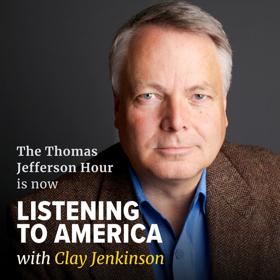
Listening to America aims to “light out for the territories,” traveling less visited byways and taking time to see this immense, extraordinary country with fresh eyes while listening to the many voices of America’s past, present, and future. Led by noted historian and humanities scholar Clay Jenkinson, Listening to America travels the country’s less visited byways, from national parks and forests to historic sites to countless under-recognized rural and urban places. Through this exploration, Clay and team find and tell the overlooked historical and contemporary stories that shape America’s people and places. Visit our website at ltamerica.org.
Hello everyone and welcome to this podcast introduction to this week's Thomas Jefferson Hour. Which is my interview with Dr. Ed Watts of the University of California at San Diego, the author of a really important book, Mortal Republic. When I interviewed him, I think three and a half years ago, he was cautious about drawing analogies between the Roman Republic of the 1st century B.C.E. and the 1st century CE. But this time, when I contacted him about six weeks ago and said, You know, do you think the Republic is surviving, thriving, hanging on, deteriorating or dying? He wrote back and said, Lots to talk about here, lots to talk about.
And I was surprised, I must tell you, that he was so willing to talk about us when you know. His work is to talk about something that happened 2,000 years ago. And, believe me, he knows as much about it as anyone I've ever encountered. But he also said some really stark things, especially towards the end of this interview. I hope you will listen to it all the way through and tell everyone you know it's something that I think that every American should hear.
And he said, among other things, that he feels less confident about the status of our Republic today than he did five years ago. That, even though we seem to have passed the high-water mark on January 6, 2021, the sacking of the U.
S Capitol. That he's not certain, that that's the end of it, that the pendulum has swung back, that we've calmed down in some way. And he said, You know, this is really not about politics in the sense of Republican and Democrat, it's really looking at the dynamics of our political situation from a deep, classical perspective. So I hope you don't take offense if you're a MAGA sort of person or of the right.
He said that if Donald Trump is reelected in 2024, keep in mind, this is a extraordinarily deeply well-educated classical historian, whose very M.
O is caution and intellectual scrupulousness. No offhand, wild comments from him. He said that if Donald Trump is reelected in 2024, we can't be guaranteed that that won't be the last election. And when he said this, my mouth dropped out.
No, I mean, that's such a big statement. But he believes that we are sort of on top of this cauldron of anger, rage, disillusionment, bitterness, cynicism, desire for vengeance and retribution.
A nihilist desire to just tear the temple down since it's behaving so badly, and he thinks that this could actually happen. If I had said that, I would have thought, Well, you know, that's the sort of thing that one might say unnecessarily bold. We really have no way of knowing what's going to happen. But when it's said by someone of this who's not, you know, just some sort of a television commentator, liberal, this is an exceedingly serious classical historian.
And he knows whereof he speaks. Because, of course, the greatest collapse of a republic ever was what happened to Rome in the first century B.CE and the first half century CE. That Pompey, Crassus, Caesar, the triumvirate in the civil war, Caesar crossing the Rubicon, Caesar, eventually winning and showing clemency to those who were defeated. But he had to mop up and he wound up having to have Pompey killed. Crassus died on his own attempt to fight wars in the East, and suddenly Caesar is undisputed leader in Rome.
And he makes himself consul for life, so he gives himself life tenure. Essentially suspending future elections. And then when he allowed Mark Anthony to just sort of almost maybe put a crown on his head, that was too much. For the Roman people. They still had some residual commitment to a republic. And so he was assassinated on the ides of March.
And there was an attempt to restore the Republic, it didn't work out. Eventually, his grandnephew, Octavius, became Augustus Caesar, the first and maybe the best of all the Roman emperors. And so that story, which, you know, used to be one of the five or 10 stories that every educated person knew, every educated person could tell you about. Caesar and Pompey and Crassus and the Civil War, and the Rubicon, and Caesar's commentaries, and Caesar's time in Gaul, and the Crown being offered to him, and so on.
Everybody knew this story, this is one of the fundamental stories, and certainly all of the founding fathers knew this story without a single exception. They all were, they were weaned on this story. The great event of the ancient world upon which everything else that they dreamed of, that alone is fascinating to me.
Some of Jefferson's small our Republican political theater. Walking to his inauguration and refusing to go to James Madison's inaugural ball. And going quietly home to Monticello and riding his horse around Washington, D.
C Without any security team, and so on. That. Jefferson understood what a small our republic is, and he worked exceedingly hard to live up to those high standards. And to set an example for the future. Unfortunately, the Jefferson example has been essentially forgotten. The last president who behaved in any way along these lines was Jimmy Carter.
If you remember, he would carry his own luggage and wore jeans to get on the plane and stayed in people's houses, wore his cardigan sweater. In the White House, we sort of ridiculed that he was committed to the idea that he James Earl Carter was temporarily entrusted with the administration of the public business of the United States. In other words, he was the president and during that time he would do what presidents have to do. But he did them with as much modesty and as little pomp and ceremony as possible.
And then, when that was over, it turns out four years rather than eight years that he had hoped. But when that was over, then he would quietly go back to Georgia and reenter the private world. Who else does that? Dr. Watson That's not what Bill Clinton has done.
That's not what Ronald Reagan did, that's not even what Richard Nixon did, and to a certain degree, and this was my point. George W. Bush has had a quiet post-presidency and I've gained a lot of respect for him because of that. But Carter really was the last Jeffersonian, if by that we mean somebody who understood that the political theater needed to be first citizen rather than proto-monarch.
I love this, I love this conversation. We're going to do a lot more of this as we move into the future of the Thomas Jefferson. I hope you all agree that it's really an extraordinary opportunity we have thanks to Zoom technology. That I can talk with Beau Breslin, that I can talk with Ed Watts, that I can talk with Grant Sazula, that I can talk with Dr.
Joseph Ellis, or with Lindsay Chervinsky? That things that would have been essentially too difficult to accomplish 15 years ago, or even 10, are now routinized. Thanks, strangely enough, to the great Covid pandemic. So I love this and I am so glad that you're with me. Please write and tell us what you think and make suggestions. And if you can contribute in any way to the Thomas Jefferson hour, we'd love that. Let's go to the show.
Hello everyone and welcome to this special edition of the Thomas Jefferson Hour. I'm Clay Jenkinson. David Swenson is taking a break. This week, I had the extraordinary pleasure of having an interview with Dr. Ed Watts of the University of California, San Diego.
He's the author of an important book, Mortal Republic How Rome Fell into Tyranny. And we've had the conversation before. And I know one of your areas is the last days of the Roman Republic. And so here's my question for you, Why does a republic die? I think, in a nutshell, the thing.
That makes a republic die is people make the choice that they don't want it anymore, or that they prefer to do other things other than protect that state and protect that structure. You know, a republic is something that depends on the consent of the people participating in it. And if you look at late Roman conceptions of what their Republic was, you have a wonderful quote from Cicero, where he says that the republic belongs to the people. It's a possession of the people. And the people are not just a random grouping of individual humans. The people are unified by a consensus about what's good and what's lawful. And that, in a nutshell, I think, is what a functional, healthy Republic is. People understand it's theirs, so you don't let somebody take control of it.
You don't give it to them, it is never their possession, they are entrusted by you to manage it for a certain period of time. You ultimately are a stakeholder in it, you're a shareholder in this.
That means that you have certain rights, you also have certain protections, and you have certain obligations. And your common consensus about what's right, what's just and what's lawful guides how those obligations are determined and what sorts of protections you can expect. And so there's a very nice theoretical way that a republic should work when a republic stops working. Some parts of that break down and you can see different moments in, you can see, for example, somebody try to assert personal ownership of it. You can argue that that was what Caesar did right before he was assassinated, when he teased the idea of being crowned by Mark Antony. You also can see a breakdown of the consensus about what's good and what's lawful. And this is something I think is pretty relevant to the moment that we've been living in in the last decade or so.
In the Roman Republic, what breaks down is a system where few people begin getting a lot of money legally. But the gap between what they have and what everybody else has increases to such a degree that it doesn't seem just so. That consensus about what's lawful and just breaks down, because there is a consensus about what's lawful that doesn't agree with what's just. And at that moment, citizens begin questioning whether the structure is actually working. So I think one of the issues that we should be very aware of in our context. Our Republic is not that different in its fundamental understanding of what it is, how citizens function in it, and what obligations and protections we can expect. But we, too, are at a moment right now where what feels just and what is lawful doesn't seem to match up. And this causes a crisis in the Republic. That makes people wonder whether being a shareholder in this thing actually matters, and whether the way the shareholding is divided is actually equitable. And that's a crisis that Rome saw as well.
Let's start with this that Jefferson.
Believed, and this is his first inaugural address. That a republic is ultimately a spiritual thing, in that there has to be a kind of a civic commitment to the idea of a republic. And that probably no laws that can adequately constrain that. It takes the will of individuals and the will of the collective to do the right thing. To postpone immediate gratification, to believe in majority rule and the rights of the minorities, and so on. And that it's unenforceable. It's a spirit that makes a Republican, and no matter how strong your Constitution is, it can never make that survive unless the people maintain that commitment is.
That a fair reading. Yeah, I think that's exactly right, I think that what? Cicero's passage, and Jefferson didn't know this because the text hadn't yet been uncovered. But what Cicero gets at is that that spiritual component relates to a kind of fundamental contract. An understanding that everybody who's a shareholder in this is equally a shareholder. And so a majority cannot overwhelm the minority, because the minority also is a stakeholder in this polity. And for the polity to work, everybody has to understand that their stakeholding is equal. Even if the decisions that they want to pursue or the policies that they want to enact affect some people differently than others, all of the citizens own an equal share of this republic.
And so the state belongs to all of them equally and fundamentally. What that does is it guides you towards an understanding that consensus must dominate the way that policy is made. Because overall, you do not want to be in a situation where the voices of some people who own a portion of the state are overwhelming the voices and interests of people who own a smaller portion of the state. And so I think what Jefferson is hinting at is very real. You cannot legislate for every single thing that's going to happen in a republic. A constitution can do a lot to lay the groundwork for things you know, and to set the basic parameters for how decisions will be made.
But nobody can imagine every single situation that's going to occur, and there will be things that are not legislated. A person who is civic-minded and who believes in a republic along the lines of what Cicero describes won't take advantage of those things to exploit their own interests or the interests of their smaller group. Because they will respect the spirit of a republic as a common property of everybody. If that spirit is not respected, then all of those loopholes become fair game for people to exploit for their own best interests and the best interests of the people that they favor.
Which maybe is where we are. So, for example, the Constitution can't make the outgoing president attend his successor's inauguration. John Adams was the first to avoid it. Jefferson was really upset with him for doing that. But normally, the outgoing president appears at the inauguration of his successor, and there's a continuity in the idea of the republic.
That's a norm you can't enforce, or if you can enforce that one, there are 17 more that you can't. When you get to the point where a major figure like Donald Trump just decides not to do any of that anymore, it's legal, but it's heavily corrosive of the very idea of a republic. Do you think he understands?
That, I think what's interesting is one of the text messages that was just released in that Dominion lawsuit shows. Tucker Carlson understood it. Whether Donald Trump understood it, I'm not sure. I don't think that Donald Trump ran for president inspired by this idea of the Republic as something that belongs equally to everyone. I don't think Donald Trump works that way.
So I don't know that. He would have understood the sort of sacred trust that comes along with being the person entrusted with managing this for a specific period of time.
If we reach a point where, and I think this is the best case you can make for the Trump presidency. That there were millions of Americans who felt that they were no longer engaged in the civic business of being in a republic, that they had been left behind, that they were despised, that their interests were systematically ignored, even by people who got their votes. They were not shareholders in any meaningful sense any longer, in the idea of a republic. And therefore, let's just get our own, let's just crash the whole system, let's tear it down.
That seems to me. Where this, for me, this conversation begins, is that a very large percentage of the American people are now actually pretty seriously disillusioned and no longer on board with the idea of a republic. You know, I think on the left as well, you see?
People who feel like this is broken, it cannot be fixed. The idea that an African American citizen in Minneapolis can be treated the way that George Floyd was treated. That suggests also a lack of awareness of the membership and ownership that every citizen enjoys for this republic. And so I think there's tremendous disillusion, and it's not just Trump voters.
You know, I think that there are a lot of people who feel like whatever's happening in this country. It is not that sacred trust that Cicero is speaking about again, very few people even read that text when you look at what Cicero is saying. We all feel it on the right and the left, and probably a lot of people in the center too. Feel like there is no common understanding among the American people about what is just and what is lawful. You know, did Trump embody an aspect of that? sure.
But so did Bernie Sanders, and so do a lot of other people who were, you know, raising their political profile in 2016 and afterwards. I think it's interesting the number of people who voted for Obama to shake things up and then voted for Trump. It is not necessarily an ideological thing to be disenchanted with the fact that the.
Republic doesn't feel like it's doing what it's supposed to. Okay, I agree with you, but how do the American people know this? In other words, our civics education is largely gone, they don't really even have any training on what a Republic is.
So they may have a sense that it's flipped away, or that it's no longer serving, but they don't have a vocabulary with which to talk about.
This, yeah, I think that this is a real, this is a real challenge, you know? There are probably 6 million citizens in the Roman Republic when Augustus takes the thing over. If you wanted to vote in the Roman Republic, you needed to show up in the campus marshes in the city of Rome and vote.
If you live in Venetia, or you live in Apulia, or you live somewhere along the PO, you're not going. You have citizenship, you own a stake in that state, but you are not going and you're not voting. But you still had a sense of what that state is supposed to do and how it's supposed to protect your interests. And you didn't have the theoretical language of Cicero, because, you know, frankly, when most of this is happening, Cicero wrote that text in the 40s. The Republic is already basically gone at that point.
So Romans knew it without knowing it, because the vocabulary didn't exist. And I think in the United States we feel something similar. We do feel like this country is not something that we just haphazardly belong to, but it feels like something that we own. In a way that is, I think, quite visible. When you even drive down the street, like, I look out the window right now, I can see two American flags.
How do my neighbors articulate their membership in that community? I'm not sure, but it's not going to be Ciceronian. I know they've never read that text, but they do feel that this is not something that just accidentally happened to them. But it's something that they've taken a part in shaping, right? This is their country, they have a role in it. And I think that that is true across the United States. Even if we don't have the language that Cicero shares with us.
How do we get there? Well, I think we don't have civics, but we do have quite a bit of socialization. That teaches you what it means to be part of this country. We have concepts that we understand, but don't really understand, right? We have a sense of what we believe freedom to be, what we believe, democracy to be, what we believe good citizenship to be. We also then have a sense of what feels off when those things are not being expressed in a way we're comfortable with.
But again, I think the consensus about what all of those things are has broken down. We need to take a short break when we come back.
I'll continue my conversation with Dr. Ed Watts of the University of California at San Diego. Is our republic doomed? Stay tuned, you are listening to the Thomas Jefferson hour.
Welcome back to the special edition of the Thomas Jefferson Hour, my interview with Dr. Ed Watts of the University of California at San Diego. He's just been to Rome and we talked at great length about the analogies between the Roman Republic and the United States in the 21st century, and how far can those analogies be pressed with historical accuracy?
Let's pick up the conversation from there. Take the average disillusioned person, whether it's a Bernie-ite on the one hand, or a Trump-ite on the other hand. What's their narrative of what went wrong? How would they formulate how?
America got lost. I think there is a very wide sense that things began to change pretty dramatically in the 1980s and 1990s, especially in the 1990s. The way we talk about this, I think, obscures some of we talk about it like it just happened, right? Deindustrialization.
I was just reading something in the New York Times today, talking about the persistence of poverty, where they say, we talk about deindustrialization. But it doesn't just happen. There were conscious choices made to allow companies to move jobs out of the United States and therefore change communities in the country. But I think there is a very real sense that that probably wasn't a majority opinion in the 1990s, and it certainly, I think, is not a majority opinion. That this was a good thing when we now look back on it, and so I think there was a sense that decisions were made there, most Americans didn't understand.
Most Americans did not decide about, they weren't really consulted about. And yet they have very far-reaching implications for the way our country is working.
Especially in the heartland where you don't have the massive urban populations and the vitality of those economies. That you might be in a steel town or a coal town or something where things look good in 1975, and they look like the wasteland in 2000. And you were never consulted.
I'm in southern California. It's also true of places like San Fernando Valley, where manufacturing is basically gone. But this was the center of aerospace in the 1980s and 1990s. I mean, Camaros in the San Fernando Valley. None of that is going on anymore.
And so that has dramatically changed the way that communities work, it's dramatically changed the way regions work and the people affected by this. Their interests were either never even taken into account, or their voices, at least, were never heard when this happened. But at the same time, the management classes have benefited greatly from this. So it's a decision where, if you are a CEO in 1980, your take-home pay compared to the average worker. What is the number?
It's something like 20 times, and now it's multiple, many multiples of that. That's a product of this set of decisions that, again, no American felt like. I sat down and I thought about this and I agreed to that. And so what you have then is that same issue that you have in the Roman Republic. Where a few people lawfully, completely legally, became very, very wealthy at the expense of the overall good of society. And so I think that's one moment where you can look at what happened in the United States and say that was not the Republic working as it was supposed to.
Another instance that you can look at that does this again. I mean, just thinking about this article, I just read on Poverty is Welfare Reform, where the way that welfare was administered changed in 1996. In a way that I think most people in the United States didn't fully understand, and if they understood, probably wouldn't have approved.
And yet it has had pretty far-reaching implications for how our society works, especially when combined with de-industrialization. Or whatever term we want to use, that actually assigns agency to somebody in choosing this. And so I think we have moments where we can now, in 2023, look back and say, a generation ago, there were decisions made that most people didn't understand. Very few of them feel like they were consulted, even fewer feel like they approved. And yet they have reshaped our country in really significant ways. In a fashion that feels kind of outside of the basic principles that are supposed to guide decision-making in a republic.
Here's another one the Wall Street 2008 2009. None of them went to prison, but millions of middle-class people lost their pensions, lost everything. You hear from the sort of MAGA crowd or from the Bernie crowd, that there was no accountability, that the richest people skated through, no one was tried, no one went to prison, they got richer than ever.
And yet there was no reckoning for the millions of people who just had to suffer and lose their retirements. There's some sense in which nobody represents me, right? nobody any longer really represents me. And therefore, when a tribune going back to the Roman world, when a tribune like Donald Trump comes along and says, I can fix it. I have your voice, I understand your grievances, I'm as mad as you are. I'm a very rich person. That's what tribunes get to be. I will represent your interests in the public square. There's a reason why people were drawn to that. It had very little, maybe, to do with the virtue or character, or biography of Donald Trump, but a tribune came along who said that he.
Would represent them. I think you're exactly right that it's the moment, I mean. Donald Trump tried to run for president in 2000. And, you know, it didn't go much of anywhere he floated. Other times when he was thinking about running for president, it didn't go much of anywhere. So I think you're right that it's the moment that makes that possible.
And in the Roman Republic, we have a number of moments like that. Where, you know, with Tiberius Gracchus, this is the most notable moment 133 B.C. where Tiberius Gracchus, in essence, says. I don't really have a big solution for the inequality that you feel and the lack of voice that you feel. But symbolically, I'm going to fight for you. Symbolically, I'm going to make the people who feel you feel are not listening to you listen, and I'm going to make them bow to your will. And what Tiberius Gracchus does is he puts forward a reform that in a Roman economy that is becoming incredibly inequitable.
He puts forward a reform that, at best, is going to change the state of things for a few thousand people. And yet he fights extremely hard for this and subverts a bunch of constitutional norms and threatens violence and intimidates people. And does all sorts of things that are way more damaging than any element of that reform ever would have been. And people support it, not because they think the reform is going to change their lives, they support it because they want somebody who's going to stick it to the powers that be. Because they feel like they are not being listened to, and this is somebody who people have to listen to because he's willing to bend the rules.
He's willing to scare you, he's willing to do whatever it takes to make sure that you are. And I think when Donald Trump emerged in 2016, my initial reaction is this is somebody who doesn't rise to the level of Tiberius Gracchus. Because we're not quite at the level where we need that. You know, we don't need somebody who's going to actually threaten violence, we not only got threats of violence, we got actual violence.
Let me understand you're not a huge fan of Tiberius Gracchus.
I'm not a huge fan of Tiberius Gracchus because I feel those problems were real. And I feel that Tiberius Gracchus was not interested in solving them. His brother was interested in solving them. And I think, you know, Tiberius Gracchus, I think, is a very flawed figure, I do not like Tiberius Gracchus. Gaius Gracchus, I think is one of the few heroes of the later Roman Republic, because Gaius Gracchus is, you know, about 10 years younger than Tiberius Gracchus.
Tiberius Gracchus is assassinated in part because people were afraid that he would eventually resort to violence, and so they decided to preempt him and use violence against him. So Tiberius Gracchus is assassinated. Gaius Gracchus begins his political career knowing full well his brother has been assassinated for pursuing an agenda very similar to what Gaius Gracchus wants to pursue. But whereas Tiberius Gracchus is effectively grandstanding, Gaius Gracchus has actual reforms that will actually change things.
And he goes into this knowing, I mean, there's a vision he has before he even starts political career, that he's going to die because of these ideas. He still does it.
That, I think, is somebody who is heroic.
Fascinating, because, as you probably know, the Gracchi are often compared to the Kennedys. Like these reformists who were cut down. And you're saying, don't confuse Tiberius with Gaius here, they are not the same, they're not the same. Another way that we can look at this is the rule of law.
John Adams famously says, No man here in this republic is above the law, and we see now that that's not true. We not only see that. Presidents of our time, senators of our time, governors of our time. Not only push the norms right to the limit, but they often cross the line into what still remains illegal activity. And the United States, the people of the United States, our system is very reluctant to make them pay a penalty, you know? So now you have what appears to me to be an almost open and shut case against Donald Trump and the classified documents and other things.
And yet I would guess that it will be very, very, very unlikely that the Justice Department indicts him. Because there's a kind of almost a taboo, don't cross that line, that somehow these people really are special and deserve to be allowed. What does that tell us about where we are? There's a couple of things.
That come to mind when you mention that. One of them is a passage by my favorite author, a man named Sallust, where Sallust says I came into public life effectively as an idealistic young person. When I got there, it became clear to me that the entire world around me was corrupt. And even though I had no inclination in my soul to do these things, being part of this world induced me to become as vile and corrupt as everyone else around me. I can see that there is the possibility that our politics have become something where an idealistic, honorable, virtuous person like Sallust may have the same experience of entering into politics and being acculturated to an idea. That rules are there to be bent, rules are there to be ignored, limits are there to be explored more.
I hope we're not there, but we might be. But the thing that came to mind that I think is really interesting is in the later republic. Roman senators are notoriously corrupt, they take out massive loans to run for office, and then when they get into office. What they are expected to do is to go to a province and effectively loot the thing. To the point where the natives, the provincials, are about to rebel, but they don't actually rebel. There are laws against doing this and there are trials that are held for.
People who do this particularly egregiously. Cicero cut his teeth on this very thing.
Very right. The governor of Sicily, who's particularly notable for his corruption. When we as historians look at this, we kind of laugh with sort of a cynical snicker that the. Of course, the Senate is not going to convict these people because the senators are all corrupt, so they're not going to convict these people. Because they're just kind of looking out for each other. But the way that you described this just now makes me feel like there's maybe a different interpretation. That's a little more charitable that we need to have. The senators don't want to convict these people, not because the senators are all equally corrupt, but because they're afraid of what happens.
If you do, I think that the challenge about prosecuting Donald Trump for any of the things that he might be prosecuted. The document scandal, the Georgia situation, the tax fraud that his company has already been convicted of. The challenge isn't so much whether the case will work or not, but the potential political blowback that comes from embarking.
On that case, so, when Richard Nixon broke the Constitution and other laws in some significant ways, he was held accountable, he was forced to resign. He almost certainly would have been impeached and convicted had he stayed. So that one worked.
But when you get to say Ronald Reagan and Iran-contra, clearly guilty, probably should have been impeached. We didn't have the heart to impeach him. We liked him. We also, I think, understood intuitively that he wasn't really fully in charge anymore. But if you don't do that, if you don't say, Look, we kind of like you, President Reagan, but we have to impeach you and remove you from office because we're a Republican and a republic.
That's what you have to do to keep it. And if you don't, if you let Ronald Reagan get away with Iran-contra, and you let other violations of constitutional norms. Obama did it himself by executive orders that are not at all enumerated in the Constitution. Donald Trump did it in a more significant way. You go down that path and you refuse to hold these people accountable. Under Republican theory, it should not surprise you when the Republic goes away.
One of the distinctions that's very important to make is between impeachment and actual criminal charges, because I think the criminal charges part actually, in some ways, is more important. What impeachment says is you have done something in office, it means you can't stay in office, but if you're not in office, then great, you know? Go to San Clemente and enjoy the ocean. If it's actual criminal charges, what you're saying is everybody is equal, right?
From a fundamental point, you get back to this idea we started with. This is a citizen-held corporation where everybody has an equal share, and if you are a leading figure in that citizen-held corporation. And you do something wrong. And you are a butcher living in Pretoli, and you are a consul in the city of Rome. You should, in theory, serve the same sentence because you are equally a part of this polity. And I think when you're talking about a criminal situation, that's different, because we are all subjects to the criminal laws in the United States, we are not all president.
So I think impeachment is something that refers to the particular ways in which you can occupy and perform the duties of your office. But I think that's a different question from if somebody does something wrong, should they be charged and should they be punished? Because I think the feeling that you as a powerful person can get away with doing something wrong that a regular person cannot. That's really corrosive to a republic. Whereas other questions of whether you should stay in office or not, those become a little more theoretical to regular people. But it's very clear that if you or I do something and we merit a certain punishment, but Joe Biden does something and he doesn't, then this is not a state that's working like it's supposed to, like it promises.
To work, No. And I'm old enough to remember when after Ronald Reagan left office and he began to make the hundred thousand dollar speeches in Japan and so on. That it really was disquieting to the American people and they lost some respect for him over this. Today, you know, I don't think there's any respect to be lost for Bill Clinton or for anyone now who cashes in when they leave.
Office, right? Uh, yeah, no, I I think, um, I don't know when that started, but there was there was something that I read a long time ago that said that, you know? The the difference in a American view of corruption between what we do and what someone in, say, Nigeria would do, just consists of when the money is paid. Right? You know, if you are, if you are in government in some countries, you expect the money to come to you when you're in government, because it won't come to you when you're not in government. In the United States, we maintain this kind of fiction that, you know, the president serves and he gets paid a salary. It's a good salary, but you know, it's not the salary even of the, I think, league minimum in Major League baseball.
Um, but when they come out, they're not going to be making the league minimum, Major League baseball, um. But that means they don't need to be stealing things when they are in office, that's kind of the idea. But is it really that different? Because you have then obligations that you know that will pay off later, as opposed to paying off instantaneously, but there are still obligations. Um, and this is something actually, you know, to get it back to Rome. This is something that you see in the later Republic, where, um, to get elected, you build up all kinds of obligations to people.
And then once you are elected, you have to pay them off. Um, and it's understood to be part of the system, um, and that that usually is not done. Uh, on the backs of Roman citizens, that's why you go to a province, that's why you're.
Yeah, no, you don't, you cannot in office loot the Roman Treasury. you cannot in office, I mean, you didn't. Even in the Late Republic, Roman citizens didn't even have to pay taxes, Italians didn't pay taxes.
Um, but it was expected that you would pay back the favors that you got when you were in. You know, when you needed to run for office, after you held office. And so I think that is something that wasn't the case in the earlier Republic. Um, you know you, you did not acquire office through money in, you know, the third century B.C. or the fourth century BC. Uh, and and therefore, it was a lot easier to step down from office and go back to private life than it was in the first century. Where, yeah, okay, your term as consul is over.
Now the bill is due. We need to take a short break. When we come back. I'll continue my conversation with Dr. Ed Watts of the University of California at San Diego. Is our republic doomed?
Stay tuned, you are listening to the Thomas Jefferson hour.
Welcome back to the special edition of the Thomas Jefferson Hour. My interview with Dr. Ed Watts of the University of California at San Diego. Let me turn it in a slightly different direction. About war powers, you know, our Republic is very strong on keeping war powers in control of the civilian authority.
And that's why the Constitution requires the armed forces to be reinvented every second year. War has to begin in the House, monies for wars have to come through the House. You can just see that the idealism of the founding fathers in this respect, that's all gone now.
So now we live in a much more dangerous world. We freely admit that, but now presidents may pay some lip service to Congress. But nobody is really believing that a war will now start in the House of Representatives. And so this is another sign in which we've just willingly decided. We're going to have a different small C constitution than the Capital C, one that we're supposed to be living under, right?
Yeah, no, I think that war powers and the ability to wage war without having it regularly checked back to the people to see if people approve. That war is, you know. It's also. It's a big problem, obviously in the United States, but it also is a problem in Rome. One of the reasons Italians didn't pay taxes is because, in the context of the punic wars. The Republic wanted to fight on, and regular Romans didn't want to do it. And they could prevent this from happening by shutting down the budget to continue to fight the wars. And so what the Republic leadership did was, they said, Okay, you know, you don't pay taxes. We're going to fund this in different ways. And therefore, you don't actually have the ability to shut down a war that's declared, they do have the right to not declare war.
But once a war starts, Rome is kind of in it. Because now regular people don't have the ability to shut off the money that goes to it. I think we're in a similar situation, you know? I think it's horrifying that we have created a situation where wars can start and drag on for decades without the actual constitutional process even starting. Clearly, when you're talking about the lives of fellow citizens and the property of fellow citizens, that's sort of the very baseline of what a republic is supposed to protect.
That's the baseline of what any state is supposed to protect. And if this state is supposed to belong to the citizens, then you need to have the citizens speaking about this regularly. Because it's their lives that are being put at risk, it's their property, and ultimately, we don't think about this, the United States. But a war that starts somewhere can end here, and so it's not just we're sending people abroad to fight a war, it could very well be.
We start a war that ends up here, and we need to, as citizens, be participating in that conversation at every phase in that conversation. We really are not declaring war or going through the process of engaging in those deliberations in any meaningful way anymore. And if you're a republic, one of two.
Things is true either. You have conscription so that you distribute the burden across the entire society, which means the people will be paying attention to the war in a big way. We've circumvented that by having an all-volunteer, highly paid army with incredible emoluments and signing bonuses and university education, and so on afterwards. And so this defeats the Republican purpose, although it fills your legions. Or the other thing is, you have to have such a spirit. And you see this at times in the Roman Republic, where the senator sends his own son into battle. Because he wants to make sure that everyone knows that he's not going to start wars and he's going to have the underclass fight.
At least his own kin will be part of this and will show that there is a senatorial responsibility or a responsibility of the powerful people in the.
Republic to take their part. Not even his son himself. You know, if you are a consul and you're fighting Hannibal, you are leading that army. So when Hannibal destroys the Roman, I mean, destroys much of Roman military power. At Canaan, there's a list that Livy gives us of how many people died. It's like 65 senators die in that battle.
It's hundreds of Roman knights who are the next social status down. And then it's a bunch of people who would have qualified for the Senate as well. They just weren't old enough that they hadn't finished their term. It's not you're sending the sons of the poor to go fight those wars.
Everybody is fighting them.
Pick somebody that you admire, who sees what's going wrong in Rome and is trying his hardest.
To remind the people of what's at stake, that's a wonderful question. You know, I feel like we don't have a political leader who's really doing that really well, you know? And in a fashion that is actually gaining kind of traction. And I actually don't know if you could. In the way that our media is set up right now, I don't know where you're going to find a constituency that.
You're going to talk to regularly that can do this, and Applebaum's work talks about when this happens. When you get to the period of deep cynicism and disillusionment, that people start to be attracted to autocracy. And they look for the strong man. They've sort of, in a certain sense, they know better, but they're drawn to someone. Just come in and make the trains run on time.
Someone just come in and knock some heads together, do what you have to do to clean up the swamp. You know, whatever the rhetoric is. But people are so disillusioned that they believe that we might actually be better off under an autocratic system. So I think the answer that I'd.
Have to. That is to look at, like, well, look at the 50s B.C. and then even look at Caesar. What Romans didn't? They didn't particularly want a strong man, they weren't opposed to it, but they didn't want it. What they wanted was someone who could actually fix things. You know, make it.
Actually seem like it worked. As we close, I had a couple of quick questions. They're not easy ones, you know? There's the atomic, the nuclear clock. How close are we to midnight? So how close are we to the death of the Republic?
Is it 6pm, is it 9pm, is it 11, is it 1145??
How close are we to losing it? It's a lot closer than I thought four years ago when I wrote Mourner Republic five years ago. Now it is.
I think what Joe Biden has done is made things seem so calm and dull that we forgot how close we came in January of 2021 to losing it. I mean, now we're again talking about policy. And you know, we're not talking about whatever tweet has come out of the White House. And we're not talking about violent insurrections that are occurring right now. But we came very close.
Is it possible to imagine a Trump presidency starting in 2024, in election 2024, not ending with something unconstitutional? I think it's very hard to imagine a constitutional transfer of power after, say, Trump's second term. If he has a second term ending in 2028. It's very, very hard to imagine how that would happen. So I think we're pretty close, but it doesn't feel close.
Because what Biden has done is created this, this kind of veneer, this idea of kind of normalcy, like it's 1986 again.
And that, I think, is reassuring us in a way that encourages us to take risks that we wouldn't take constitutionally. If we were more aware of how close we are to things tipping into, you know, a really irrecoverable situation.
One way to look at January 6 is that we reached this moment and there was chaos. Most of us understood that we were playing with really a dangerous fire here. And by the 2022 elections, we have pulled back some into something closer to what John McCain called regular order. That's one way to look at it, Another way to look at it is that we dodged that bullet.
Now we have a dull caretaker president. It's actually unfair. He's done some really good things, I think. But this is not over yet and it could come back in an even more virulent form.
Where are you on this?
Spectrum So, in 100 BC, there's a consular election in the city of Rome and two demagogic figures who are associated with the consul in power at that moment. Guys named Glaucus and Saturninus, Glaucus is running in that election. The way that you vote and count votes in a Roman election is. There are voting groups, kind of like our states. And you count the votes and announce the voting groups decision, and then when you have a majority of those voting groups, you don't even announce anymore.
It's just over. Glaucus It became very clear to Glaucus that he was going to lose. They hadn't yet announced that a majority had gone for the other person, but Glaucus mobilizes his supporters. They go in, they disrupt the counting of the votes, they kill the opponent, and then they retreat out of the campus, marshes onto the capital line, and they barricade themselves there.
And Marius, who is the consul, is charged with the Senate to put down the public emergency. These are his allies. He owes some of the most important political victories that he's won in recent years to these people. He still leads a force to the capital line, gets them to agree to leave the Capital line, and then they are killed by a mob in the Senate. Because what they've done is so abhorrent that it is intolerable for them to continue as part of the Roman polity.
We didn't do that in January 2021.
We have imprisoned a few people who broke into the capital building. We have done nothing to the leadership, we have done nothing to the people inside of this. We have done nothing to the people who created the rhetorical groundwork for people to become excited enough to go to the capital.
Rome descended into civil war less than 15 years after that riot.
Where are we?
So I think this is what terrifies me. Romans knew what to do when a mob disrupted the counting of the votes and seized the capital. I mean, it's eerie how similar that is. They knew what to do, and even people who were allies of these people did it.
And we don't, either we don't know or we're not capable of doing it.
And even though Romans knew that, the republic still only remained intact for another 15 years. So I think we need to really reckon with why we are so relatively tolerant of the sorts of stuff that happened leading up to and on January 6th. And I don't think we're doing it.
So we're close to the brink, we're not quite there yet. Maybe some little shred of the Republic is still alive in our souls and in the country. How do you come back? how do you rebuild when you've?
Reached this trough, the opportunity that we had and squandered was, I think, the opportunity to come together for the pandemic. You know, what brings you back from these kinds of things is a understanding that what unites the people who are part of that citizen body of the republic is far more important than what differentiates them. So if you look at Roman politics in the 220s BC, you see some stuff that happens in the 220s B.C. that looks pretty dangerous.
You have a consul who is out on campaign, he's a populist, His opponents don't like him. They contrive to say that his elevation to office was illegitimate. They send out a messenger to recall him back to Rome.
He ignores the messenger, goes into battle, wins a victory and then goes back to Rome victorious. It's really shady. But, you know, a few years later, Hannibal invades Italy. And you do have some of that. In the early phase of the war against Hannibal, that Consul Flamininus is actually one of the commanders that Hannibal kills.
And he does it, in part because he rushes into battle, as Hannibal knew he would, because he also again fears that he's going to get recalled.
But two years later, Romans realize this is really bad. It is better for us to put aside whatever problems we have and unite around the fact that we need to save our country. And, you know, those problems, they don't matter as much as defending our country and defending, you know, our security against Hannibal. And so the stuff that goes on in the 220s is forgotten by all, but, you know, the most kind of obscure Roman historians like me, right?
We don't talk about it, we talk about Rome coming together around Hannibal to fight Hannibal, and it worked. The pandemic was something that could have done that for us, you know? In the 170s, Marcus Aurelius creates a way for Romans to all contribute to the recovery of the Roman state from a pandemic. That probably kills about 15 or 20 of the population.
And the way Marcus does this is he effectively identifies what someone can contribute. He identifies tasks that they can complete that are, you know, consistent with the skills they possess. If they do it, he praises them, if they don't, he doesn't criticize them. It's all about getting everybody together for a common purpose to make things better.
We had a chance, maybe we'll get another chance, you know, maybe there is a way that we can, as a group, as a people, as a citizen body. As you know, the stakeholders in a republic come together and find a common purpose. And recognize that what we as Americans share is so much more, so much greater, and so much more important than what divides us.
Idealistically, that's what I hope we can do. Practically I don't know that. I'm terribly optimistic that we will do that, you know, maybe the best case, if we can't do that, is to have a caretaker president who just muddles along. Until we get tired of fighting and the anger gets out of our system. And we become more interested in solving problems than in sort of yelling, screaming and blaming each other.
I'm sorry, I can't be more optimistic. Well, just two last things, you know? In 1950, most college students would have to take your introductory course. They would have to come to terms with Livy and Plutarch, and Sallust and Caesar, and so on, and they'd have a smattering of Latin. But even if they didn't, they would know who Cicero was, and they would have a sense of the ordeal of being Marcus Cicero.
That's gone entirely. Now, the number of high school or college students who could tell you any meaningful thing about Rome now approaches zero. That's a form of civics education that used to be in place. And even though most of the Roman analogies of lead in the paint and what went wrong and gladiatorial sports, those are, you know, silly and trite, mostly.
But Rome is the best mirror we really have. I think, if we really want to understand what's at stake in the last gasp of a republic. So it seems to me that that's not going to happen. Obviously, we're not going to get Cicero back into the curriculum, but if we did, we'd be better off. The second thing just is a throwaway sentence.
And my favorite moment in all of Plutarch, and there are lots of them, is the death of Pompey on the shores of Egypt. It is so moving, you know, this scene, of course. And Caesar then comes and they say, Here's his head, and you know, it's an incredible moment.
Can you think of one of your favorite moments in Plutarch?
Oh, wow, you know, I think that it's not a particular moment. It's more of a sense when Plutarch talks about the way that people fight for Caesar, the way that Caesar inspires people. You can see the shift from the Republic to the empire right there. Because what you have, there are, you know, people who are incredibly inspired for a version of Rome that one person is in charge of. And those troops that Plutarch describes as being so inspired by Caesar, those troops are the key to the entire civil war that Augustus wins.
And that's why he has a those troops. So I think what Plutarch saw there was so key in understanding everything that comes.
Later, that's a lovely way to stop. You've had the great fortune of listening to one of the most extraordinary classical scholars of our time. Thanks. We'll see you all next week for another important edition of the Thomas Jefferson Hour.
The Thomas Jefferson Hour is brought to you each week by Dakota Sky Education. The program is distributed nationally by Prairie Public. President Thomas Jefferson lived from 1743 to 1826, and this program presents his views. President Jefferson is portrayed by the award-winning humanities scholar and author Clay S.
Jenkinson. This program is also available online at jeffersonhour..com and on Apple Podcasts. If you'd like to correspond with President Jefferson or submit a question for him to answer on the program, please visit the website at jeffersonhour..com. Bach Cello, Suite No. 3 in C Major by Stephen Swinford.
Thank you for listening. Please tune in again next week for another thought-provoking, historically accurate program through the eyes of Thomas Jefferson.
v1.0.0.260408-1-a910ba6_os