

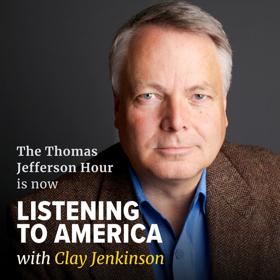
#1564 The New Look of the Jefferson Hour: Listening to America
2023-09-11 01:00:31
Listening to America aims to “light out for the territories,” traveling less visited byways and taking time to see this immense, extraordinary country with fresh eyes while listening to the many voices of America’s past, present, and future. Led by noted historian and humanities scholar Clay Jenkinson, Listening to America travels the country’s less visited byways, from national parks and forests to historic sites to countless under-recognized rural and urban places. Through this exploration, Clay and team find and tell the overlooked historical and contemporary stories that shape America’s people and places. Visit our website at ltamerica.org.
Hello everyone, it's Clay Jenkinson and welcome to this podcast introduction for this week's program. David Horton is an administrator and professor at Radford University in Virginia. I've gone there four or five times now over the last few years. He's interested in artificial intelligence and robotics. Pedagogy about the future of higher education.
We've become good friends. I went there not so long ago and we did a program, a live Jefferson hour from an auditorium at Radford. But he's agreed to come on the program as a guest host from time to time. And he suggested that we talk about the name change and the new emphasis in the program. And I would not have changed the name or moved in a different direction if I didn't think that it was for good purpose. I'm not at all tired of Thomas Jefferson.
Nobody can ever really become tired of Thomas Jefferson. Every time I think that I know what there is to know about him. Or more particularly, every time I grow a little weary of talking about certain aspects of Jefferson's life, particularly, of course, race. Suddenly, I read a new book or have a new thought about him, and I light up all over again. Thomas Jefferson has been one of the central themes, almost said obsessions of my life. I first encountered Jefferson when I was in my late 20s or early 30s.
Everybody knows about Jefferson, but I read Meryl Peterson's amazing book, Thomas Jefferson and the New Nation. And for a friend of mine, my beloved mentor Everett, see Elber's, I agreed to portray Jefferson for one night. Only a one-night stand as the third president of the United States for a conference on agriculture that he was hosting in North Dakota. I was a college professor at the time, I was my. My central interest was John Donne and the early 17th century English literature. My degrees are all in literature, I was.
I'm not a historian, I'm a humanities scholar, and I've attempted to give a significant portion of my life to trying to understand this extraordinary, paradoxical figure. When I look back on it and think that that was 30 some years ago, I'm a little surprised and and almost a little embarrassed. I don't regret any of it.
Truly, Jefferson has been the most important factor in my life. And, you know, I was a young idealist at the age of 25. So believing in our republic, so wanting us to be the class act of the world, so wanting us to set the standards of enlightenment and justice, and generosity, of spirit and magnanimity.
Purposeful and thoughtful foreign policy, respect for other nations and other traditions. A belief that the books and learning and conversation can lift us to a higher plane of human existence. I know those things sound a little threadbare or quaint at the moment, but I didn't see that at all. And I still don't. I'm still an idealist, I'm a grieving idealist. I'm a somewhat disillusioned idealist now, but I still want America to be bad America.
Jefferson will always be a part of this program, and the Jeffersonian particularly.
But I felt that it was time to move in a new direction because the 250th birthday of the country is coming. I'm fascinated by this, I want to prepare for this, I want to create a book club that will help me make sense of this. I'm reading every book I can possibly read on where we are.
What's happened to us? What are the dynamics of what appears to be American decline? is it decline or is it just a very bad mood that we're in?
I've also dreamed since I was a young man of traveling the whole country. you know, I've never really been to Florida.
Mississippi and Georgia and South Carolina. You know, I've been, I've gone flown in and flown out of, driven across those states from time to time, but I've never really.
Traveled the country? I'm too busy reading, No, I was at Vanderbilt for a year, but I was busy studying when I was there.
When I go to a place, I get to the hotel, it's 1030 p...m. I have a salad at the bar the next day, I talk or perform, or meet.
A day after that, I fly somewhere else or fly home. And so I haven't had a chance to really see what Steinbeck called this monster land, and I so want to do that. So all of this is the reason behind the shift from the Jefferson Hour to Listening to America. And we get a lot of questions from our listeners, like, What's happening? will I like this? Are you abandoning Jefferson?
Where's this headed? And so David Horton suggested that we do a program on this subject, and I'm very glad to do it, and he asked great questions. He's a terrific guest host and so I hope this sort of marks the path that we're taking.
But I?
Will say that I did not expect in the last three innings of my life to be bewildered about America. I thought we would lurch from strength to strength, and from enlightenment to greater enlightenment. And maybe we are in some sense of that term, but it's a particularly.
Unsatisfying time. And, of course, you know, let's not ignore the truth. We have a former president who's now been four times indicted.
If there is a justice system that works, he will either be acquitted or he will be convicted. But I'm assuming that he will be convicted of some of this. And because, for example, the documents case appears to be an open-and-shut case. Now, whether you hold a former president accountable even for that kind of recklessness is another question. But if we're a government of laws and not men, as John Adams said, then surely someone who is that reckless with state secrets?
Needs more than a slap on the wrist. So here we are. I mean, to see mug shots of a former president of the United States, it's not satisfying. I'm offended when the folks at MSNBC seem to be cheerleading about this.
It's deeply distressing because it's a symbol of decline. How have we reached this point?
So the moment that we're in is not.
A glorious moment.
The glory will come if the rule of law holds. And that the conviction of at least some of these fellows for some of these crimes, and maybe including the former president.
Perks the country up. It discourages this sort of activity. You know that a very large number of the of the January 6th insurrectionists have been convicted and have gone to prison or will be going to prison. We need to hold people accountable at every level of this.
So maybe that discourages the next insurrection. Because somebody who was there and got caught up in the mob, as can happen to anybody, and wound up shattering windows or assaulting a capital policeman. That person didn't really go there expecting to go to prison.
That has to be a deep shock to the person and his or her family.
One hopes that that, and you do see anecdotes of this, that that sobers people up and they say, I got caught up. I can't believe I did this. Yes, I'm guilty.
I'm of course, I have to pay the price. We hope that there is a.
Persuasion that comes from this, that we have to live within the the lane of political discourse. We. We have to solve our disputes by debate, including fierce debate, rather than through sticks and stones and guns and mace and bear spray. Anyway, the times we are in do not lend themselves to great optimism, but I continue to believe we can turn this around. And if we go through the 150th birthday, I'm sorry, the 250th birthday of the country, and it's just a screaming match. As it very well may be, that will be one of the most disheartening events of my life. So let's go to the program.
I so appreciate your being here. I hope you stay with us and encourage others and join us on the road. And make suggestions of people to see places to go, interviews to conduct, vistas, to photograph.
Experiences to.
To seek out. That's what listening to America is all about, so thank you everyone.
Good day friends and welcome to Listening to America with Clay Jenkinson. I'm David Horton and I have the honor of serving as your guest host today, coming to you from the studios of WV. Are you Radford at Radford University here in Virginia?
Mr. Jenkinson, how are you today, My friend? I'm fine, I'm leaving tomorrow for a three-week adventure. And it's really the beginning of what will be eight to fifteen years of wandering around this country, attempting to get the pulse of America at this.
Really, I think you'll agree. Extraordinary time in our history last night. We're recording this in early August. Last night, more indictments were brought down on the former president. The former president is suggesting that there could be civil unrest and even worse if these indictments go forward. It's a very volatile time in the history of our democracy.
Absolutely, it is, and I think it's a critical juncture for America now. One of the interesting things I think you're going to find as you travel the highways and byways of this great nation is that life goes on regardless of what happens with politics. And I think you're going to really get to the core of America as we approach our 250th birthday, which is really something that we're going to talk about. Over the course of this episode of Listening to America, Clay is being so wonderful to me as a guest host here, allowing me to kind of go inside listening to America. Inside the Thomas Jefferson hour, I understand you have a whole raft of new correspondence and questions and things folks want to know. As this great evolution and trans transition has taken place from the many, many years of the Thomas Jefferson Hour into this great new concept of listening to America.
Can you talk just a little bit about some of the feedback that you've gotten so far?
The first thing I did was call our key stations around the country and say, Does this sound like a good idea to you? And if they had said, no, we're not interested in listening to America, you know, we like the Jefferson Hour. I wouldn't have done it because I so value the stations that carry us and the our audience around the country that has come to count on us. But all the feedback I've received, David has been positive that this is a good departure. For a lot of different reasons, which we can discuss. And so on that basis, I decided to move forward. So, as I keep saying, there's gonna be more continuity than change.
It'll still have a lot of Thomas Jefferson and the founding fathers and so on. Lindsay Trevinsky will still be a very frequent guest, Joseph Ellis will continue to be a frequent guest. David Swenson will come back from from time to time to guest host the program and so on. So I hope people don't feel like, Oh, you know, farewell Jefferson, because that's not it at all.
But what I've wanted to do is to really try to get a sense of America at this moment. And, you know, I went on this trip down to the four corners area, the Colorado River Plateau. A few months, a couple of months ago. And we were gone for two weeks and we met dozens of people and had amazing adventures. And never once did anyone say the word Biden or Trump. Which is, to your point, that most Americans are living their lives? Of course, they know what's going on, but if they're not fixated on it, they're not. They're not current events junkies, and they don't spend all their time on MSNBC or Fox or CNN or or others. And so most Americans are just doing the things that Americans do now. I do think it's an unsettled time in our national history. But people's concerns are not necessarily these two octogenarians who are.
Slugging it out on the national scene well, and I think that's a crucial part of all of this. You know, I love the concept you're listening to America, listening to what the average everyday person has to say. What their concerns are, whether it be water or land use or development, or whatever happens to be happening across this vast, vast nation. And a brilliant concept here as we go to the 250th anniversary of our birth, you mentioned someone very important.
First of all, you know who is this David Horton joker that you're talking to, and what happened to the wonderful David Swenson? Can you talk a little bit about where he, where he is and what he is doing?
Of course, David is still here in North Dakota. We're old and dear friends. He decided that he turned 70 in February. He decided that it was time for him to slow down a little bit and tend to his garden, like Voltaire's candide.
He's a great gardener, he's done some mightily important work on Native American voice. Going all the way back to an ethnomusicologist named Francis Densmore, who came to the Great Plains around 1910 and recorded Lakota Sound and Mandan Sound, and had Odds the sound and a Ricker sound. And he's done this amazing, really stunning project, trip, the stunning project for them, and he wants to devote more time to that. That was his first great love. And he's also been the semi-permanent guest host of The Jefferson Hour for 20 years. And so he said, You know, what, what, what? what's enough here?
I hated, I'll tell you, honestly, and to our listeners, I hated to see him go. I love him. I have a deep respect for him. We're we've been friends for a very long time.
I miss him, I think our listeners miss him, but the strength of the program is the ideas that we explore. And you know, he's not going anywhere. He'll, he'll be back, especially on the Joe Ellis programs, because they've formed a very special friendship. And so, and no shake-up, no, you know, no chaos.
It's just that David has has determined that it's time for him to spend more time focusing on his first love, which is Native American culture, and his life as a, as a gardener and as a. He's a very shy man. Everywhere I go, people say, Where's, you know? Why don't you ever bring Swenson with you? I say, you call him, you know, he's a he's a homebody.
So he greets everybody.
I hope people understand that the program will grow in strength over time and that, you know, a series of guest hosts are here, including yourself.
You've agreed to do a number of programs when. It's such a great honor and David is such a wonderful, wonderful host. And such big shoes to try to begin to fill for those of us serving as guest hosts. But truly a wonderful man and we are so glad he's going to continue to be a part of listening to America. You know, you've talked about the last few decades that you've been doing this. And during that time, things have certainly evolved in the perception of all of our founding fathers, including Thomas Jefferson. And things have certainly been challenging in many arenas as we discuss some of the hard facts that have been a part of Jefferson's life and and many of the early founders. And and how they are perceived and received by the general public, by a listening audience, by by a crowd of folks. I think you've done a brilliant job bringing Mr. Jefferson to life with all of the golden luster that he, he shines forth. But also the works that exist as well. But can we talk a little bit about how that has? The perception and reception of Mr. Jefferson has really evolved in the last 20 to 30 years, but particularly the last six to ten years. As we have moved into a time where the pendulum has swung. From the deification of our founding fathers to maybe looking at some of the real challenges of the early and middle parts of the American experience.
That's a great question and I want to be really thoughtful about my answer here. So I've been at this for a very long time, for more than 30 years. When I started, Jefferson was riding high. He was the without question regarded as the greatest of the founding fathers, almost unique as this Renaissance man, America's Da Vinci, this, this incredibly gifted person. And slavery was an issue, but it was a very minor issue and sort of got it on and off the table pretty quickly. And Jefferson was regarded as a good slaveholder.
If that isn't just a contradiction in terms, over time, the questions of race and slavery and Jefferson's hypocrisies have caught up with him. Until now, the the pendulum has swung far in the other direction, to the point where he's essentially the poster child. Now for the unresolved race issues of the founding generation. And continuing to this day, and let me say right off, he richly deserves this increased scrutiny. There have been a number of times in the last 15 years when I thought I can never put on the wig and tights again.
I don't want to be that person, be not that I don't admire Jefferson because I do deeply, but I don't want to. There are days when I just don't want to have to face the fact myself. That this great man, one of the greatest advocates of liberty that the world has ever seen, had this deep contradiction at the center of his life. And that he didn't actually wrestle it to the ground, he, he found a way just to learn to live with it. And he would wring his hands and say that nobody wished more than he did for an end of this, and so on, and so forth. But when push came to shove, he was paralyzed by his dependency on slave labor.
He was paralyzed by his, I'm sorry to say, his attitudes, which were racist. He was paralyzed by his vision of America, which was a an Anglo-European, Caucasian vision of America. And so it's not that that didn't drive me away from Jefferson, but it has made me uncomfortable, so that's for me. It's not that I would ever have quit doing the Jefferson hour on that basis alone, but it has made me less comfortable with Jefferson than I used to be. And I acknowledge the justice of the deep scrutiny and judgment.
Meanwhile, a number of Americans, some Black, some not, have found that Jefferson is now simply intolerable, that he's toxic, that that he must be canceled. In fact, I got a letter a couple of weeks ago from someone who said, I will never listen to you again because you're attached to that man. And went on to say, You know, he was a racist and a rapist and so on. And so there is that energy. Schools are changing their name. Statues have come down, there's even talk in some quarters about erasing him from Mount Rushmore or demolishing the Jefferson Memorial. And in Washington, D.C. I think we will survive that and things will return to a more balanced view over time. But there's no question that he's.
He's fallen precipitously. And, frankly, David. If I were a young humanities scholar today, I would not take on the character of Thomas Jefferson now. Because I I think it. There's too much that you have to face. So when I started, maybe one out of every three presentations that I would give, there would be a question about slavery. Now, I may as well just start answering that question the minute I stand up. Because it's so central now to everybody's understanding of this great man. And so I don't think that's fair, but I understand it.
And so that isn't what's changed the nature of this program, but it's a factor because I don't want to be giving my energies.
To a perpetuation of pain, and in some quarters.
Jefferson equals pain, and that is a brilliant way to discuss all of this. And I think one of the true services you do, not only for Mr. Jefferson and the founders, but for the listeners of this program, is to contextualize what's happening. You can present as Mr. Jefferson at times, but also as Clay, and to explain this is why it's different.
This is the way things go, we need to take a break here in just a moment. But when we come back, I would like to talk just a little bit more about the transition. And this brilliant concept of listening to America, this is listening to America with Clay Jenkinson.
Welcome back to Listening to America with Clay Jenkinson. I'm David Horton, your guest host, and we're talking about the behind the scenes of Listening to America. The Thomas Jefferson Hour and all things connected to this radio program. Clay. I think as we rapidly approach our nation's 250th birthday, it's a great time for reflection, introspection and exploration. And I can't think of a better platform than listening to America to explore that. Can you talk about how you went down that path of creating a new version of this concept and this program to bring?
American voices to the table. A friend of mine in Sacramento, named Dennis McKenna, has been wanting for a very long time to do a sort of a magazine about America. Of course, we're beyond now the the age of print in many respects. And we've been working together for 30 years on a range of projects and we've both been dreaming of sort of. What would it take to really try to make sense of what Steinbeck called this monster country? I've been wanting for a number of years. To do more than Jefferson, to talk about Theodore Roosevelt's America, to talk about Robert Oppenheimer, and of course, now suddenly here's Robert Oppenheimer. And with the 250th birthday coming, I wanted to try to get a sense of the pulse of the country. And I. I worked with a woman in Charlottesville, I'm sorry, in Norfolk not so long ago. And she said, Look, there's not one soul of America, there are many souls of America, and of course, that's true.
And and I'm a white man, senior citizen, born in North Dakota, highly privileged in my education, had a very comfortable sort of life, have never been discriminated against. And so I can only see what I can see. The lens we wear determines the thing that we see. So I know my own limitations, but here's what I want to do. David Horton Everywhere I go, everyone. I mean, I'm gonna ask this question as gently as I can.
But you know, what is America to you? what's right about America and what's wrong about America? What are we off the rails, have we missed our mission? are we failing?
If you could change anything, what would you change? If you had to explain America to someone from Sri Lanka or from Jupiter, how would you explain it? And I think people at first they'll be like, that's too big a question, that's too abstract a question. But it won't be long before they really start to talk, and I want to really listen to this.
You know, it would be easy to be a cynic and say that what, I'm what? What binds America together now is is Walmart, you know, is with, is consumerism, is a schlock, television, is, you know, an instant messaging, and so on. It would be easy to say that, and it does appear to have taken over an enormous amount of our souls. Bandwidth. But I don't think that really covers it. And I think here's my question for you, I think, beneath the surface of our cynicism and our disillusionment.
There is a deep hunger for a more authentic, more idealistic America. That is sort of what Pericles said of Athens and the Great Funeral Oration, that is sort of the shining city on the hill. That the world looks to America as the nation that gets it right, and even when we don't get it right, we self-correct. And that we're filled with idealism to want the human project to succeed. I believe that with all of my heart and all of my mind, and I think you do, too.
I think you're exactly right, the American ideal is the ideal. Trying to figure out, will this experiment take us where we want to go? One of the most beautiful things about the concept of America is democracy, giving voice to everyone. And that that's what I see you doing with this program. Because I'm a strong believer that no matter how smart and how learned some folks are, all of us are smarter together than any one of us. And by listening, truly listening, and I'd like to talk about how you feel about actually listening to people.
Then we can begin to understand things and we can begin to come up with concepts. That is truly the only way we're going to find our way out of these problems that we have and that we're going to build the future that we would like to live in. And one of the biggest challenges that I see is so many people are more than willing to talk. It's just the listening part, not so much. Can you talk a little bit about your definition of listening and what you hope to achieve as you truly do?
Listen to these citizens going around place to place. I'll be listening, but I'll be recording some of it, so not surreptitiously, but I'll say, Would you mind if I? If you sat down for an interview? This could be someone I met in a campground, this could be somebody I met on a hike on Mount Whitney.
It's gonna be somebody I met while the canoeing the Missouri River in Montana. I'm gonna use a kind of gentle, socratic approach to it. DAVID So I want to say, you know, tell me how you see this country, and then I want to really listen. And here's the thing you, you sort of touched on.
There are between 40 and 70 million Americans who are who voted for President Trump, for Donald Trump. Who identify themselves as MAGA, who are routinely belittled and put down by major media and by the intellectuals, and by the, you know, the great establishments by Yale and Columbia and Stanford. And though that's a fatal mistake, I think we have to grant everybody agency and so I want to hear what people have to say.
And I don't think that it's really about Donald Trump. I think it's about frustration. Feeling left out of the American equation, feeling put down by those who are politically correct, feeling that the coastal elites regard the heartland as as a redneck and bigoted zone. I'm sure you get it at Radford from, you know, from Washington, D.C. and from Norfolk. I think that there are millions and millions of Americans who are good and decent. People who are so frustrated by what that nothing ever seems to go right. Deficit just gets bigger.
There's corruption in both sides in Washington, getting reelected seems to be the whole business of being in Congress, etc. That they're disaffected, and their disaffection is honest and real and authentic, and needs to be taken seriously and respected. I don't happen to agree with their answer to their alienation, but I respect their alienation. And I think that if we had treated them better, if they had been really regarded as equally legitimate citizens, as the best educated and and the most powerful, this might not have happened. I want to listen and so I don't want to get tripped up.
When someone says, Biden is the worst thing that ever happened to this country. I'm not gonna flare up and say, I got nothing more to talk with you about. I'm gonna say, tell me more. You know why and what? What? Exactly? What are his errors or sins, aside from his son? But it's not about politics.
My point is that I want to really go and get over the crust. We all carry a kind of a rhetorical crust, the talking points that we bear when we talk at coffee houses. And I want to get beyond that and say, what does it mean to be an American at this moment in our history? And I think that the answer will be surprisingly positive, and I think the answer will not be the talking point. Cliches. And so, you know, my daughter says that I have a talent for staying engaged with people who I disagree with and who disagree with me.
I don't make it clear that I'm judging, or that I'm flaring, or that I'm resisting that. I really, genuinely want to know how people think and what makes them tick. I hope that's true. Certainly, that's my goal.
I think you do a beautiful job with that and it is very challenging. When you're presented with something that, on the surface, you may find it abhorrent and and uncomfortable and and difficult discussions. I talked to a group of friends not too all too many years ago and we talked about. One of the most important skills you can develop is the ability to have an uncomfortable conversation. And to be able to sit and truly listen and communicate on a level that comes up with some sort of understanding outcome solution, I will say, to your point, of so many Americans feeling frustrated and unheard and left out. I think what tends to happen in those situations is folks look for chaos because their lives, in many ways, are chaos. And they think I got a better shot if everything is chaotic than if the system works against me. And that's a fundamental thing to listen to as a, as a leader. That's a fundamental thing to listen to as a scholar, and it's a fund of fundamental thing to listen to as a citizen. I think one of the biggest challenges of being an American and being in a democracy is that we are all have this glorious burden of being responsible and and we need to be a part of this system.
There is no authoritarian government that rules us. We all together are part of this and we have to come up with our own solutions. There's no white knight who's coming in to save us in one way, shape or form. And there is no easy solution that is just going to magically happen. I agree with that, by the way, I totally agree with that.
I think that I think people are disaffected and alienated. Can't listen while you're talking, you have to shut up and listen and listening. It's harder than you think because you have to discipline yourself to listen. And listening doesn't mean just letting someone talk, it means being able to say.
I think I hear you saying, listening, is it as an active, generous phenomenon? And most of us just let somebody yak on and wait for the moment when we can talk? And I think listening is a much deeper commitment than that. I think you're exactly right with that.
It's a process, you you take it in, you mull it around in your mind, you, you would contextualize it with your experiences. And then you want to reassure the person who you're listening to that you're understanding them. And I think that that's a big part of this. And you're, you're completely right about talking and how people wait to talk as opposed to actually listen. I think this is a great concept as we're moving forward. And you know what? What I find in my experience is we actually agree on far more than we disagree on. It's just big headline.
Things that are on the extremes of society tend to be those areas where there's divisiveness and challenge and drama. And and all of the pieces that begin to tear us apart and silo us as a nation. I think it's gonna be fascinating to find out what people have to say and also ask them, what are your solutions? You know, that's the biggest part of this, it's one thing to identify a problem.
There's a hole, there's a bridge that needs fixing. There's this problem, but how do you fix it? How do you go about it?
And and how do we work together as a nation to move forward and and become who we could best be? You know, one of the things I'm always fascinated about. As we go back to Mr. Jefferson, once again, as we go back to the founders. They identified a problem, but they also identified a solution. It was an imperfect solution, but a constitution, a democracy, a new form of government that had never been seen in this way on this planet. And I think that's kind of where we are. We can identify all these problems and run down a whole list of concerns and worries. And and ways that some people aren't being given a fair shake and don't have an opportunity.
But what are those answers? And I think listening to America can help us with that. If you and I play Monopoly.
And you're winning, and I'm not liking that. I can't just take an axe and smash it down on the on the board. That you have to play by an agreed-upon set of boundaries and guardrails, that that's what politics is. It's a way of solving really difficult public problems with your voice and with reason and persuasion and majority rule, rather than the threat of violence or the use of violence.
And I fear that we've reached this point where people are so disaffected. They think the system is so rigged that they are willing to use violence as a means of directing public policy. And that's not a republic, that's what happened to the Roman Republic. When there are private armies, when violence replaces persuasion and oratory, when people, you know, use the forces of intimidation, that's when a society dies.
And you know, one of the mistakes we make is thinking that one of the mistakes we make David, is thinking that the collapse of a republic happens in one spasmodic moment. It doesn't, it's a it's death by a thousand cuts. I would like us to reinvigorate during this 250th birthday.
I almost said celebration. I'd like us to reinvigorate the idea that we, that we will develop a set of norms and rules. And we will agree to live within their boundaries. Even when it's frustrating, and I think that that erosion in our time is the first time. It's legitimate to say we might be Rome, we might be the collapse of the Roman Republic. I think we're teetering on the edge of that now. And and so I and I think that until we start treating whoever the other is, you have another. I don't know what that is. Could be a libertarian, it could be a conservative, it could be a liberal, could be an environmentalist, but there's a.
There's an other in your life until we agree to respect the other. I don't pretend that one tiny little humanity scholar can make much of a difference, but I think we all have to do what we can.
I think you are setting up a stage for opportunity and also all those you encounter. And the people who listen to this program will have an opportunity to do the same thing. To carry forth these ideas, to talk about it a little bit and to listen in their communities that that can be a part of this journey as we move forward. You mentioned several things in your comments there that reminded me of a government teacher I had in a civics class just a few years back. I won't mention how many, but she told me The rich and powerful, we don't have to worry about them, they can take care of themselves. We are the government.
The government is us, the government is a group of us. Sitting around the table with some assets in the middle, trying to figure out how to solve the problems we have in our lives. How to utilize those assets to give folks the best opportunity. How to explore different pathways that present us with the quality of life we hope to achieve. That has always stuck with me. Now, I will tell you when I tell some of my friends that they're like, socialist. Or that's an idealistic way to look at it, and it doesn't work that way. And, you know, I get it because I hear this all the time.
But I also see where that's very true. And that if we get back to that thought that the government is us working together. And we have a responsibility. Whether we're a voter, an elected official, a staff member or whomever we are in this process, how do we participate, how do we connect, and how do we make things better? Can you speak to how that is going to impact you? And the nature of a Jack? Kerouac or other great explorers across America who have reflected on the day might be a part of your experience.
Thanks, a great question. So I am gonna get out on the road and it'll be off the interstates whenever possible. William Least heat moons concept of the blue highway. I like that concept very much, so I've been trying to decide who I am.
Am I William Least Heat Moon on the blacktop roads of America? Or am I Charles Corralt for CBS? Wandering around, he was a little schmaltzy for my taste.
Am I Steinbeck? And travels with Charlie, going out to pretend to rough it and and and to have conversations? Am I Kerouac? I think I might be beyond the Kerouac phase of my life. Am I? Robert Peirce? Egg was then in the art of motorcycle maintenance. But I'm I want to be some of all of those things.
But if I had to choose one, I would choose Steinbeck. Because Steinbeck in 1960 felt that he was out of touch with America. That he had largely lived a coastal life, mostly in California and partly in New York. He decided that he wanted that he, that he was out of his own mojo. So he decided to buy one of these newfangled truck campers and go out in search of America. Made a 7,000 mile journey, went all the way up to the top of Maine and then along the Great Lakes. To Seattle and down to San Diego, and over to Amarillo, and then to New Orleans and back up. About a four month journey. And his wife, his third wife, Elaine, said, Take the poodle. So, of course, that became the making moment of that. I will not be taking a dog. David I can't keep a chia pet alive, but I want to do some of that. And you know?
He said that that he wanted to go see if he could, if he could understand the pulse of the country. And so yes, I will. I'm reading all those books, actively reading them, and it's just great. I've read Kerouac for now, for the probably the 20th time in my life. I'm gonna read all that travel literature, and people are suggesting other books for me to read, too.
But I'm mostly gonna go myself, I'm gonna have an airstream and it's gonna say Listening to America. And I'm gonna get up in the morning and and and load it up. And I'm gonna drive to some place and I'm gonna see what happens, but I'm gonna also go see people. So, you know, it's not just gonna be wandering and whoever you meet in the campground. But I want to interview people who are Steinbeck scholars, I want to follow the Lewis and Clark trail.
I want to look at Theodore Roosevelt's conservation footprint in America. I want to go to national historic sites and national battlefields and presidential libraries, and national parks and national monuments. And so I'll be traveling with a purpose, and so my first journey will be a Steinbeck Ian journey. But then there will be others and lots of things along the way. I have a particular interest in white Indian relations, relations with Native Americans, that's one of my passions.
And so there'll be lots of that. I plan to put on a lot of miles. My administrative assistant and good friend Beth says, Great. So what's your carbon footprint going to be here? Well, there is that I will have a relatively large carbon footprint, but I hope to make up for it.
You'll have to plant a tree. Wherever you go, exactly, there will go. That's how we'll address that. This is Listening to America with Clay Jenkins.
You?
Good day friends. You're listening to America with Clay Jenkins and I'm David Horton serving as guest host for this edition, and we are talking a little bit behind the scenes of Listening to America. The Thomas Jefferson hour. And all that has made this program great for so long. And all of the wonderful new concepts and the evolution that's moving along with this journey across America. Clay One of the things that I'm always fascinated about. As you go on the road and you present Mr. Jefferson, you present other people who I'd like to talk about. But I would love to share with the listeners some of your favorite stories about times when maybe it didn't go exactly as planned. Some of the unique experiences you've had?
As Mr. Jefferson, portraying a founding father is not always easy.
Questions How much time do you have here? I've had a great life, but things can go wrong. I've had to fly in character on a commercial airline because I was late for something, I've had to dress in innumerable closets and men's rooms. And one time in Austin, Texas, I had to fly through the night because planes had been canceled. So I get to this major conference and I'm in the men's room putting on my tights and my wig. And and somebody who doesn't know any of what's going on walks in and sees somebody putting on tights. Did backflips right out the door?
I was arrested in Kansas and not arrested, but stopped by a highway patrolman. And I was Jefferson. And I said, you know, I don't really believe in state militias. And boy, that was the cavity search that time. One of my favorite stories is when I was Theodore Roosevelt in Dallas and there was the Dallas Humanities Group. They put me up in this fabulous, like 30-story hotel and I'm like, on the 26th floor. And I dress as Roosevelt. When I dress as Roosevelt. I have a top hat and I have a pince-nez glasses and a black tuxedo and a cane.
When I get into an elevator, my only hope is that I get to the ground floor without it stopping anywhere. No matter what character I'm doing, I just if there were a secret back elevator, I'd be in it. It's like the 26th one, I know what's gonna happen, so it stops like at the 24th floor and the door opens. And in walks. Kobe Bryant, the famous basketball player. And I looked at him and he looked at me and I thought I look like Mr.
Peanut, You know, what does he, you know, and what are you supposed to say? I'm a humanity scholar who's portraying Theodore Roosevelt. Nice to see you, sir. I admire your work.
And so, you know, he's in one corner, I'm in another corner. It's one of the most excruciating moments of my life. He's someone I really respect, but I look like an idiot. That's a nice term to put it in.
So that was a rough one. Here's another one. This is another of my very favorites. I'm Meriwether Lewis and I'm in this town in Colorado and I'm dressed in buckskins. Just about the time, they're like 200 people in the audience, and they're all really nice senior citizens. Just about the time. I'm going to start in walk like five or six men in buckskins.
They're reenactors, they're, they're like, they're out of time. They wish they had been mountain men. They look like mountain men, long, greasy hair, and, you know, knives and hatchets and so on, muskets.
And they come and they all sit in the front row and I think, Oh, God, you know? When the q&a session comes, they're gonna say, like, how many grains of gunpowder do you need when you're whooping a badger? Or they're gonna ask some impossible mountain man questions that I'm gonna be exposed as a complete fraud, right? Gave like a two and a half hour monologue to just try to outlast them, but finally, when the q&A session came, all their hands went straight up.
Immediately I'd look over them and I see some 70 year old woman. I'd say that woman in the back and she'd say, You know, what did you eat on the road, Mr. Lewis? But finally, I had to call on them and luckily I was able to answer their questions. So then afterwards they come up and they said, Would you like to have lunch?
And I thought, Okay, so we go out of this cafe and you have. It's like a scene out of a Gary Larson cartoon there. Now we have six people in Buckskins having lunch in the cafe. And, you know, think of the waiters, think of the staff, and so they, they bring the food and we're eating. And then towards the end of the meal. And this guy says to me, Have you ever eaten dog? because they ate some dog, you know me? And and I said, You know, no, no, you're not.
No, I know I'm. I have to say, I've never, I've never eaten dog. And then it was like a drug deal. In the back alley. This guy leans forward and he says, We could make that possible. And so what do you do that?
So this, this is the kind of thing that happens to me. And and as as as John Wesley Powell, the one-armed civil war hero? I'm at Grinnell College in Iowa. I've got this beard that's almost down to my belly button, this mustache. My arm is pinned behind my back. I'm dressed in kind of river rat clothing. And I'm sitting outside waiting to be brought into this conference. And a campus policeman comes up and says, You're gonna have to come with me. Because he thinks I'm some homeless derelict, a dangerous, homeless man who's found refuge in this auditorium. And I can't, I can't get my arm out from my back, and I think I'm gonna wind up overnight in jail. Luckily, I was rescued, but I could tell stories like this forever.
About the stuff that can go wrong. You do too good a job portraying these characters, it's too real, it's too real. I have to ask, Did you take him up on the offer for the dog?
I did not, you know, I should have so one time.
I'll just tell this story where it was in West Virginia. And I needed a haircut, and because. And I asked the host, Can you find me a place to get a haircut? So I go to get a haircut. And he's asking what I do. And I don't really like to talk about what I do because it's so goofy. I finally say, You know, I'm here to beat Thomas Jefferson, and he says, So you dress up, do you? And I said, Yeah, I do.
And he said, Yeah, he said, I want to show you something, so he goes and gets a magazine and he shows it to me. And there's a there's a spread like eight pages of this really handsome woman in high heels and sequins and so on. And he said, What do you think? and I said, You know, she's really, she's really, very beautiful. Why are you showing this to me?
He said, Well, that's me okay, and he said, I'm going to this club tonight. Would you be interested? I could make you up, we could shave your legs, I've got clothing for you, I do your hair, and here's the thing, David.
I felt I should do this, I didn't do it. I'm too much of a coward, but this is the only chance I was ever going to get. It was gonna be perfectly safe, I wasn't concerned about anything.
It was the only chance I was ever gonna get to go kind of immerse myself for a moment in that world. It's not my world, that's for sure, but it's not a world I disrespect. And he was making this offer, so of course, I tipped heavily and got the heck out of there.
One time I was in a minimum security prison in California for women and I gave this Jefferson performance. So during the q&A period all went well. And then I broke character, as I always do, and I said, Are there any questions for me? As a humanities scholar? This woman stood up and said, Well, how do you feel about forming as Jefferson? They're all Black, It's like a hundred percent Black women, and I said, Well, you know, it makes me a little uncomfortable because Jefferson was the slaveholder.
And then she stood up in front of everybody. She said, You're gonna dress like that, you're gonna get that. Okay, you're right. I think you're right, that if I dress like this, stuff's gonna happen.
There are gonna be embarrassing moments, there's gonna be misunderstanding, there's gonna be comedy, there's gonna be farce.
You know, it's two quick things about that. It goes with the territory, obviously. And you do such a brilliant job. And I'd like to get into the development of some of these characters for just a minute, if we may. Was Jefferson your first character, or had you portrayed other?
Characters earlier in your life? Well, when I was in Boy Scouts and Cub Scouts, I portrayed either Lewis or Clark in a skit. My first character was Lewis, actually, and I did it for a year. But then my mentor, Everett Albers, of the North Dakota Humanities Council, who sent me down this path. He asked me to do Jefferson, and I did it as a favor for one night. Only when I realized I had to do at least a minimum of work to get ready for that night. And I realized, Oh my goodness, Jefferson is like the most extraordinary human being I've ever encountered. Oppenheimer's a character that I worked up about 15 years ago.
The phone doesn't ring that much, although it's ringing now, so how do you get ready to do this? Well, first of all, you read a couple of biographies and take very extensive notes. I mark up my books. I don't. I'm not afraid to mark up books, type out passages to memorize.
Then you read secondary and tertiary literature, so the Manhattan Project Life at Los Alamos books about the decision to drop the atomic bomb. So that you start by reading biographies, taking extremely extensive notes, and then you read this wide body of secondary and tertiary literature, and then I read an negative biography. And then you try to take on a little quantum mechanics, quantum theory, and that doesn't really get you very far.
You know, Neil Sports said, anyone who says they know anything about quantum theory is lying. So that's a good news for me. But I read four or five books, including dumb ones like The Tao of Physics, and then moving my way up. You know, I've probably read 30 books now and I haven't given a single performance. And then I build a Bible, a kind of one page on every subject. So the Chevalier affair of his relationship with his wife, what he said on the day that the detonation occurred at Alamogordo.
So, and I typed these out and I laminate them and bind them so that becomes like the Bible. So I'll find on an airplane I can quickly, kind of with the exact data points. And then I say, you have to do it. You have to perform 50 times before you're ready, so you just have to go out. And, you know, with Oppenheimer.
I love Oppenheimer, he's my favorite character, he's amazing. But once I gave a talk in Las Vegas and and there were like 30 nuclear physicists there, I virtually had a nervous breakdown. Because if they had asked a single question like, How does a black hole really work? Dr. Oppenheimer, you were the pioneer on black holes.
I would have just had to faint.
Well, you know, I, I think that's one of the challenges when you perform any character who owns the story of that, that character. So often, if it comes from an autobiography, it's it's colored and definitely goes down the path. So that the individual wanted folks to share if it's owned by someone else.
What was their agenda, what was their time period? how did they frame that character? In fact, we here in our community have a pioneer, a female. Mary Draper Ingalls and her family has told her story for many generations of a long journey home after captivity. From Native Americans and their different interpretations of those stories by different folks over the years, and certainly, it has evolved as we have learned more. But I think that's always fascinating as you're developing a character, and Oppenheimer is a good one.
Now, without any spoilers, how do you think Oppenheimer was portrayed in the new blockbuster motion picture that has just been released in 2023? I think that it's brilliant.
I think that the film is not flawless, but, from a historical accuracy point of view, virtually flawless. And I just wrote about this yesterday and posted it on Facebook and on LT America. org. You know that if you see, like JFK, Oliver Stone's movie Beware, you'll just get confused. And and to the extent that you understand any of it, it's wrong. I really object to that in Hollywood. When they own, they willfully distort the historical record. And I went to Oppenheimer on the day that it opened, and I prepared to shake my fist at the screen. And I was certain that Hollywood would do what Hollywood does and just make a hash of it.
They didn't. Christopher Nolan is spot-on. They're quoting directly from the record. I, I wanted to find fault and I really couldn't. Now I have some concerns about the overall argument of the film, but that's neither here nor there.
From a historic, it's you can count on this. So, in other words, I would teach Oppenheimer in a graduate studies course on the Manhattan Project, I would teach that film and we would then talk about it. But I wouldn't have to say here are the hundred and ten historical errors, because there aren't any.
It's a highly accurate and reliable account of the life and achievement of this man.
I think it's wonderful to be able to explore that, but, you know to, to your point, I think it's interesting to have the film serve as a catalyst for discussion, even with JFK, with all the things that may be historically inaccurate. It's an opportunity, particularly in our digital, virtual world that exists today, to have so many people weigh in and say, this is why this is not accurate, or this is why this is a flawed interpretation. I think one of the biggest challenges for someone in your position is to continue to evolve with these characters. And, for example, Oppenheimer, not known by very many people prior to this film in the public sense today. And there will be an impression of Oppenheimer on millions of Americans minds after they've seen this film. Does that adjust your performance?
Does that affect your performance in any way as you continue to present this character? Another great question.
So I've for nine years, I was the director of the Great Plains Chautauqua and for 17, the Great Basin Chautauqua, out in Reno. And I'm in some circles regarded as the sort of the person who crafted the the method, so Jenkinson's method has three elements an unscripted monologue, I repeat an unscripted monologue. So if I go into a society of physicists, I give a different Oppenheimer than I would to a senior citizen center. And in, you know, des Moines.
An unscripted monologue and everyone pretends that they're not going to script, but they do. Then you have to take any question from the audience in character. Nothing planted, nothing prepared.
So whatever they ask, you have, you have to answer you, you can't. You can't duck certain things. So that means you have to know way more than you ever are gonna use, which is what I love about it. And then, third, you must break character and say, all right, I'm taking my wig off or I'm taking my atomic badge off.
I'm now a scholar. Let me tell you a little bit more about why I answered that question in that way, or let me say I didn't give a very good answer on that. As I think about it, you know, Oppenheimer probably would have said such and such, I think so. It has to have these elements unscripted monologue, a genuine q&a, and then break character so that the scholar can say. The only way to contextualize what Meriwether Lewis was doing is to understand what Captain James Cook was doing in the Pacific. So those are the elements and and I developed that early and and in my when I direct, I insist upon that. You know, you've we've both seen Chautauqua characters who working from a script, and.
It's a distortion of the truth. They make the character, you know, they, they paper over the warts and the problems. I've seen Lincoln that performed by someone who looked like Lincoln was a rotarian, you know, I mean you. There's a lot of bad chautauqua out there.
There's an enormous amount of bad chautauqua out there, we and I always say when I train people, and I'd like to create a Chautauqua training institute. If you start by thinking about the costume, you're out costumes. The last thing you think about. If you start by saying, Well, here's what I'm gonna look like, you know, here's the dress I'm gonna get, Oh, here.
I'm gonna wear this sword. You're out, because it's not about that, it's about ideas, and that's that's my concern about Williamsburg. I admire and respect Williamsburg. Their model is different from mine, and I admire and respect it. But I think that there's too much emphasis on staying rigidly in character when people that are there to try to understand the dynamics of American history.
So I once saw someone portraying Jefferson and he was asked, How did you? How did you feel when your daughter Maria died? And he said, what, she's very much alive. This is 1782. No, no, that, you know, they asked because they wanted to know. And so so I might care. I provide present my characters from an indefinite retrospective, including their death, which I'm, you know.
I've written reluctant to talk about, but I'm willing to talk about. And I think that's an interesting perspective to have on all of this. After so many years of performing the characters and interacting with people to see what they actually want. Which takes us back to actually listening to the folks who come to see you, listening to America, and you mentioned Lt America. org as your website, you have a Facebook presence available in many different ways. You know, one of the most important parts about listening to America is getting America involved. We need some Americans to be a part of this.
How would you like listeners to this program, and Americans in general, to be a part of listening to America?
They can go to the website and follow, I have a newsletter that they can sign up for, they can follow what I'm doing at Lt America dot. org. We're gonna have an interactive map when I do this Steinbeck tour next year, so they can follow along and that's the most important thing.
They can contribute, they can say, what if you're going to be in Miami? You should talk to such-and-such a person because she's really extraordinary. They can say, you know, if you're really interested in wounded knee, here's a place you should go, and here are people you should talk to. I need a new pickup, so there's one about a about a $3,000 gas card.
I'll take that, you know? So people can contribute actual funds if they wish, and we need some of that truly. And we're trying to find people to fund the My Edward S. Curtis project. I'm gonna interview 30 Native American elders about the work of the great photographer Edward S. Curtis. People could underwrite that, so people can contribute, of course, and people have people, but more.
But that's, you know, of course, of course. Who doesn't want a $3,000 gas card, but or a new Ford F-150 e pickup? Man, I mean, that thing, we don't even. I mean, you're a tech guy. The e 150 Ford pickup is is revolutionizing.
I have a rancher friend here who has one, and he says it's more powerful than the best diesel Ford F-150 that he ever had anyway. So yes, people can contribute, but the best thing they can do is to wish us well and to follow along. And go to Lt America. org in the Facebook sites.
And so on. Okay, America, it's up to you to help make this a big success. And Clay, thank you so much for this program, which, for me, is a fan of the Thomas Jefferson hour. And as someone who has followed your career, has been wonderful to hear all of these elements and to understand where we're going with listening to America. And thank you for taking this great journey as we move toward the 250th birthday of our wonderful nation.
We'll see you next week for another important edition of Listening to America with Clay Jenkins. Thanks, everyone.
You?
v1.0.0.260408-1-a910ba6_os