

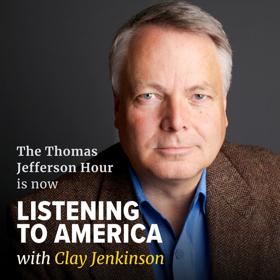
#1549 Welcome to Listening to America
2023-05-29 01:03:11
Listening to America aims to “light out for the territories,” traveling less visited byways and taking time to see this immense, extraordinary country with fresh eyes while listening to the many voices of America’s past, present, and future. Led by noted historian and humanities scholar Clay Jenkinson, Listening to America travels the country’s less visited byways, from national parks and forests to historic sites to countless under-recognized rural and urban places. Through this exploration, Clay and team find and tell the overlooked historical and contemporary stories that shape America’s people and places. Visit our website at ltamerica.org.
Hello everyone and welcome to this podcast introduction to the first of our new programs, Listening to America with Clay Jenkins. When I decided to change the direction of the program somewhat. Jefferson will still be here, our usual guest will still be coming. The Jeffersonian will always be a central theme of everything that I do, because from the time I was 25 years old until today, I've been a Jeffersonian.
I want to live in Mr. Jefferson's America, with, of course, some key adjustments on slavery and women and Native Americans, and so on. But I believe in Jefferson's vision of a self-governing people. A people who educate themselves, a people who are up to the challenge of sorting out their public business together with civility, majority rule, science and good sense. My host for the initial program was my old friend Barbara Ham Lee of WHRV. In Norfolk. She hosts a Thursday noon program called Another View, which is very popular. And she agreed to be the guest host on the first of these broadcasts and podcasts. And I couldn't have been more gratified by that.
We were in the studio, there was a live audience of, I suppose, 60 or 70 people. I've had a long and interesting history in Norfolk. My old friend, Paul Lassico, of the TCC Roper Theater, has been one of the people that worked hardest to make all my dreams come true. When I wanted to do a play, Mr.
Jefferson and Maria Causeway. My head and my heart. He agreed to produce it. In fact, that was the first thing I believe that we ever did together. I performed a range of characters on the stage of the Roper Theater. Theodore Roosevelt, J. Robert Oppenheimer, Of course, Thomas Jefferson. I've debated Hamilton.
When I wanted to do Shakespeare, sort of a one-man Shakespeare recitation program. He agreed not only to be in it and to direct it, but to appear with me after the intermission. In Maybe the Greatest scene in Hamlet Act 5, Scene 1 The Graveyard, which ends with Hamlet saying, Alas, poor Yorick, I knew him. Horatio, a fellow of infinite jest and most excellent fancy Paul, played the Gravedigger, the Clown there and we've had a wonderful time with it. In fact, we've gone to several different venues around the country and are seeking more. I love to perform the Shakespeare program. My first love was Renaissance literature back when I was a young man.
In fact, I expected, when I was 23, to be an English professor at some liberal arts college. With a tweed jacket and maybe a pipe. Although I've never smoked, that's how I saw myself writing learned manuscripts about John Donne and later Shakespeare and Milton and St. Augustine, and the Reformation and the rise of humanism. I've continued to do some of that through the course of my life. But at a certain point, my old friend, E.V. Albers of the North Dakota Humanities Council, sort of tripped me out of that traditional approach. And asked me to perform under an open-air tent. As Thomas Jefferson, I did so with great reluctance, and now I've been married to Thomas Jefferson for more than 30 years.
I spend more time thinking about Jefferson than about any other subject. I've written more about Jefferson than any other subject, with the possible exception of Lewis and Clark. I've performed in all 50 states, in the Mariana Islands, in Hawaii, in Europe, on cruise ships, in the Panama Canal in Alaska. It's been quite a run. I was making a list earlier today of all the characters that I have performed, some of them for one or two performances only because they were relatively obscure.
Say Jean-Jacques Rousseau for the Great Base in Chautauqua when we talked about the Millennium, or Jean Calvin for a Presbyterian conference in Iowa. That was a predestinarian disaster. I've performed as Steinbeck many times around the country. John Wesley Powell, J. Robert Oppenheimer. My favorite character is having a little bit of a resurgence now that the blockbuster film is coming out in the summer of 2023..
And most of what I've done, I've been able to perform at the Roper Theater thanks to.
Paul Lasko And this time we did something called what we called It is Jefferson cancelled, but it really was the trial of Thomas Jefferson. And Paul was unable to perform as the interlocutor. Because he was sort of under the pressure of trying to get so many things done with a short staff at the Roper. So he found this extraordinary actor and comedian, Jason Kipros to be the interlocutor, and he was fantastic. And we had Jefferson in the dock. I was about to say on the ropes for an hour and a half as Jason really challenged. Jefferson's views of political infighting, his dispossession of Native Americans and his American Indian policy, his attitude towards women in public life, and, of course, the issue of issues Jefferson on race and slavery.
And it did not, of course, put Jefferson in a very favorable light. In the end, he asked me to defend myself as Jefferson, and my only defense was, look, what else I did? The Declaration of Independence, the Virginia Statute for Religious Liberty, the Library of Congress, et cetera, et cetera. Jefferson America's first great architect, America's first great wine connoisseur. Jefferson, one of the fathers of the library classification systems of our time.
Jefferson The paleontologist Jefferson, the man who collected Native American vocabularies, was intending to publish a list of them, a comparative list of them, during his retirement. But unfortunately, the papers were lost in a sad accident at the docks of Richmond. But that's hardly a defense, is it? It's really just saying there's so much more to Jefferson than just the fundamentally difficult issue of race and slavery. And then we took a break.
When I came back, I was out of character and I proposed a new way of thinking about all this. I've been obsessed with how to maneuver our way through this righteous moment of cancel culture. Will Jefferson be canceled? if not? How do we need to think and talk about him in the future so that we can do justice to his greatness and his genius? He's America's Da Vinci.
And yet hold him accountable for those parts of his career, his writings, his life. That are not just cringeworthy now, but appalling for us to think about. Although I don't like presentism, which is judging the past by our standards. Even in his own lifetime, Jefferson knew that slavery was an abomination and a fundamental hypocrisy. His closest friends were abolitionists. There's no way that we can say that he was a man of his times. Because, first of all, he always wanted to be ahead of his times and usually was. And secondly, the closest friends he had in the world were all principled antagonists of the future of slavery.
And so Jefferson reflected a sort of complacent attitude of the planter class of his times. But it was by no means representative of all Virginians, all Americans, or all of the members of the Enlightenment scattered around the world. So I tried to make sense of this. I called it the asterisk project. I'm going to change that to something else because it could be seen as a sort of footnoting system.
It's marginalizing, rather than what I intend for it. Which is to make sure that we never talk about Jefferson again, about any part of his great achievement. Again, without factoring in race and slavery. So it was a stunning week. I did four different things before, four different audiences. I can't thank the people at WHRV enough. Barbara Hamley, of course, Bert Schmidt, my old friend, Tom, Heather, Katie, etc.
I came back a little tired, of course, a little bruised by some of the criticism of Mr. Jefferson and the Jefferson performer, but it was glorious. And now here we go, listening to America with Clay Jenkins. We're underway. There will be voices from the road.
There will be some of the voices you've always been hearing. Jefferson will, of course, make appearances. There will be book reviews, there will be essays, there will be ambient sound.
From my travels, I couldn't be more excited from the time I was 17 years old. I have wanted to do this, to wander the country in an RV of some sort, or a trailer or truck camper, you name it, and to see the country for myself. To go to all the national Parks and all the national Forests, and all the national Wildlife Refuges and all the national Monuments and all the battlefields. And to the homes of presidents, and to the homes of Elvis and John Steinbeck, and Mark Twain and Emily Dickinson and Zora Neale Hurston, et cetera. But most of all, just to go out, slow down, park in the open air, meet people, some that I seek to meet and some who are perfect strangers. And listen, listen, listen, listen to, try to get the beat of America on the eve of our 250th birthday. So I know some people are going to miss the Jefferson Hour, but, believe me, not much will really change.
Some people are cautiously interested in all this and want to know how it will really be accomplished. There will be a few growing pains, I'm sure, so I just ask you to stay with us, keep listening, and, if you like it, to tell your friends. But go to ltamerica..org, sign up for my weekly newsletter, contribute to the success of this program in any way you can. We need, of course, a budget.
But most of all, provide comments and suggestions, tell me people. We should meet around the country, places we should go, themes that we should pursue, interviews, we should conduct books and articles to read magical places that are not on anyone's map.
What is this country as we approach 250?
Are we a single nation anymore? Unclear. I'll have lots more to say about this from every zip code, I hope in this country, certainly the great bulk of them.
And I really mean it that I'm going out to learn not to speak, you know, you can't learn when you're talking. I've had a lifetime to fill my mind with whatever's in it and all the perspectives that I have developed. But I'm just one person, and indeed a male, a white male, senior citizen, white male and a very privileged American. You know, I got to study at Oxford.
I got to study at the University of Minnesota, I've had a chance to travel the world, I've had extraordinary experiences. Addressed 24 25 state legislatures, all the judicial conferences in the country. I've met presidents, a couple of them, and performed for the White House on Jefferson's 250th birthday. And thanks to the Chautauqua work I've done, I've been in a number of Ken Burns films, another one just about to be released, The Buffalo.
I couldn't ask for much more than I have received in the course of my lifetime. I write for Governing..org and now, of course, I'll be writing SCADs. I think that's a technical term for listening to America, that's LtAmerica..org.
So let's go to the first program with great thanks to Barbara Ham Lee and Bert Schmidt at WHRB. Thanks for listening.
Hello everyone and welcome to the first edition of my new program, Listening to America with Clay Jenkinson. I had the great good fortune of recording the first of our new series in the studios of WHRB in Norfolk, Virginia, with a live studio audience. The guest host was my old friend Barbara Ham Lee, who has a very popular weekly program on Thursdays called Another View. We talked about my plans for Listening to America. How much continuity it will have with the Thomas Jefferson hour, whether Mr. Jefferson will continue to make appearances on Listening to America. And what am I trying to discover as I travel the country on the eve of the 250th birthday of the United States?
I had said that I was searching, like Steinbeck, for the soul of the country, and she rightly challenged that and said, There is no one soul of the country. And how can one person, however good his heart and his intentions, can presume to get at the soul of this extraordinary country? With so many regional dialects, so many different ethnic groups, so much multiplicity of races and vocations and identities? Maybe there are only souls of America, and maybe there isn't a single America in which to seek the soul. We talked about one of my heroes, John Steinbeck, and whether his 1960 travels with Charlie. Journey around the country could serve as a template for a country almost infinitely different from the one that he saw on the eve of the Kennedy administration. We talked about some of the projects I'm undertaking with Edward S. Curtis Water in the West, Theodore Roosevelt's conservation footprint and much more.
So let's go to the interview with Barbara Hamm Lee in the studios of WHRV in Norfolk, Virginia.
So hello everyone, I'm Barbara Hamm Lee, executive producer and host of the radio show Another View. It's heard on WHRV FM, NPR for Eastern Virginia and streamed live at Anotherviewradio..org. And I am so honored to serve as a guest host on the inaugural edition of Listening to America with Clay Jenkinson. So what is Listening to America and what about the Jefferson hour? Here to tell us all about it, please welcome Humanities scholar, author and educator Mr.
Clay Jenkinson.
So you got to put people's mind at ease. What's going to happen to the Jefferson Hour?
So there will be more continuity than change. We'll still have Joe Ellis on from time to time, and Lindsay Chervinsky will be coming on. And David DeCandre, our enlightenment correspondent from the West Coast, and Mr Jefferson will make appearances. So it'll be more of the same, really, but here's why I'm changing it. I've been at it for a long time.
You can never grow tired of Thomas Jefferson, you can never really finally understand Thomas Jefferson. But I know that I want to look at some things that are sort of outside of Jefferson's purview. And so I thought this would be a good time to sort of morph the program, make a wider embrace. And you know, one of the things is that I have all of my life, since I was 17, wanted to hit the road. Sort of like Jack Kerouac or Charles Kuralt, or William Leastheat Moon, or John Steinbeck, and go what Steinbeck called it, this monster country. I thought, wouldn't it be something if I could just go out now that the technology is possible? So you're going to be in a big old bus and.
With all the amenities and, you know, like Glam camping, you had to bring it up, Barbara.
I'll be in a pup tent, but what I want is an airstream, and I know someone who's listening has one and needs to. You know, it's time you don't use it, it's time to, you know, re-gift it. But I'm going to hit the road like John Steinbeck, and I'm going to do programs from the road. We just got back from a two-week period in southern Utah to talk about water in the West. We interviewed eight or nine people.
We were on several reservations, we were in a number of national parks and national monuments, we saw Marble Canyon and Lake Powell. And we really wanted to go down and figure out what's going on with water in the west. That doesn't sound quite like Thomas Jefferson, but it does sound like listening to America, so that's the idea.
Well, that's the idea going now. I gotta ask you, Do you have a Charlie?
You know, I can't keep a chia pet alive.
I travel a lot, you know, you've got a dog is a discipline, and I'm on the road too much. I would love to take a dog, but I wouldn't take an aging French poodle. My mother was a great lover of miniature schnauzers, but that doesn't really seem romantic enough. You know, a yippy little lap dog, you need a big dog.
Yeah, you gotta have a big dog, so no, I don't think I'll do that. I might get a giant stuffed dog and put it in the passenger seat.
You know, because it's about the same if you think about it. So Steinbeck talked about the soul of a nation, the soul of America. You're in search of the soul of our America today. So my question to you is, Whose soul are you looking for? You know, I knew you would ask that question.
And it's a scary question to me because, of course, we all have our zones of familiarity. So if you just said, go do good stuff for the next 10 years, I would know how to do that. But if you're going to look for the soul of America, first of all, you have to realize there are many Americas. Virginia is not North Dakota, North Dakota is not Utah.
Utah is not Alaska, so you should get out of your mind that there's one paradigm. And as you know.
After 250 years, we're approaching the 250th birthday of the country. Race continues to be the unspoken center of American history. That we've all been made aware of. This more than probably ever before in the last few years, I think in a good way. And so we can't talk about the soul of America if we just talk about the soul of Anglo-Saxon America. But I'm going to need your help. People say, Well, you should talk to this person about this subject.
What we've found already in going to the Southwest to talk about water is that one person will say, Oh, you need to talk to George over there. And that leads to somebody else and another perspective and another voice. I don't presume that I can just wander into African-American communities with a microphone and say, Tell me what the soul of America is. I think that's probably.
Not a really, very polite thing, you know? It's interesting. I served as moderator for a discussion in Colonial Williamsburg with all of these museums and places around the country in preparation for the 250th. And the topic of the conversation was How do we make it inclusive? And so I know that in some of the materials that we've been talking about. And all your fear is that it becomes a jumble of everybody doing their own thing, as opposed to us looking at.
America as all of ours, it's a really tough question. So if you just think of for a moment of spending an evening watching an hour of Fox and then an hour of MSNBC on any cultural issue. And you come away just tearing your hair out and saying, you know, there is no America, it's just brick baths and it's chaos. So imagine what the 250th birthday of the country is going to be like.
On the one hand, you're going to have sort of the 1619 perspective that it's been a racist country from the beginning. And that there's an awful lot to answer for. And on the other end of the spectrum, you're going to have the hard right. Conservatives saying we're the greatest thing that ever happened to the world. And we have nothing to apologize for. And how dare you apologize for this country? I'm just afraid it's going to be nonsense and chaos, and I want to find.
A better way to look at it than that? And do you think people in the middle have a better sense? I know, because, you know, the coasts are divisive, I get that we both not live on the coast, we live on the other coast.
But the folks in the middle, do they really have more of a sense of what America is, or what its ideal should be? Well, this is complicated again, I think most.
Americans, even now, are idealists. We have an idea of what America means, what America signifies, what America is in the world. I think all of us feel this. I think we're a little shopworn and disillusioned at the moment, roughed up by all that's going on, but I think that idealism continues.
And what we found like in this two-week trip through Utah and parts of Arizona and New Mexico? We talked to dozens of people. No one ever said the word Biden, no one ever said the word Trump, no one ever said the crisis at the border. In other words, people are going about their lives. And all that stuff we hear about every night is just a kind of a surface madness, I would call it.
Not that it's not important, but that's not where America is at. People are doing creative things in their garages and in their basements. There are communities that are very healthy. There are people that are enlightened in ways that they don't beat their breasts about, but they're just trying to be good citizens. I'm not Charles Caralton.
This isn't meant to be Pollyanna's America, either. We get it that this is a deeply divided, troubled country. And I think that if we don't in a very purposeful way examine our nation at 250 years old and say, who are we now? what are we now? where are we headed?
What are the unresolved issues that have been with us for a long time that need to be addressed in a meaningful and generous way? If we don't do that, the 250th birthday is going to be absolute nonsense and chaos and I'm worried about that. I want to hear the pulse of the nation and you have to be willing to wander and get lost.
You have to be willing to get off the main roads and not go to the usual suspects, you have to be willing to be surprised. And at times, I think a little uncomfortable. But I hope that I come out of this a much different person from the one that's going in. And I think the only way you can really get to the heart of this country is to listen, listen, listen. And, as you know, not a lot of that happens anymore in America.
Absolutely so. Beyond the radio shows that you'll be doing, you also have podcasts you're going to be people can follow. You. Tell us a little bit more about how this is a very well-rounded look.
It's a new website, LtAmerica.
Org. We're posting articles and photo essays and video interviews and transcripts of interviews already, so there's already a rich content there, and there'll be much more. Because here's the deal once I get my airstream, and I don't know if I mentioned that, if I mentioned that.
If you're listening, he needs an airstream.
That's really, I mean, is that so much to ask listeners like you?
But once I'm out there, I think magical things are going to happen, I truly do. And because you get off the main roads and onto what William Leastheat Moon calls the Blue Highways, and you stop at a diner somewhere and you go in. And normally on a plane, I put on blinders, but I won't be doing that, I'll be trying to really listen.
But you need Charlie in order to get people to talk to you.
That's the thing he would get to a spot, like a little roadside thing. And then he'd turn Charlie out to do his business. And Charlie would go get into trouble. And then Steinbeck would go, Oh, my dog is a problem. And then, well, why don't you come in for a cup of coffee?
And then, three hours later, he knew what America was. So, you know, do I want a dog that badly?
We need to take a short break. You're listening to the first edition of Listening to America.
With Clay Jenkinson recorded in the studios of WHRV in Norfolk, Virginia, we'll be back in just a moment.
Welcome back to Listening to America with Clay Jenkinson.
I can't tell you how excited I am to be undertaking this new adventure.
I hope to spend the next 10 or 15 years traveling the country, attempting to get the mood and the.
Tone of America as we reach our 250th birthday. This is a conversation I had in studio at WHRV with Barbara Ham Lee, the very popular host of the weekly program Another View.
Let's pick up the conversation from there.
So let me ask you this before we move on, because I do want to play a couple of clips from.
Right from what we're doing, right.
Yeah, from listening to America, but I don't want to let Mr. Jefferson go for just a second. What would he say if he saw America today?
Oh my.
I think about this all the time, you know? For 30 years, I have been in a kind of a marriage with Thomas Jefferson. It's the most intense and intimate relationship of my life. Think about that for a minute. No wonder I didn't get out on the road.
But you know, I've fallen in love with him, I've fallen out of love with him, sometimes I can't even stand to be in the same zip code with him. Then I find myself in costume and I'm having to say stuff that I hate or don't understand. So it's been like the central relationship of my life.
And so I think about these questions. I think that's the strength of the Jefferson Hour, my short answer to your question. I think he would be horrified, the divisiveness, he was a harmony obsessive. The loss of agriculture.
You know, we have agribusiness, but we don't have family farming really anymore, he said. If you expect to be a nation ignorant and free, you expect something that never has been and never can be in the history of the world. Well, we're testing that principle right now because our K-12 system and my mother was a teacher, my sister was a teacher. I have a lot of respect for public school teachers. But it doesn't seem to be really making young people ready for the challenges of the 21st century.
For example, the new studies show that most third graders can't read at a third grade level.
And no matter what your community is.
So we've got to turn that around if we really want to be a republic. So I think he would be horrified, but on the other hand, he might not be able to see straight. Because he'd be buying Apple computers and Apple watches and gadgets. Jefferson, with an Excel program, is the happiest man who ever lived on Earth. And so he'd be buying these on credit, with money that he didn't have.
Like everybody else that does this, like the rest of us.
I mean, just imagine he kept a copy of every letter that he ever wrote. Handwriting, you know, these lousy little fake presses today, with mail, merge and cut and paste, he wrote 85 volumes with a quill pen. imagine him with a word processor.
So, I mean, he would love this time and the scientific discoveries of this time. We now know that we don't live in a world, we live in cosmos upon, universe upon, cosmos upon. You know, I think he would be utterly fascinated by the scientific and technological genius of our time. And then he would say, How is it that the wealthiest nation ever doesn't require a living wage for every one of its able-bodied citizens? How can this be?
How can this make any sense? And I think he would look at our cities and the class system. Growing ignorance. But here's one thing that I think we will address again on Thursday when we talk. But I think he would say, I'm sorry to say. I kind of recognize that the racial tension, the legacy of slavery, was going to bedevil us for a very, very long time, he said. Hundreds of years.
And here we are.
So he'd still be disappointed that it's still.
How could any rational person not be? In other words, the question that he faced was, once we emancipate all the enslaved people, then what can we be a biracial republic? And sort of, we sort of are in many important respects.
And we're sort of not, as you know, in some fundamental respects. I think he would say it's going to take a long time to work all this out. And we either have to quit and just become different nations, or we have to work harder at it.
So would he be mad at the students at UVA who want to cancel him?
I'm going to sound like a real conservative here. If you accept admission to UVA, right? Are you with me so far? If you want to go to one of the most prestigious universities in the world? And they only let in like 6 of all the applicants, and you get in. It seems a little late to start bitching about Jefferson and slavery, you know, like, you didn't know this, you didn't. I mean, okay, the enslaved people worked the grounds.
They baked the bricks, they cut the timbers, they built the thing for him, Then they turned out to be the staff. The walls were built by enslaved people.
What part of you doesn't understand that Jefferson has a fundamental race problem at the very heart of his life? And then you go to UVA and then you say, I shouldn't even be here. I'm just so appalled by the come on, you know, go to Yale.
I mean, truly, if this is your issue that Jefferson, I cannot stand to be in a building that Jefferson claimed that was built by African-Americans. If that's your issue, I'm with you.
But don't go through the school.
But then don't expect the scholarship and then whine about it, too. I think we're in this period where grievance is our national hobby on every side.
So what do you think about the whole statue issue?
No, I didn't know I wouldn't have agreed to this if I and they said you were tough.
Okay, I think I'm going to talk about this tomorrow night at The Roper. But in short answer, these are individual situations in individual places. But there's no one-size-fits-all answer to this. It depends on when the statue was put up, by whom, for what reason. It. Also, I think the community itself should address this and every stakeholder should be at the table.
Everyone who has any interest in this should be at the table. I think there are many, many, many, many possibilities about how to address this without tearing something down or exploding something. Even if we got rid of everything that we find objectionable, we can't pretend that our history didn't occur. You know, we have serious environmental, long-term issues in America. We dispossessed the native peoples who were here for thousands of years.
We brought African-Americans, Africans against their will, across the Atlantic. We have many things we must address as a people, and there's no way we can duck that by taking out of the public square something that offends us.
Actually, I happen to agree with, you, believe it or not, because no. What I worry about is erasing history. And I look at the Jewish community, for example, that talks about the Holocaust, because they don't want people to forget. And I think it's really dangerous sometimes if we just tear things down without context, without any place else for it to go, and then eventually it's forgotten. Almost like, not including Black history, for example, for the longest time when talking about this country.
I don't want to see that happen again because we are so bent on turning things around. I think the pendulum is swinging back and forth and it's on the far end right now for me.
It's very complex and we can all agree, for example, that Stonewall Jackson is not the same as Thomas Jefferson, right? Think of, say, a community in Tennessee that has a statue to the young Confederate soldier, a nameless, kind of average Confederate soldier. I think, well, he grew up in that state, he felt that he was doing the right thing, this was his community.
It seems to me that we can be a little charitable about something like that. But if the statue was put up in 1963 in Selma, Alabama, that's a whole different thing, isn't it? And so I think we need to have a case-by-case basis. I will go out on a limb and say, I don't think Stone Mountain can survive in Georgia because it was created by the KKK. There have been KKK rallies there as late as the mid-teens of the 21st century.
It's pretty hard to make the case that that's okay. Of course, it's not an easy one to erase. You don't want to be using small nuclear weapons to clean up our national history. But, I mean, in other words, that's one that I find egregious. But then Borglum, who did Stone Mountain, also did Mount Rushmore. Now you're in slightly more difficult ground.
But think of it, Jefferson has a problem, several problems. Race is the chief one. Washington Not as bad, but far from exemplary. Lincoln, at one point, thought of repatriation societies for freed slaves.
Roosevelt, My man, Roosevelt, he was a crazy guy. He's the only one that was ever in South Dakota. I think that should matter, but if you're going to start erasing those guys, they're all going right. I mean, and you know what?
Remember what Hamlet says, He says Treat every man according to his desserts. And who shall scape whipping? We all have things to answer for, don't we?
Absolutely.
And another one of my mottos comes from my great beloved mentor, Everett Albers. Judgment is easy, understanding is hard. That's where we need to go with this.
I love that.
I try to withhold snap judgments, but we do have to make some hard decisions about some of these things as a people. And I think, if we will do it with civility, mutual respect, granting each other agency that you have a legitimate point of view. And so do I, and we bring all the stakeholders to the table. And then we don't just say, pull the darn thing down or paint over it or whatever. I think we can get through this.
But I do agree with you that this wave has sort of reached its strongest moment and it's beginning to recede a little bit. And I think Jefferson will survive, and I hope he will survive.
Well, he's going to survive. On Listening to America. We're going to take a quick break, but when we come back we'll talk some more about the show, and you're listening to Listening to America. I want to play a clip.
One of the major issues that we're looking at in America today, and that's gun violence. And you spoke with someone I believe about that.
You know, I wrote about this about nine years ago for The Jefferson Hour, an essay that I read on the air, and it was about eight things. We could do background checks and so on. And they seemed to be like, so centrist and so rational and so uncontroversial to me. But at the end of it, I said, Can you believe it? We now have as many as three mass shootings per year in America.
We have three per week now.
Yes.
Three per week. We've had 126 in this country since January 1st. So we're in a very serious problem here and we can't have a discussion about it. So here's what Listening to America tries to do.
Instead of just saying, take away your AR-15. Or, you know, whatever, the Second Amendment is absolute, we don't want to stick with those kind of easy answers. So I have been interviewing a whole series of people about this. And this is David Yamani, sociologist at Wake Forest, and his view is that, unfortunately, guns are not the right way to address this.
They are central to this, but they're not the way to get at this. But he also says that given what's going on, there's now kind of a narrative, a template that, you know, a young, alienated person now has a template. You go get your AR-15, you go to the mall and you start shooting. It's got a blueprint. Let's listen to David Yamani.
Really interesting thoughts there.
Cultural script great phrase to help us think about, but a more simplistic way might be to say copycat. I'm a 19-year-old, my girlfriend just dumped me, I can't get along at school.
I'm at odds with my parents. I fall into a rage, take an Ar-15 into the public square somewhere and shoot. You're saying that I didn't generate this idea myself, I'm working from a well-laid-down public script.
Now, the Ar-15 is part of this story. The randomness or the targeting of this is a story. Once that happens, every 19-year-old knucklehead has a script to play if he wants to, right?
Obviously, this is a huge concern because the ability and the willingness of people to do this seems to be more widely available. At the same time, given the number of weapons that are out there and the number of 19-year-olds, and the number of problems that 19-year-olds have. I think we're fortunate that it doesn't happen more often. Which, again, is no consolation to the parents and families of Uvalde or any of these other places. But some moderation in thinking about how do we address this issue and having some more targeted approach. Obviously, non-events are not newsworthy.
So when people are stopped from doing these things, we don't hear about it. They're also very systemic. It's not just about trying to target individuals. It's about thinking about a mental health crisis among young people that we're experiencing today. It's thinking about the systemic inequality that we live with in this society. Fosters a grievance and hatred.
It's a very complex problem and I worry that we might, in the rush to try to do something. Kind of go down alleys which aren't going to be profitable and may actually end up dividing the country more. I think the assault weapons ban is something that people of goodwill can disagree about. But I do know that every time it's moved forward, it's divisive in the country. And I don't know how many problems that will actually solve, given the small number of people in any given year who are actually killed with assault rifles.
Now, obviously more than in England. I was just looking at some numbers. And the U.S.'s non-firearms homicide rate is three times England's overall homicide rate. So even if you eliminate every firearms homicide in the United States, we still have three times more than England, Japan and countries like that. So we have, as you were saying, Clay, a violence problem, which is also novel for our country. We've had a violence problem in our country.
Our country was founded in violence, some of it positive in terms of freedom from colonialism, but some of it negative in terms of colonizing the continent of America.
I think I hear you saying that. If we really want to talk about this in a mature way, that coming at it from the perspective of guns is not the best start.
I think it's extremely unfortunate that we have a politically polarized society and that guns have gotten drawn into that polarization. You know, that guns have become a wedge issue. They become, you know, symbolic for both sides, and once they become symbolic, then I think that leads to further polarization. I'd like to see some problem-solved policies that seek to undermine gun violence without directly over-regulating firearms.
I think those are the more fruitful paths.
In a sense, the easy path is to say there are just too many guns. We should do something about that. If you take this bigger view that you're offering, okay, we have mental health issues in the country, social media that has poured kerosene on whatever is out there. We have a broken health care system, we have policing.
We have our incarceration problems in the country. In other words, if you really wanted to get to the soul of America, which is what a sociologist is doing, get to the soul of America. That produces this phenomenon. As opposed, say, to Denmark, or, as opposed, say, to Finland, then you're in such troubled waters. Okay, let's fix the problem of adolescent mental health care in the United States. It seems like that's intractable. Whereas if we just said, well, ban bump stocks, we can at least feel that we're doing something about it, right?
Yeah, but I feel like that's just a false hope, that it's going to feel like we've done something. It's not actually going to do anything. And also it's going to aggrieve one side. In this already polarized situation, a lot of people are very critical of the NRA today, I'm critical of the NRA.
I hate that it became this right-wing culture warrior organization. But honestly, the NRA and the modern gun control movement have been in a death spiral with one another. And so now the NRA and modern gun control movements are just in this kind of never-ending battle. That doesn't help us address the actual problems, and I would say problems that get exacerbated by firearms.
I don't think of them as primarily being gun problems. Suicide is a problem that gets exacerbated by guns. Homicide is a problem that gets exacerbated by guns. Firearms are certainly a very efficient tool if you want to kill a lot of people fast.
So let me ask you this question, you heard that now? So, on the one hand, it makes perfect sense there are deep underlying problems in America that you have to get at because guns are not exactly the centerpiece of that. On the other hand, you think, Oh no, now we have to fix all the problems in America before we fix this one, right?
Well, my question is, why not? If we know that they are the underlying problems, and we know that they're exacerbated by guns, particularly the high-powered rifle ones, the Ar-15s, why not eliminate them while we're working on the problem?
I appreciate what he said as a sociologist, so I'm with you. So just take the Ar-15 for a moment. But we don't seem to be able to have that conversation, right?
Because it's so polarizing and there are so many other underlying issues. If you know that, that's the flame, why are you going to put the match there instead of trying to work on all of it together? But again, you got to have people come together to talk, and I think that's what's going to be a challenge as you go around the country.
We need to take another short break.
You're listening to the first edition of Listening to America with Clay Jenkins. We'll be back in just a moment.
Welcome back to this final segment of our first edition of our new series, Listening to America with Clay Jenkins. As you've heard, there will be more continuity than change. Mr. Jefferson will be making appearances as well as our frequent guests Lindsay Trevinsky, David McCandry and Dr. Joseph Ellis.
Let's pick up the conversation from there.
When we get into the bigger arena of bringing together a bunch of voices to deal with a problem, that's where it seems to fall apart. But the question is, how do we get people engaged? Because, to me, that's the biggest issue. We can come up with all kinds of solutions, but if we don't get people to truly engage in a problem or in solving a problem, we're never going to get anywhere.
We can't even get people to take the time to sit down and listen to an hour's show. I don't have time.
Well, we can't fix this one, we can't fix this one, but I do think there are things we can do. So what I have found in the whole course of my life is that people just want to be taken seriously and they aren't very often.
And so our national debate is sort of brickbacks and shallow and crazy. But when we were on this water trip, we just sat down with people and let them talk for as long as they had things to say. And when they realized that we weren't just in to get something that we could appropriate from them and take it back to a media center, they began to relax into it. And then they start to tell stories and they become fascinating.
And so we've stopped listening to each other, and that's why we chose as our title Listening to America, and we mean it. The country is filled with really extraordinary people and I believe in this country.
And here's the thing I'm going to get very serious for a moment. Barbara. I never thought that in the last third of my life, which I'm certainly in, maybe the last seven, eight. You know, I never thought that I would feel disillusioned with my country, but don't you feel disillusioned like this isn't America?
This isn't what we're meant to be, we're meant to be striving always to be better, and we're meant to be the class act of the world. And we're meant to be, you know, centered in Jeffersonian idealism and that we're never going to be perfect.
But we keep working at it and we believe in civil rights and we believe, you know, that's how we feel. And yet there's been this terrible, terrible slippage and I want to go out and see if that's really true.
And I don't think it is. When you get out there to Ritchie Montana, or Wadena, Minnesota, or Broken Bow, Nebraska, or, you know, a small town in western Virginia. You see good and decent people doing good and decent things. And they don't really recognize the usual national debate.
So how do we get those of us who live on the East and West Coast then to see things the way that you perceive they see things?
You come out and join me. I've got extra room in the airstream, Have I mentioned the airstream? I don't know, and we'll wander about.
And I'll show you things now. You're probably thinking this wild-eyed, you know, knucklehead just wants his trailer. But I wouldn't be doing this if I didn't believe that. The country was more interesting, more virtuous, more idealistic and more optimistic than we are led to believe. And so I would like to show you that, and I can, by bringing back interviews.
But I'd rather take you there into a small cafe in Wyoming and see what happens.
So clay, if that's the case, if really, the soul of America is more like you just described.
Healthier than we think?
And healthier than we think. Why are we, those of us who think we are healthy, allowing those who we think are unhealthy to take over? To make to be the sounding board? Because that's all the rhetoric that we're hearing right now. Why are we doing that? Why aren't the good people jumping up and down and screaming, Stop, this is not who we are?
They're not jumping up and down, but they are saying, stop. Just remember when Donald Trump was running for office and became president, the president of CNN said. This is great for ratings, this is great for business. We just learned from Fox, on the other end of the spectrum, that the key people did not, were not on board with the Trump narrative.
But they decided that it was the only profitable way forward. And so we live in a very deeply capitalistic country. You've been in commercial media, you know, and it likes sensationalism, and it likes revenue.
And it's not very sexy to talk about somebody in Montana who is welding some superb art. There is a kind of a sense in which the sensational has taken over, and I blame popular culture, too. If you watch an average night of television, just surf around.
The amount of mayhem.
It's all about confusion.
Rape and sexual exploitation, and sex trafficking and murder, and so on. And if you were from Jupiter and saw this, you'd say, this must be America, but it's not America, it's our pop culture America.
You know, we did a show on another view when you just said it reminded me of. We were looking at the relationship between the African-American community and the Latinx community. And one of my guests talked about how. When she moved to America, her mother was so upset. Because all she had ever seen were Black men in handcuffs on TV. And she just kept telling her daughter over and over Don't go to America, be careful, stay away from Black men.
They're dangerous, you know? Because that's what the pop culture in her country was showing her, because that's the way that America is perceived. And again, there should be enough of us. I would think that should be able to stand up. Even though it's not sexy, so that we can turn it around to make it sexy. That being good is sexy, you know?
The ultimate I'm going to sound like a Marxist, and I'm certainly not a Marxist. The ultimate capitalist drug is television. You know, almost everybody has a widescreen home theater now. I remember when mine was put in about 15 years ago and they turned it on to some like Swedish basketball team. And I said to the guy, I will never leave this room again.
I was just like, you just mesmerized, and then you're binge watching 250 hours of NCIs. And so, I mean, we've done this to ourselves if we wanted to save the country, which clearly we don't if we cut the plugs off of our television sets. And for one month, they went dark. People would be out in the streets saying, Hey, should we barbecue together? And I didn't know you lived here.
So you're going to follow the trail pretty much that Steinbeck followed, right?
Roughly if I get the you know what.
I know if you get the air stream.
Not to bring it up again, but I'm going to start on Long Island, at Sagamore Hill, not at Sagamore Hill. that's Roosevelt's place. I'm confusing my journeys here. I'm going to start at the end of the at Sag Harbor, okay?
And I'm going to go all the way up to the top of Maine as he did. And then all the way out across the Dakotas to Seattle, and then down through Monterey and his old stomping grounds. To San Diego, and then over to Texas and then to New Orleans and back up. And I'm going to do it in five bites, not just one continuous journey. And I'm going to write every day and then I'm going to do like a subscription service, that people can join me once a week. And there'll be photo essays and interviews and so on, and so forth. And while I'm doing it, I'm going to read the complete works of Steinbeck.
From the first short story that he wrote until the last thing that he wrote, which was called America and Americans, and so this. Then this will be two books, one on. As America approaches its 250th birthday, what does it seem like now? And I know I'm not going to get to the heart and the soul of the country, but I'm going to do my best. You know, that's all I can do, Barbara.
As I'm listening to Where you're going.
And you're coming along.
I don't see other than Native Americans, I don't hear a lot of diversity in your trip. No, so I'm wondering, how do you make sure that you're? How do you check your bias in terms of how you present this information? Ultimately, so that it is something that everybody can absorb, you know, because Steinbeck was criticized somewhat by academics, at least in the reading that I was doing, because they were saying that he didn't always capture what was really happening.
I think no American, we have 340 million of us, I think no American can ever presume to be able to really get to the heart of this country. There are Creole communities, there are Mandan, Hidatsa, Shoshone.
Arikara communities, There are African American communities that are urban and rural, there is a Southern African American community and a Detroit and Chicago African American community. There are Polish Americans and Ukrainian Americans. It would be madness for me to say I'll go out there and my antenna will be up and I'll listen to all of these things.
Of course not. I'm as blind as anybody I have. One advantage is that I've had a really privileged education, so I've read a lot in a lot of directions.
But I can't possibly do this well without the help of people like you. And you have to say I listened to your program. I thought it was sort of interesting, but it seemed a little like you, you know, it seemed a little like monocultural or a little blind. And then we're expecting people to teach us how to see this country, because you can't just, I mean, how do you do this?
Let's say that I started in Chicago, what a city.
Exactly, but we're in Chicago, the south side, the million mile. Which one are you going to do?
Well, you know, at some point. If you really want to get to the heart of this country, you have to get into the heart of the inner cities of this country. I'm a really just a stiff white guy, you know, I'd be scared. In some of these communities because you come in perpendicularly, these are communities that don't always welcome outsiders. There's a fair amount of violence and poverty and chaos.
I would be, I think, really presumptuous if I thought I could just show up and say, Tell me about the woes of the south side of Chicago.
I'm glad to hear you say that clay. Because there's so many people who think they can do that no way, and they don't understand that. There is no trust.
How could there be trust?
Exactly, because if the only time that they see someone who looks like you is in some sort of authoritarian position. And we talked about this over dinner. You know, if the only time a Black child sees a white person is as a cop or as a social worker? To take them away, you know, or some other kind of punishing or authority figure. And that's the only time that they interact, then what would their expectation be?
You got to go with humility, you have to go with a liaison of some sort, you have to put your own preconceptions, your own stereotypes. You can't get rid of them, but you can put them on a shelf a little bit. You have to be careful. Because there are, I don't know how many different types of African-American communities you would say there are in the United States, but it's more than a dozen at least.
And so to say the Black Americans think of this, that would be a very silly thing to say. I'm a little better versed on Native Americans because I'm a Lewis and Clark scholar. And I've spent really a lot of my life in that world. And I've been doing some work on Edward S. Curtis, the great photographer, and he's absolutely unbelievable. And I'm going around....
I was looking at some of the photographs, they're incredible.
And he took 40,000 pictures of Native Americans. He's criticized in some quarters for the usual things, but he's unbelievable. And I'm working with Native elders. I've done about seven of these interviews with elders, where I take them Curtis's fabulous photographs and show them. And they'll say, Now this one, you see what she's wearing, that is not Shoshone.
That is a lakota, so that's a trade item. I'm thinking, what? And so they see things I could never, ever see.
And the interviews, we've already got four or five hours of them, which we're putting into these modules. They just change the way you see. And then I say, Do you think that Curtis was wrong to romanticize Native Americans? And they'll say yes, but they're still great photographs, and so I don't come with any preconception.
I just say, tell me about this, and so this is it. So Native Americans have been extremely generous to me. I think that the African-American community is a little bit harder for me to make sense of because I a grew up in North Dakota.
Did you snort?
You snorted. I'm a proud citizen.
That was a cheap shot, but it's true and I want to get this right. And I've worked with humanities councils all over the country and we've had forums of African-American people and spokespeople and so on. And I've benefited greatly from it.
But it's not yet a natural comfort zone for me, and I want it to become one without ever becoming cocky or presumptuous. And so, listen, listen, listen, right?
Listen, listen, listen. And I'm so glad we had the opportunity to chat.
I would not have done this without the support of WHRV. Truly, I regard it as our flagship station. And then I said, Would you be willing for me to launch the thing at WHRV? And he said, Yeah, Barbara's going to really put you on the hot seat.
You didn't, you were, except for the cheap shot about North Dakota, I think, and get in line on that one, honey.
No, I was going to say, you have to invite me to North Dakota, because, trust me, I've never been there.
You're coming to North Dakota and I'm going to give you something called fleischkikla, which is like a coma in a pocket.
And Neffla soup and borscht. Oh my, I will take you to places that will astonish you. Because I know you have some kind of moronic idea of North Dakota. That it's flat and dull and windy and stupid.
Pretty much exactly not the stupid part, but the windy.
So when you come, you'll see it's only somewhat windy and somewhat cold. Winters are not endless, they're just semi-endless, and it's not flat, there are a few hills.
So it's pretty warm here for you today.
Here, yeah, oh my goodness, I got Suntan Oil and Norfolk, I love it.
I love coming here because this is really the. This has been the flagship of the Thomas Jefferson Hour for 20 years. And a lot of people, even in this group tonight, are people that I've had on my cultural tours or on my online courses. You and I have spoken many times. It's a thrill to launch the program here. And I can't tell you how much I appreciate this community because it has really opened many doors of perception for me.
And we're just getting started here.
I want to go, I want to go on part of the trip, we'll see.
We'll see.
We'll see.
You know, you're going to have to do a lot of persuading now. I don't know where would you, what state if you were going? what state would you most want to wander about in?
Oh, California, anywhere in L.A.
How much time have you spent in California?
Probably over my lifetime, probably about two months worth, you know. In other words, going in short spurts. I've been to L.A. I've been to Northern California, I had a very strange experience in Lodi, California.
I've been to Lodi.
Where we? When I was in college, we traveled to 26 cities in 30 days in Northern California. Because we were owned, we are. The school was owned by the United Methodist Church, and so we would go out. They pick students from the various schools that they owned.
And we would go out and talk to people about the school and what we were doing, you know what we learned, and so forth. And when we got to one family one, when we got to Lodi, the families that we were to stay with were not available. And so they took us to a park. But we had police escorts because it was too dangerous for us to be in the park because we were Black. This was in 1977..
And that your being African Americans was an issue there.
Yes, and the police stayed with us until our host families were together. And this is like, what is Lodi like, 40 miles outside of San Francisco? I mean, it's like, kind of close.
Well, we've come a long way, so we've come a long way, we've come a long way. And one of the parlor trick is if there were only one state.
What would it be?
And the answer in North Dakota never comes up.
You know what happened? I know we have to stop here. But Laura Bush came to North Dakota.
Really.
About three weeks before the end of their administration, so it's just about the time for the bushes to leave. Laura Bush turns up in North Dakota. I met her and I said, Well, what brings you to North Dakota? She said. I wanted to finish.
You think that's funny?
Lt.America.
Org Sign up for our newsletter. We're going to have a lot of fun with this.
Absolutely.
Thank you, my friend.
Thank you, Clint, appreciate it.
What a great start. It was such a joy to launch the new program in the studios of WHRV with a live audience. Thanks to the generosity of my old friends. One of the flagship stations of all the work that I do. We'll see you next week and thereafter for more episodes of Listening to America with Clay Jenkins.
v1.0.0.260408-1-a910ba6_os