

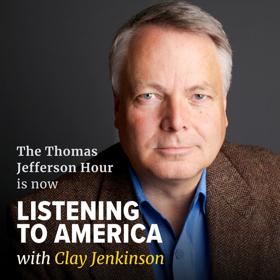
#1577 The Listening to America Origin Story
2023-12-11 00:59:06
Listening to America aims to “light out for the territories,” traveling less visited byways and taking time to see this immense, extraordinary country with fresh eyes while listening to the many voices of America’s past, present, and future. Led by noted historian and humanities scholar Clay Jenkinson, Listening to America travels the country’s less visited byways, from national parks and forests to historic sites to countless under-recognized rural and urban places. Through this exploration, Clay and team find and tell the overlooked historical and contemporary stories that shape America’s people and places. Visit our website at ltamerica.org.
Hello everyone and happy holidays. Guest host David Horton asked me today if we could talk about my life as a Chautauquan. How, how the Jefferson Hour began, what it had to do with my my traveling performances of Jefferson. All we got here over the last 20, some years, and where the program is headed now, that it's listening to America. And particularly what I'm planning to do with these, these journeys between now and the 250th birthday of the country on July 4th, 2026. So a really interesting program made me sad in some ways to look back on all of these adventures. It's been a really interesting ride and I've been so blessed.
I sometimes forget how blessed I've been to be able to to portray historical figures. And to have audiences that are that are interested in what I have to say. Both as myself, but, of course, primarily through the voices of others. And so my gratitude is immense for all of that. So we talked about how this program really began at the Bohemian Grove, north of San Francisco, that exclusive Redwood club where I've spoken three or four times, we talked about. It's the early iteration of the program on commercial radio in in Reno, Nevada, how it then went over to Kunr for public radio. A couple of the hosts, particularly two extraordinary hosts, David Swenson of McCoche, the most recent semi-permanent guest host.
And we lament his departure. And also Bill Crystal, the first great host of the program, my extraordinary friend, now then of Reno, now of Appomattox in Virginia. And he and I had some of the great experiences of my life together, and he was a magnificent friend and host. And I'm sorry that I don't have more daily contact with him now. So we talked about all of that and and also why the program is leaving Jefferson a little bit behind. You know what happens when Jefferson becomes a toxic figure in American memory as he currently is? I think unfairly, but. But it's certainly the case. And some of the incidents that have occurred in which I've been reminded of the, you know, the fundamental hypocrisy of Jefferson on race and slavery.
So it's a really interesting kind of look back through the past and an anticipation of what is to come. And a kind of menu of what I'm hoping to achieve with my travels in my airstream through America over the next five or six years. You know, it's Thanksgiving week, when we're recording this program, we'll air later, you know, people ask, how how many do you put in the can? how many do you record? We usually a couple of weeks ahead, sometimes three weeks ahead, but never more than that, because we want to be able to respond to emerging events and so on.
And so, while I'm addressing you in this podcast introduction, I can talk a little bit more candidly about certain things. I don't have to be as careful as I tend to be when it's the actual podcast. But we're watching one of the great catastrophes of our time right now. Well, two, really. The war in Ukraine is an appalling violation of the idea of self-determination. I personally believe that we must continue to support Ukraine, that we must. The West, by which I mean that Europe, NATO, the United States, all civilized countries must win this war, that this. We cannot let Putin get away with this. This is the road to World War, probably, and certainly the road to greater annexation of former satellite nations that were part of the USSR.
I think Putin's ambitions know no bounds. Only the actuarial tables can stop him. I think, you know, there's the medieval concept that goes back to Aquinas and Augustine about what a just war is. In my opinion. The war in Vietnam was not a just war, in my opinion, the wars in Iraq were not just wars, or Afghanistan. In my opinion, the attack on Grenada in the Reagan administration was not a just war.
This is the first just war of my lifetime that this is civilization standing up to brutal barbarism.
And I'm glad that we so far American troops are not involved. It may come to that, but I think this is a war we have to see through. And that Ukraine must win to vindicate the principle that people have a right to self-determination. And I know it's more complicated than that, but I think that, in essence, that's what's at stake here. And I don't think that Putin will use a nuclear device. I certainly hope that Putin, in extremity, does not use a nuclear device.
And if he did, it would be a tactical nuclear weapon on the battlefield, I think, not used against Kiev or Odessa or New York for that matter. So that's one catastrophe, and it's kind of off the front page now because of the second catastrophe, which is in some ways more horrific. What's going on in Israel and Gaza, you know, the killing of more than a thousand Israelis, using torture and dismemberment and slaughtering people in front of their families.
Whatever possessed Hamas to do this is just unbelievable that this can be happening in our time, you know? It really is the greatest assault on Israel since the Holocaust, on the Jewish people. Since the Holocaust. We all understand that Israel has to do something and that it has to be violent. But the slaughter of innocents in Gaza, you know? 12,000 now, according to some metrics. That can't be okay.
That can't be okay. I think that the world community, the U.N. and the United States, and France and Britain, and Germany and Japan need to step between the combatants. And go shut down this war and say, that's not how this has to come, that's not how this will be resolved. That the only resolution of this is going to be a two state solution. It's almost, almost, almost too late now for a two state solution. Since the Israeli settlements have gobbled up much of the West Bank. But we still have to do it.
We have to make it happen, you know, it's, it's this simple. Until there is a homeland of real sovereignty, of secure borders, of an uninterfered with economy. For the Palestinian people, there will never be peace, I repeat, there will never be peace there until we force a two state solution.
And the United States is the only country in the world that can make that happen. We're going to have to overcome our own politics in order to do it. It'll be incredibly divisive, but if we don't do this, we're going to see this again and again and again. As Hamas has declared, and Hamas may be evil, but it's not intrinsically evil. That the rage, the the, the grief, the sorrow, the madness of it comes from somewhere.
And the somewhere it comes from is the unresolved issue of the. The plight of the Palestinian people since 1948, when millions were displaced from their homeland by the new State of Israel. And you don't have to take sides in this. There's no right on both sides, and there's no wrong on both sides. That everyone's complicit. Every everyone in this story, including the United States, is complicit in the UN.
And so I feel so strongly about that and I just, I just deeply saddened. And then, finally, as as much, lower down the scale, the disintegration of our civility in America. That, you know, the United States senator from Oklahoma offering to have a. Um, a fist fight on the floor of the Senate Committee room with a leader. Of the Teamsters. All I can say is he's lucky he didn't do it, cause the guys from the Teamsters, you know, who's going to win that fist fight? Uh, but you know, Kevin McCarthy elbowing his enemies, uh, in the halls of Congress. And the shouting matches between Lauren Boebert and Marjorie Taylor Green, and so on, and so forth.
It's all a sick, sick decline of American civility, and it's only going to get worse before it gets better, if it gets better. I just wanted to say all that, Uh, if you disagree with me, please let me know.
Or, if you have thoughts about this, I'd love to hear them. But, uh, I'm so looking forward to getting out on the road next year. Thank you for for your perseverance and your patience with, uh, the adjustments we're making from the Jefferson Hour to listening to America. I so appreciate all of you and I wish you the happiest of holidays. God bless you all.
Good day friends, welcome to Listening to America with Clay Jenkinson. I'm David Horton and I have the honor of serving as guest host, and I am currently in the studios of WVRU in Radford, Virginia, participating remotely with your host, Clay Jenkinson.
Good day Sir. How are you?
It's great to see you, my friend, and happy holidays to you and all of your family.
Happy holidays to you as well. You know, this has been a long, long journey since the Jefferson Hour first began, and and your portrayals of Thomas Jefferson. I know I have really enjoyed following you on the radio, on the computer, on podcasts over the years, as the Jefferson Hour has evolved and then morphed into listening to America. As you have taken trips around this nation and shared your adventures and your experiences with all of us. And I think many of your listeners feel the same way. And would love to go back to the origins of the Jefferson Hour and talk about how things have evolved over that time. Talk about how technology has impacted things, good and bad, as we always discover, as we try to do these programs thousands of miles apart.
But I was wondering if you would like to do that today, to talk a little bit about the journey of Jefferson and listening to America and Jenkinson for that matter.
I'd be happy to, you know, this program has been around for almost 30 years in some places. And when I look back, I feel amazed that it's still on. And continuing to examine the life and achievement of the founding fathers, and particularly Thomas Jefferson. And I feel such gratitude, David, to all of the long-term listeners who have followed us through various hosts and various locations. You know, we were once in Reno, on the 21st floor of the new Enlightenment Radio Network Tower.
And then we came here to the new Enlightenment Radio Network Barn in North Dakota, and now it's a more or less an airstream. But it's so gratifying to me to think that we almost accidentally created something that has made a difference in people's lives.
Absolutely, I know it's made a difference in my life because this is a place where I know I can come to get perspective, to try to put things into a historical context, to try to understand at a greater level, and at the very least, to do what democracy really is all about. And have a conversation and a thought process as to what's happening, why it's happening, where we're going and why we're going there. And I think you've done a beautiful job with that. How did this all begin? I understand a little bit about how you began portraying Thomas Jefferson, but how did it become a radio program?
How did it become a forum on the airwaves?
My friend Everett Albers of the North Dakota Humanities Council convinced me long, long ago to dress up like Thomas Jefferson for a single event. And I reluctantly agreed. I don't have any theater background and I'm not particularly interested, even now, in putting on tights and buckled shoes and a wig and so on. But I did it as an act of friendship and fell in love with Thomas Jefferson, and everybody falls in love with Thomas Jefferson.
Everybody at first glance, Monticello, he knew seven languages. He's the father of the Library of Congress, he's the greatest architect of his era in the United States, an exemplar of the Enlightenment, an inventor, one of the most clearheaded writers in history.
He wrote the immortal Declaration of Independence. He separated church and state. Everybody falls in love with Jefferson, but almost everybody falls out of love with Jefferson at a certain point, when they realize there are some inconsistencies. At times. He was duplicitous. The problem of race and slavery has really overwhelmed Jefferson in our own time.
Now, and in the second and third decades of the 21st century, so many people sort of fall out with Jefferson. I called them Adamsites. These are the people who, when push comes to shove, when they really become disillusioned with Jefferson, see an alternative, and they always honest. John Adams. But you can't do this unless you can get through that temporary separation and get back to falling in love with Jefferson.
And I would say that in the course of 30 years, I've fallen in and out of love. I'm using these terms deliberately with Thomas Jefferson five or six times. And there've been times when I just think, I can't do this anymore, I just can't do this anymore, and then there are times when I think. This man was reading Thucydides in Greek in the last months of his life, without a dictionary and without a grammar.
Try it sometime, any classicist in America? I challenge them to be able to do that, and so I love Jefferson. So let me tell you how it started. I've been doing the performances since the 1980s.
I was living in Reno, Nevada. I got invited to the really extraordinary Bohemian Grove, which is a redwood camp for privileged people, men only in northern California, near Santa Rosa. And magnificently beautiful. And you know, you go there and you're walking down a path. And there's Henry Kissinger, and you're walking down a path. And there's David Gergen, and you're walking down a path. And there's Dan Quayle. And it's a pretty heady experience. And I gave a Jefferson performance there, and a man came up afterwards and said, You know, you live in Reno, don't you? and I said, Yes.
And he said, Well, I own a Reno commercial radio station. would you like to do a show for us? And I said, Well, what would that look like? You know, I don't know, we'll figure it out.
And so there was a host there, a really nice man, and we did this half hour program. But when you do commercial radio, as I'm sure you can appreciate, every three minutes, you're interrupted with a um, an ad for gold bond powder. Or put all your money in gold. Because the economy is about to collapse. And so that you could never get a conversation going because it's just so fragmented. But we did it for a few years. Uh, and at that point, K U n R Reno FM Public Radio Station contacted me and said, You know, I think this might work better on public radio.
And, of course, I immediately agreed. And so it moved over to public radio, and we've been on public radio ever since. There've been several hosts, and the first host still beloved, Uh, was my friend. Bill Crystal, who, um, among other things, now lives in Virginia and portrays John Adams and Alexander Hamilton.
In other words, he went over to the dark side, but he was a great host and we had. We had magnificent times together, we were dear friends. But all things must pass, as George Harrison says. And so then I moved to North Dakota with a couple of intermediate steps, and here, when I first came to North Dakota. I had worked with David Swenson, the Makoche recording studios, on some Ken Burns related projects, and on a radio documentary about Lewis and Clark that I directed.
And so I came in to his studio and said, Would you be willing to be the guest host for a few weeks until I can figure this out? And he said, Oh, okay, you know, how hard can that be? And so he started, and he did it for 20 years, almost 20 years 2005 until 2023..
And people loved him. uh, I loved him, he's an extraordinary human being. Um, and and and wonderful host, you know, because he was able to, he was the listener's friend on the show. So if I got wound up about something. Or started to speak in too much detail, or was not sort of explaining the terms of the conversation, he'd say, Wait, let's hold, stop. What you know, what was the Alien and Sedition Act? Or, I know you feel strongly about this? But let's return to our theme. Um, and so he was terrific, but he, he decided this last year, uh, that he had turned 70 years old. And he had just done some magnificent work on Native American sound, you know, award-winning, world-class work on this.
And by the way, if you saw the recent Ken Burns Buffalo Uh documentary, his music is in it a lot, you know? He contributed an enormous amount to the success of Ken Burns Buffalo, and he's he's provided music for several other of Ken Burns films. At any rate, he left, and now we're sort of looking around to try to figure out what the next era of this is. But meanwhile, and one reason he left, I think, is that we decided. I decided that the program needed to change. I decided a couple of things.
First of all, Thomas Jefferson will always be central to what I do, but I wanted to move a little bit away from the specific focus on Jefferson. Because I I think we've. We've had plenty of time to explain him for one thing. But also, you know, he's increasingly regarded as a toxic historical figure. He's been canceled in some situations. His statues are being removed from schools from City Hall in New York.
There's even talk of removing the Jefferson Memorial in Washington, D.C. And he's being accused of being a vicious racist and a and a rapist, and and so on. All of which are unfair, it seems to me, but that's the nature of things. And so I wanted to to get a little breathing space for the program and not have it so tightly tied to the fate of this man. Just to go back when I started doing this. Jefferson was the ACME of the founding fathers, he was riding high, he was, he was, he was the one indispensable founding father that universally, or nearly universally beloved and respected.
And now, as I sometimes say, he's sort of the poster child for the unresolved race issues of American history. And it's not pleasant, I think, to contemplate, and not fair, but it is what it is, as we say. And so I thought by moving the program into a somewhat wider lens. But keeping Jefferson always at the center of my thinking that I could address that problem and and acknowledge that I understand why Jefferson is being canceled. In some quarters, I understand how strongly people can feel about this issue. How can you not feel strongly about the enslavement of other human beings based on their skin color alone?
Of course, you have to get that in order to to be able to be a responsible Jefferson scholar. So that's where we essentially are.
Well, and I I think you're exactly right on all of that. One of the interesting things about Jefferson and the complexities of Jefferson's life. I think it gives us a way to really examine American life in a unique perspective, and to look at the complexities of a country that's free, that respects freedom. But for many, many decades, for hundreds of years, enslaved people on a regular basis. A country that is about equality and sometimes has some of the biggest challenges regarding equity in this nation. So it is fascinating to look and talk about. We're just about due for a break here, but I and thank you so much for sharing the origins of how all this came about.
When we come back, I'd like to talk a little bit about you going on the road, talking with folks as Jefferson for many years, when you travel. Versions of the show that we have done here in Radford and that you've done in other places around the nation, and some of the interesting experiences you've had from that. And then, as we move a little further along, talking about some of your new adventures as you are traveling across America and listening to America. So if you're willing to do that, let's continue on our journey here in just a few minutes.
I'd be happy to talk about all of that.
This is Listening to America with Clay Jenkins.
Welcome back to Listening to America with Clay Jenkins, and today we're talking about journeys, journeys on the radio, journeys with Jefferson, journeys with Jenkins. And your host today, of course, is Clay Jenkins, and I'm David Horton serving as your guest co-host for today. And Clay, you know, you did a great job helping us understand the origins of the Jefferson Hour and the origins of the Jefferson Hour.
First in Reno, later in North Dakota. As as for many years, it's been. But one of the things I'm always fascinated about is when you take Jefferson on the road. And I've had the great honor of serving as your partner when you've come to Radford several times. We've produced programs here and certainly talking to the audience, talking to the public, engaging with people to find out what they're thinking, what they're wondering and where that goes. Can you talk about how some of that came about and some of your experiences?
I love a live audience, when I work now on Zoom for some things, I find it hard not to be able to see the audience. I take energy from a live audience and they make me more tighter, sometimes wittier. It just gives me great confidence and strength to be able to look out on a live audience and to form them and please them thanks to the emerging technologies.
I've now been able to record programs from other locations, including Radford University, and it's been terrific. Because, as you know, different regions see America and see American history in different ways. So it's one thing to talk about Jefferson in Montana, it's quite a different thing to talk about Jefferson in Alabama or Mississippi. You know, with the long, tragic history of race in the American South. And so I've gained a lot by doing this, but, you know, it's not always been fun and games.
I remember, for example, being in Lincoln, Nebraska, for a State Humanities Awards banquet, and there were about 200 people came. And you can imagine the hotel, banquet room and so on. When I was in an African American woman, the only African American in the room had come very early and sat at the front table. When I started to talk as Jefferson, I was introduced, I started to speak as Jefferson within about 30 seconds.
She stood up and said, You don't own me and I. Everyone was shocked, and I said, No, I don't. And and I congratulate America on having finally abolished slavery, and and I certainly don't own you.
And then she shouted You, you don't own me. This went on and on. And of course, the audience always sides with the guest at this point and they're angry at the disruptor, which is not fair. And so I said, No, wait, you know, stop, and we spoke well. She finally was escorted out of the room because she wouldn't communicate.
She just wanted to shout. But that, of course, was deeply upsetting, but not as upsetting as another occasion when I was speaking before an all school assembly at a historically Black high school in Denver. When I do a program like that, I talk about other things, mostly because I don't want to just get stuck in the race. Question Um, I don't duck it ever, but I don't lead with it. People should know if they don't already know that. I don't, I never work from a script, I just I just wing it.
I was about five minutes in and this young African American man, 16 or 17 years old, stood up in the front row. And he said very politely. Mr Jefferson, do you think I'm inferior? I was really a bad moment, because the answer is yes, that's what Jefferson said in notes on Virginia. I advance it as a suspicion, only that you know, et cetera, et cetera.
And so I wasn't going to say that. How can I say that to this group of a thousand young people, or 450 young people? How can I say yes? Because it you need? There needs to be some idea that this is just a scholar wearing a wig pretending to be Jefferson. this isn't Jefferson. So I broke character immediately.
I I. It was about 10 minutes and I took off my wig and I said, I'm done being Jefferson here, let me talk about this, and I tried to provide some context for this, but it was harrowing and deeply upsetting to me. And then I was living elsewhere, living in Reno, and I came back to North Dakota. And I was in a coffee shop in downtown Bismarck, ordered a cappuccino or something and sat down. And as I was waiting to pay. I heard this guy on the radio who was saying that African Americans are inferior and that it's easier to get into slavery than to get out of it. And I thought, Who is this bigot and moron?
And then I realized it was me that I was saying those things on the Jefferson hour, and it was being it was. It was playing on public radio in Bismarck in North Dakota at that hour. I don't normally listen to myself and I thought, Oh, this is not good. Because if someone just walked in here who has no background, doesn't know about the Jefferson hour, doesn't know what I do, doesn't know about Chautauqua style humanities performances. Just walks in for a cup of coffee and hears somebody saying these things. Think of what this could, the damage this could do, how how horrible it is to give utterance to these thoughts. And so I thought, now I went back. And every host that I've worked with since, I've said every few minutes, say. We're talking with the historical figure, Thomas Jefferson, who lived between 1743 and 1826..
We don't necessarily any longer agree with some of the things that he has to say. But, you know, because I just don't ever want to have a trucker going by and hearing some of this and thinking, Yeah, that's my guy. Or. Or somebody thinking, how horrible and obscene that anyone allows this kind of discourse to occur. That could be coming from the same trucker, by the way.
Well, you know, it's incredibly complicated as we've talked about. But I think there is so much value in doing just what you're doing today and talking about some of the challenges that are there. I I have wondered at times when you've portrayed Jefferson, how much the temptation to break character is there? When you were here at Radford, we had a young woman who was asking questions. And as Jefferson, you, you could not be Clay Jenkinson. And answer the question the way you might've liked to. But I think you have always handled it beautifully. Uh, but for the people that are on the other side of that question, who see, okay, this is an opportunity for me to ask something that's been on my mind.
I guess this is the way I see it. If I'm going to stand up there and pretend to be Jefferson. And want people to be compelled by it and, in some sense, to suspend their disbelief, then I have to be prepared for them to pretend back or to speak back to this historical character. In other words, it comes with the territory you're going to portray Jefferson. You have to expect that someone's going to say, How can I take you seriously?
When you say all men are created equal. When you, you bought and sold them, when you, apparently, you had sexual relations with at least one of your slaves, when you bought and sold slaves. Even during your presidency, how can I take you seriously as a freedom loving historical figure? That's the question of questions. And even though it makes me uncomfortable and I'm squirmy up there and wish I were anywhere else, but in that room, it's an absolutely essential question. And since, the sort of the cultural turn on Jefferson, which really dates to around 2000, when he began to be a problematic figure in a big way. In every program that I ever do on a stage, if slavery doesn't come up, I bring it up. You cannot do a Jefferson performance that does not let the audience know that. The scholar behind the character is is completely aware of this whopping problem at the center of Jefferson's life.
But let me give you one one happier story. I was in Norfolk and I was performing as Jefferson before historically Black University, and there were seven or 800 people in the auditorium. And I talked about a lot of different things and proactively talked about slavery. But, and I at one point I said, But you need to understand is that these individuals, my enslaved family. There was nowhere for them to go. If I had freed them, they were dependent on me.
And this, this lovely young woman stood up, like five or six rows in, and she said, Look, I've been listening to you here for a while. I don't know who was dependent on whom, and the crowd went nuts. They were, I mean, they were. She was, I brought her up, I broke character at that moment.
I brought her up on stage, I said, You've got to come up on stage. That was the best riposte ever. Absolutely, you nailed it.
And it was such a great occasion, because laughter, as you know, is cathartic, it releases tension. And when she said this, she said what everybody was thinking. But might not have been able to put so pointedly or so generously. Really. That they all laughed and there was cheering. And so then, because of that, the tension was relieved. I had broken character.
I said, Absolutely, you know, why am I even on this stage? It was great, it was a great moment and there have been so many more great moments than there have been difficult ones.
I think it's important that you have those difficult discussions, you know? The challenge of living in a participatory government that we have with democracy, with Representative Republic, is that we have to be able to have the difficult discussion. And we have to be able to sit and honestly say, I disagree with you, this is my thought, you disagree with me. And where do we find consensus and where do we move?
So I think that's brilliant. But I would like to keep talking about those happy surprises and those things that have happened over the course of the Jefferson hour. Where it's just sort of stuck in your mind. What's been some of the most unusual conversation you've had? Things that you never would have thought of as asking Jefferson or asking even Clay Jenkins? And what's been something that's stuck in your mind? That's been kind of unusual out there?
Well, first, let me say that it's an amazing process, because, just to kind of reiterate, I, I dress up in a costume and I pretend to be someone that I'm not. Could be Jefferson, it could be Meriwether Lewis, it could be John Wesley Powell, it could be Theodore Roosevelt, John Steinbeck.
I'm pretending to be somebody that I'm not, and the audience understands this. There's a magic that I really love in this. And people want to process our time through their time, they want to know what Jefferson would say about Gaza.
They want to know what Theodore Roosevelt would say about the space program. But I'll tell you, the happiest moment of my entire career maybe was when I was performing for a fifth grade class somewhere. I love the fifth grade. It's sort of the last year before adolescence starts to percolate in, and then all bets are off, so I'm in this class.
I've been going on for a while. And then this young, this girl, raises her hand and she says. Mr Jefferson, now that you've had time to spend with us, what would you like to take back with you to the 18th century? Just think about what a great question that was that she would not have asked of a historian. She could only ask of Jefferson, you know, because she was playing back at me.
I was playing Jefferson, she was playing back. I wanted to say the vegematic, you know, the old slicing dice machine, you know? I just so want it because that's the smart Aleck in me, but I couldn't. It was a fifth grader, right?
But I want to say ginsu knives, or, you know, the ziploc bag. And then I said, antibiotics. Because Jefferson had six children, four of whom died before their seventh birthday. And all of them probably would be alive if they were born today. With our prenatal care and with our pediatrics, and so on, with with penicillin and other miracle antibiotics. And surely that's the answer, right? I mean, you could say I'd like to have a MacBook Pro with the Excel app, which he would also want, and he'd want one of everything.
One thing I would find fascinating what book would Jefferson want to take back with him?
You know, it's so interesting because when I won the National Humanities Medal, which was then called the Charles Frankel Prize. There were five of us in that first class and we each had to give a little five minute, no more lecture. Each of us had a different question. The question she put to me was name three books that Jefferson prized? And so I thought about this and I thought, okay, I said to myself, since I'm a Chautauquan. I'm going to give one book that we know he loved, and then we're going to give from the ancient world. And then I'm going to name another book that he loved from his own time.
And then I'm going to name a book from our time that I think he would love, so I named Tacitus The Annals The Histories of Tacitus, his favorite Latin historian. The book from his own time was Montesquieu's. The Spirit of the Laws, which was enormously influential and really was the blueprint for our tripartite system of government. And checks and balances, and so on. So the question was, What's today's book? I chose The Unsettling of America by Wendell Berry.
I love Wendell Berry, of course, and The Unsettling of America is a book I highly recommend to all of the people listening to this. It's about what happens when the agrarian disappears and is replaced by agribusiness. What you lose culturally, what you lose spiritually, what you lose in your own character. When you're producing food but not participating with your hands in the soil. So I did that, and then the ceremony ends. And Lynne Cheney was a, I'd say, a dark conservative.
She came up to me after this and she said, If I had known you were going to name that book, I would not have given you this award, which I took as a badge of honor. Actually, how can anybody be offended by the work of Wendell Berry? You could disagree, you can say doesn't work for me, or that's a quaint nostalgia about an America that's gone, but you can't. you can't despise Wendell Berry.
He has one of the greatest hearts of any American author, and he's a brilliant poet and prose stylist, and he writes about things of enormous importance. But he would also because he's Jefferson, he's an omnivore. He would be interested in many things, including AI, by the way, but imagine Jefferson toying with AI with Chat.
GPT say write an announcement to the world in hopes of getting an alliance and some troops and money from France. And declaring inalienable principles of human rights. And including a list of the things that England has done to damage us in the colonies, make it about 600 words. He'd be fascinated by this and and, and you know, he had every writing tool available to man. He had a polygraph, which was a pantograph, a copying machine.
He had a copy press, which was extremely primitive. He was one of the first people to experiment with ballpoint pens. He would have lived at Best Buy or an Apple store.
I think that's fascinating. Now I have a just an offshoot question from that, and I'd like you to think about this. You're a humble and modest gentleman and certainly not about yourself in this program. But which of Clay Jenkinson's books would you have hoped that Jefferson might read or might find interest in?
I've written 14 books, a couple on Theodore Roosevelt. He would not be interested, he would be he would be appalled by the idea of Theodore Roosevelt. This kind of bully boy. Changing the constitution by aggrandizing the central government and et cetera. His love of war one is my book Becoming Jefferson's People. Because I tried to distill his his outlook on civility, on science, on separation of church and state. In other words, I tried to figure out what's left of Jefferson.
If you, if you take out his biography and his attitudes towards race and women and slavery, and Native Americans. But what's the what's the positive matter in Jefferson? That can really help us, and I think it would if we would just follow this. And so that's one. The second one is is my book on Meriwether Lewis.
Jefferson might not be too happy with it because it's a little bit hard on him. Lewis died of suicide, almost certainly, on October 11th, 1809, and part of it was the breakdown of his relationship with Jefferson. He had stopped communicating with Jefferson, and Jefferson was concerned about this. Angry, really, one of the few times that I can point to anger in Jefferson's correspondence. I would like to have Jefferson's take on it, have him read the book and say, no, that's not exactly what happened. And I have a theory, too, that Lewis tried to marry or court at least Jefferson's granddaughter, Anne Randolph. Because he he writes about, is his failed relationship with an a dot dot dot, R dot dot, dot, dot dot.
The way people wrote it in those days, I think it's Anne Randolph. And I think Jefferson realized Meriwether Lewis was a problematic individual who was mentally fragile. Let's say that he had a severe drinking problem, and I think Jefferson waved that off. And this may have contributed to the breakdown of the friendship.
We just don't know, but I'd like, you know all the questions I would love to ask Jefferson, that you can never ask things we can never know. That's one of them. And the third book is my most recent book, The Language of Cottonwoods Essays on the Future of North Dakota. Because he bought North Dakota, or half of it, but also North Dakota was the most agrarian state in America. Our state motto, you know, the highway sign at the border could have said Those who labor in the earth are the chosen people of God. Thomas Jefferson.
We're now becoming a state of robotic agribusiness. Most farmers have very little contact with the soil now. So I would want him to read that and reflect, I think, you know, because, he said, as long as the great majority of us are farmers, we will be the freest people in history. And in his time 90, some percent of the American people were family farmers, growing their own food, building their own shelters.
Today, less than 2 of Americans are farmers, and they're not really farmers in the farm sense, they're agri producers who are farming the farm program in large part. And who are forced by technology and by the government to get bigger and bigger and bigger, and to buy monster equipment and to, and now it's all robotic in the extreme. I think he would be deeply concerned about this. Um, so I would let you know, I, I. I don't know how humble I am, but I'm humble enough not to think that Thomas Jefferson should ever read me. It's the other way around.
But if he did read me, I think that my book on sort of the future of the Jeffersonian persuasion is one. And my study of Meriwether Lewis I think he would be fascinated by and he could clear up a lot of things. And my book on the future of North Dakota, you know, he must've known a Fort Mandan and the Mandan Hidatsa and the Arikara natives, but that's about what he knew about North Dakota. I think he would be, I think he would find a great deal to ruminate about in in reading those books, but I'll settle for anybody reading my books.
I think we're finding a great deal to ruminate about in this edition of Listening to America. We need to take a pause. But when we return, I'd like to spend our last segment talking about the evolution of the Jefferson program to Listening to America. And then some of the journeys that you've experienced in the last little while, this is Listening to America with Clay Jenkins.
Good day friends, and welcome back to Listening to America with Clay Jenkins and I'm David Horton, your guest co-host, as we're talking with Mr. Jenkins. And today about some of his journeys, the Jefferson Journey and the Jenkins Journey, for that matter. And in the last year or so, the program, The Thomas Jefferson Hour, has evolved into Listening to America. Can we talk about that evolution just a little more?
I know you mentioned some of that earlier, but also some of the journeys you've been taking in this beautiful new airstream you've been traveling in.
Well, first, I have to tell one story about Bill Kristol because I was just thinking about it yesterday and it's one of my happiest of all stories. So we did a program on. On Jefferson's Ten Commandments, he wrote his own ten commandments, and they included like, Take things always by their smooth handle and never put off till tomorrow, What you can do today, and so on. And we were going through them, sort of, I'm Jefferson and he's Bill Kristol. And then he said, Well, here's one. Never spend your money before you have it.
And I started to laugh, because, of course, Jefferson always spent his money before he had it. He died, he died mountainously in debt, ruinously in debt. If ever somebody didn't follow his own advice, it was never spend your money before you have it. So I laughed and he laughed, and you know, it took about 15 or 20 seconds.
And then we're down two more. And then the next one was never ask another to do what you can do for yourself. And suddenly, slavery just jumped into the room and we both started to laugh, and we laughed for about seven minutes. I mean, truly, we couldn't stop laughing, and you never get into those laughing fits where you can't stop laughing. Because the utter absurdity of Jefferson saying this and meaning it. When he said, never ask another to do what you can do for yourself, he meant it.
He was not pretending, in other words, he was blind to the fact that his life depended upon the actions of several hundred enslaved people. Jefferson had these walls in his consciousness that he built, and things were required to stay on opposite sides of the wall, and they never mingled. And so he's, he's unaware of the, you know, like, the insanity of a statement like that. So we had to edit this down to like two minutes because we didn't think anyone would listen that long.
But once in a while, I listened to the tape and I just, I just love it, so anyway, that that's my absolute top favorite. Bill Crystal Story So to answer your current question, you know, we changed the name to Listening to America because I want to do that. The 250th birthday of the country is coming on July 4th, 2026. These are these occasions when you step back and ask, Who are we?
How did we get here, where are we headed, how well are we doing? And we Americans ask a still more specific question What would the founding fathers think of where we are?
What did they intend, and how? How well are we living that dream? I wanted to do this and you can't just do it, you know, in your study. So I wanted to get out there. And so I thought that if I traveled the country not a hundred percent of the time, but about 60 of the time. For the next five years, I could find some answers to these questions that I could ask people how they think about America.
Are we still one nation or are we several nations? What do we share? Is there a common narrative in America? If you were in Japan or on Jupiter and someone said, What's the story of America? what would you say?
All these questions and so I'm going to go out and listen. I was at a banquet for WHRO. I've done that three, three times. I think I love it because I usually just do comic commentary. But I was said, I need an airstream.
You know, certainly somebody one of you has an airstream you're not using, you know, you're not using it. Come on. And I sat next to this wonderful woman at dinner and we had a great conversation. About Lake Chautauqua, up in New York State, which is the mothership of the Chautauqua movement. I've never been there, I've never performed there.
She said, You know, we need to get you to Chautauqua, and I said, Of course, and she and her husband had been at Lake Chautauqua when Salman Rushdie was attacked. And they were in the audience and at first they thought it was a skit, and then they realized, Oh my god, somebody is attacked.
The Great Salman Rushdie, the Anglo Indian writer. She said, We need to get you there. And so anyway, when I got up to give my talk, then I begged the I said, Come on, people, I need the airstream. And like, a week and a half later, she called my business partner and she said, Is he serious? He said, I don't know what it seems to be.
And she said, Well, I'll make that happen. So she bought me an airstream. So now I'm saying, I need a Ford F-150, I need a bunch of computers, I need a bunch of microphones.
I need several video cameras, you know, who knows? But beginning with the Ford F-150.
So now I have the airstream and we got a magnificent decal for it. That says, Listening to America and the and our web domain on the back, and it's magnificent. Let me tell you so. It's being stored until around March 15th or April 1st.
And then I'm going to get out on the road. And my first great journey is going to be to follow John Steinbeck's Travels with Charlie Tour from 1960. He, he felt that his creative mojo was dissipating, uh, that he had lost touch with the American people. So I'm going to recreate that not as a feat, but as a framework in which to ask these questions about where are we? how are we doing here? I want to see what this country is.
And I every day now, David, I realized how little I really know about it. I've traveled in every state I've, I've, I've addressed, I think, 28 state legislatures, I've addressed two presidents of the United States, the Supreme Court, judicial conferences.
I've had a lot of chances to travel the country as Jefferson, and and and and in other characters, but mostly Jefferson. It's been an enormously gratifying career, although unexpected and and in some ways weird. I haven't had, you know. You fly into Birmingham, Alabama, and you stay, you get there at 6 p.m. y.o.u. you take a taxi to your hotel. The restaurants are closing.
So you have a salad in the bar while the game of the week is on. And then you go back to your room. And the next morning you get up and you put on a costume and you go give a talk. And then you may stay that night, but more likely, you're off to the airport. And so have you been in Alabama? Well, the answer is sort of no. So now I want to go linger.
And I want to go to national parks, of course, I want to go to all the presidential libraries, of course, I want to go to many, many, many historical sites. I but I. But mostly, I want to go to a like a county campground in Selma, Alabama, and park my rig at about 2 p.m. And then see what happens, wander the perimeter and get into conversations with people.
You know, that's a pretty nice rig, you got there. What's that? Listening to America? You have to have conversation starter.
And so my hope is that that the decal listening to America and I'm going to have a cap, so he asked me about listening to America. And I'm hoping that I'll do what Steinbeck did you know what? He would stop and he would turn the poodle loose?
Charlie Charlie would go out and do his business and make them trouble, and you hear him barking or something. And then he'd come out of his rig and he'd walk up and he'd say, Oh, I'm sorry, I'm sorry my dog. I, you know, I should, I should, I should be more responsible.
And then he'd make friends with them and he'd say, what? After a while, why don't you come over and have a cup of coffee in my rig? And so then people would come over. They'd sit around his little table and he would then say, pour them a cup of coffee. And then after a cup, he'd say, May I sweeten your coffee a little? and he'd pour a little whiskey in.
And suddenly, they're telling their life story, and they're talking about America, and they're talking about their dreams. And I'm going to do some of that.
The more you know about this nation, the more you realize what you don't know. And I think it's going to be fascinating as this is a journey of discovery. One of the great things you started this program, the Listening to America version of it with, was a look at water, and I think that was a fascinating way to get started. What are some other topics that you're hoping to explore over the next few years as we head toward the 250th?
So we did about a three week tour in the Four Corners area on water, that was the first trip. Then I did a trip to the Black Hills because they're in South Dakota, so nearby, and I wanted to. The highest peak east of the Rockies, including higher than the Appalachians, was known as Harney Peak, but the name has been changed to Blackout Peak because Harney was a U.S Army Indian fighter.
And it seemed wrong to name this majestic thing after someone who came to steal the Black Hills from the Lakota and the Cheyenne. And so it's been renamed Blackout Peak. So I climbed it, which I've done before, and we've done some video modules and so on. And then I went to the Pine Ridge reservation. And there's a recent one on Sue Ann Big Crow, this young native woman who really did something incredibly courageous in the face of a racist white crowd and so on. So I've done those, but the big thing that I'm going to do besides travels with Charlie is the Edward S.
Curtis Elders Project Curtis was a photographer. Everyone has seen his famous picture of Canyon de Chey or his picture of Chief Joseph. He took 40,000 dry glass plate negatives in a 35 year career. With 70 native tribes in the West, these are amongst the greatest photographs ever taken of Indigenous people.
And I'm going to elders and asking them to read specific photographs, notice detail and talk about what they see. They often recognize someone from a clan that they know, some of them are descendants, and then I have them. Speak in more general ways about cultural appropriation and the work of Curtis. And the myth of the vanishing Indian, which was a myth that was incredibly tenacious but untrue, fortunately, and that elders project. My goal is to do 35 to 52 hour interviews with native elders from seven regions, including Western Canada and Alaska. And to then provide these to the tribes and to state historical societies.
And we will then feature modules. David It is utterly fascinating and incredibly important work, and I give credit again to David Swenson. Here's what's so great about him. In the course of a long, humble, humble, humble career, he has gained the trust of the Native Americans of the Northern Great Plains.
And he gets, he goes to their powwows, he's been to more sacred things. These individuals are willing to talk with him in a way that they wouldn't talk with you or with me. He has a rapport, they can smell the respect and they love that about him.
And he's taught me a lot about how you do this, and I hope I learn more from them in this regard. So there are many different initiatives. I'm going to follow Lewis and Clark across the country, because, you know, the trail is now all the way from Pittsburgh to Astoria. But I'm going to actually start at Monticello and I'm also going and this is. This'll take three or four years to do all of these things. And I'm also going to try to assess Theodore Roosevelt's conservation footprint in America, which is infinite.
It's infinite, but I'm fascinated by this and so you can see it. And the idea is just keep pouring in. So it's a question of time and gas money.
Well, you know, I think it's. It is a wonderful journey to take and very appropriate at this time. Because I think, as we're coming to a reckoning of how different populations have been treated and what stories have actually been documented and told, it's fascinating to look at that.
There's all this complaining about cancel culture and woke culture and the left, and so on. But the fact is, David, that we are now prepared to look at these questions in an open eyed way for the first time. The impact of the Americanization of the continent on Indigenous people. We're really beginning to look at that in a big and important way. And if we duck this and don't get this right, don't really wrestle it.
And you and I, you know, you're a white man, and I'm a white man, and we're of a certain age. I'm older than you, but we are, we're not 20. We're going to be the most uncomfortable people in this story because we're complicit historically. And a lot of this has to come at the expense of a of a white complacency, even a white male complacency.
And so I respect it and love this and my goal is to get out there and to re report it. But not in the kind of crossfire he, you know, shouting at each other. Brick bats, MSNBC versus Fox. Sort of way. I think those things are toxic. I want to look at it with more nuance and to make sure everyone is granted agency, that everyone is respected.
Every voice is respected, even if I disagree with those voices or they disagree with me. And so I think this is the most important thing we can be doing now. Whether whether I am capable of doing it in a big enough way is, of course, another sort of question. But I'm going to give it the best energies of the rest of my career to try to do this right. And I believe that I will be a better human being for it. I think that my eyes will be open to things I did not know.
I think that my listeners will be made better by it. But there are so many things that are America, and one of my mottos, David is, This too is America. Last weekend, I drove by a farm with just crap, you know, old combines and trucks and wheels and motorcycles, and lawnmowers, and refrigerators and freezers and tanks. Just sitting out there, just like an eyesore on a main highway. And what I thought was, and this too, is America. You see a sign every 10 miles in rural America that says Abortion stops a bleeding heart.
This, too, is America, and so my goal is to see things I've never seen before. This is this is risky, it takes courage. I'm even David going to go into a waffle house.
I hate to even say it. I'm even going to have breakfast at a waffle house in the American South. I'm sure I won't survive that.
Well, we've got a waffle house right here in the New River Valley. I'd love to have you come join us, you know, Clay I? I will say this about what you just mentioned. It's kind of like when you have a health issue and you never want to get a diagnosis, you don't want to hear. But if you never get the diagnosis, you're limited as to the things you can actually do about it.
And you're sort of the victim of fate at that point.
The diagnosis has to be open eyed, open ear, open heart, and and what we're, what we're going to hear, is not necessarily going to be.
Comfortable? So, I think with the journeys that you're taking. It is going to be an opportunity for us to have a great national discussion. For us to explore all the things that you're talking about and for us to talk about. Okay, what's your solution when you're speaking with a group of people? what? what is your idea for a possible solution? How can we move together to try to improve things and make things happen in this nation? And I think that's very exciting because the 250th, it will be a great opportunity not only to reflect back, but for a rebirth of the American spirit.
And hopefully we will have political leaders and thought leaders who will move us in that direction, who will say this is our moment? To imagine what the next quarter quarter millennium will look like for this nation, what America can be and where we're going and what can happen. I want to shift our conversation just for a second. You've taken the airstream out for a shakedown tour, you, you've done some things. You mentioned that you had to put her in cold storage for a little while because of the winters there.
What has happened that has surprised you, you know? Certainly, we all wax poetic about these trips, but trips are not easy and there's a lot of challenges. So tell me what surprised you on your journeys?
Well, first of all, you need to see the Lucille Ball Desi Arnaz film called The Long Long Trailer. And then there's the more recent film called RV, which also shows what can go wrong. I may not be ready for Prime Time. So I took the rig out to the Badlands, to Theodore Roosevelt National Park, and I stayed at the Cottonwood campground, which has no hookups. But I have solar panels on this thing and inverters and giant battery arrays.
And, you know, I thought I was fine, so I got out there and I went to town because I had to give this evening lecture. And I came back out. And it was a little cold in the rig and I couldn't get the heater to work because the battery the sun hadn't shown. And you know, I just something, something went wrong. And by morning I was under five blankets, I was in the fetal position and I was frankly dying.
I could see my breath, I was dying, it was. I've been in some very cold nights in my life. That was among the top 10. And I'm in this multi, multi tens of thousand dollar rig and I can't make it work.
And so I'm cursing the day I was born and trying to rethink the whole thing. Maybe I just give the airstream back. So I got up and I turned the oven on, cause the oven worked, and so here I am, with the oven open and all the burners going. And they took the the worst of the cold away and I was able to survive. This happened again two nights later.
And so now I realize, Okay, you can't count on the sun. So I'm going to have to get that super duper. Honda generator, that's a whisper generator that you have at all times. If you need it, put in the back of the truck. So live and learn. The thermostat has a problem and needs to be replaced, and so I couldn't determine which is air conditioning and which is heat.
I couldn't. It has the instant water heater, not the tank water heater. It's very persnickety and so I took a bunch of really cold showers and so on. Each of those has been overcome. I still haven't had to back into a camping spot.
I can back up. Every North Dakotan knows how to back up a trailer, otherwise you're not even allowed to be a North Dakotan. I'm not great at it yet and so, and of course, I was at a KOA to do this.
And a Koa? They don't just let you go do it, they send a guy with you and so what's worse when you're an idiot? Oh, having somebody giving you directions through. And so this took like 45 minutes, but I didn't break anything.
Although I broke my spirit. So there's a big, a big stout learning curve ahead, but it's been fabulous and I'm keeping this, I'm keeping this journal. I have a special journal, beautifully bound, in which I'm putting all these little stories. Because, of course, I'll forget them over time. But you don't just start out one day and it all works.
It's everything is, it's like in your house only. They all have attitude, every appliance has attitude, and if you, if you address them wrongly, they will make you pay.
Well, and it's part of the journey, that's the whole piece. If it were easy, anyone could do it, but because there's a challenge, it takes a man like Clay Jenkinson to get it done.
It needs a better man because I have some friends here that could have fixed any one of those things instantaneously. So I don't have those skills, I have to learn those skills because you will be doing repair work on the road.
To all of my fellow listeners that are out there, you know, look for Clay when he's on the road. And I'm sure you'll be able to find out opportunities where you can participate in Listening to America and share your voice. We want to hear from you here at this program and hear the things that you would like to know more about. As clay goes coast to coast and border to border throughout this great land of ours, this is about all the time we have today. I want to thank you for sitting down with me again.
It is always my honor and I always learn so much whenever we talk. And I'm excited for the next few years as we venture forward toward this 250th birthday.
Yeah, Ford F One 50, Ford F One 50, Ford F One 50. Yes, I'm excited, too.
And I so appreciate this conversation, it brings back a lot of wonderful memories. And I say to you, thank you for being a guest host on the program, and thanks to all of our listeners. You know, I hope we're only at the halfway point on this odyssey of decades of public radio and podcast. To try to bring some good sense to the debacle that is now the United States of America.
We're moving forward together. Thank you, my friend. This has been listening to America with Clay Jenkins. Good day.
v1.0.0.260408-1-a910ba6_os