

#1536 Ten Things: Jefferson and John Marshall
2023-02-27 00:59:45
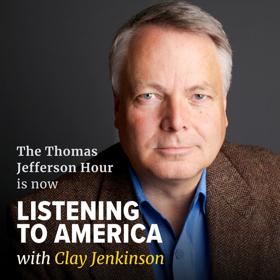
Listening to America aims to “light out for the territories,” traveling less visited byways and taking time to see this immense, extraordinary country with fresh eyes while listening to the many voices of America’s past, present, and future. Led by noted historian and humanities scholar Clay Jenkinson, Listening to America travels the country’s less visited byways, from national parks and forests to historic sites to countless under-recognized rural and urban places. Through this exploration, Clay and team find and tell the overlooked historical and contemporary stories that shape America’s people and places. Visit our website at ltamerica.org.
Welcome everyone in our podcast listenership. I'm Clay Jenkinson. Our good friend David Swenson is taking a break this week. On the Jefferson Hour, I talked with Dr. Lindsay Chervinsky about 10 things concerning Chief Justice John Marshall.
John Marshall was a Virginian like Jefferson, a plantation owner, a lawyer. In fact, he studied under George with the same political genius who tutored Thomas Jefferson in the law. Marshall was a federalist. Jefferson, of course, a small are Republican. They couldn't like each other.
Jefferson didn't like what he called the loose, lax, lounging manner of Marshall, who seemed to frequent taverns. Jefferson, of course, was aloof in his fortress of solitude and Monticello. They didn't like each other, ideologically or politically either, and yet John Marshall issued the oath of office to Jefferson on the 4th of March 18-1. It's always fun to talk with Lindsay because she brings such a fresh perspective to all of these things. And she has a new book, by the way, that she edited and wrote the introduction to, about America's mourning its fallen presidents.
It came out in February and I think it's going to be a really interesting book. And the chapter on Jefferson's death and the way he was mourned and memorialized was written by a Jefferson descendant. From the Sally Hemings side of the question. So that is certainly something that brings a fresh perspective to the death of Jefferson, and literally could not have been published 15 or 20 years ago. That shows you how far the the intellectual revolution has taken us in, and in almost every regard, in exactly the right direction. And Lindsay brings that, a younger hipper, fresher perspective to all this, in a way that I think really deepens the discourse here at the Thomas Jefferson hour. So, so glad for that. I should tell you just a few things.
It's a new year, I just came back from Locksaw Lodge in Montana, eastern Idaho. Our topics this year were the Return Journey of Lewis and Clark, and I can tell you that I spent five weeks preparing. I read all of the journals of Lewis and Clark from March 23rd, 1806 until September 23rd, 1806. That's Lewis Clark, Patrick Gas, John Ordway and Joseph Whitehouse. So I read all of it. In the spectacular University of Nebraska edition of the Journals of Lewis and Clark, edited by Gary Moulton. It was the most significant dive into Lewis and Clark Journals that I've ever made.
Now I need to continue to go back to the start in May 14th, 1804 and and read with equal discipline and care all the way through. But it was extraordinarily satisfying to do this, and I learned an enormous amount about the Lewis and Clark expedition. Things that you can only get by close textual reading. And the second one was on Dostoevsky, and one of our guests, Jim Kenyon, said that reading Dostoevsky is like being an inmate in a Soviet Siberian gulag. On a 25 degree below zero, day out, chipping rock and ice with a pick. So I guess, I guess it didn't work for Jim, but I think he was mostly joking was spectacular. And if you've never read Dostoevsky's Crime and Punishment, or Dostoevsky's Notes from Underground, or Dostoevsky's House of the Dead, or his late masterpiece, The Brothers Karamazov. I so strongly urge you to do so, and if you need help, just let me know, because it's it's not for the faint of heart.
You really have to tiptoe and train a little, I think, to read Dostoevsky, but the payoff is just enormous. So all of that has been going on. And by the way, this year I'm reading a I'm trying to read a classical, a classical book, a classic every month. So January was the month of Dostoevsky. In February, I'm going to read. Don Quixote by Cervantes, widely regarded as the first novel, in some regards, one of the greatest of all novels.
I haven't read it for 35 years, later this year I'm gonna read Moby Dick, etc. I'll try to keep you posted and if you want to, sort of join me in all of this. You can read these great works too, and we can discuss them and correspond about them, and I would very much welcome your own thoughts. So the next one on the list is Don Quixote by Cervantes, and there are many good translations. But if you choose one, you will almost certainly do well with this.
So it's snowing hard here in North Dakota. I'm recording this in the last days of January 2023. And by the way, next year's Locksaw Lodge retreats have been set. One will be on the Atomic Bomb and J. Robert Oppenheimer An American Tragedy. As you know, there's a blockbuster film coming out about J.
Robert Oppenheimer This summer, we're planning a cultural tour, I hope to Santa Fe and Los Alamos, so watch for that. But at the winter retreat at Locksaw Lodge, we'll be spending one week on that. And the other week we're gonna read two epics that are four thousand years apart. The Epic of Gilgamesh, which is in many respects the first book ever published in Western civilization, published, I say, an oral epic, but it was published soon enough that we still have it.
And then we're reading Moby Dick at the other end, and they speak to some of the same questions. They're both epics. One's a short epic, one, of course, is a it's a fairly long one by Herman Melville. So I urge you to go to the website to look for all of that.
More online courses? I'm starting one this week on Henry David Thoreau, and I'm still planning to do one. On ten iconic photographs of the last hundred years. Of course, it'll be more than ten, but ten that will be the primary focus of all of that. So we wish David Swenson a happy 70th birthday. He's been engaged in some of the best work of his entire life. On these Native American cylinder discs that were recorded by Francis Densmore a century ago, he's been widely praised for this pioneering, a work that he has done. He's really tremendous master in this field and is taking a break in some part because more offers are coming to him. To look at other of the discs that Francis Densmore recorded, around 1912 or so.
Fabulous for him and we wish him the best and happy birthday, our dear friend David Swenson. I'll be going to Vail next week doing a series of moderating's there about controversial issues in American life. This one will be on free and fair elections and voting rights. So that has calmed down a little, but not entirely. I've begun to write a new book of essays about the Great Plains.
The first one will be about East Helena, Montana and the country-western singer Katie Oslund Grizzler. Are you listening? Unfortunately, she's died, but she's someone I deeply respect. If you've never listened to Katie Oslund's Love in a small town, I urge you to do so. I just adore it.
She's sort of the country. Janice Joplin and Janice Joplin in hard 60s rock-and-roll was was singing about many of the same pains and longings. So all of that is going on in my life. It's going to be an exciting year. And the Thomas Jefferson Hour, we're going to sort of refocus, regenerate, re-energize the 1776 club, and I strongly urge you to join it. Of course, we need operating money to continue to do the Jefferson Hour.
If that's something you can help us with, we'd be thrilled. This is where I think I asked for the ranch and the airstream trailer and the electric bike and the Wine of the Month subscription, and so on. You're free to send all of those, of course, to the addresses on the Jefferson our site. And, you know, I'm only partly joking, of course, but what we need is operating funds. So if that's something that you're comfortable with, we'd be truly and deeply grateful to you. So today, we talk about Marshall and Washington, and Lindsay tells a hilarious story about the moment when Washington convinced John Marshall to stand for Congress.
We talked about Marshall's increasing vulnerability, he's being canceled. Several law schools have changed their name because of his complicity in the slave trade, in interpreting the slave trade as the Supreme Court's chief justice. We talked about the ways in which Jefferson and Marshall just couldn't see eye-to-eye or get along. Even though they were both Virginians. And I offer my theory that Jefferson couldn't stand it that a fellow Virginian could be a federalist anyway. It's really interesting and I just love working with Lindsay because she represents a new generation of thinkers and she's on, I think, to a spectacular career.
It's already notable and just going to grow. She's working on her book on John Adams now, and I just can't wait to read that. Also, our friend Joe Ellis has agreed to come on a number of times this year. That'll be wonderful. And other innovations are coming this year. And as you know, we're sort of moving now towards a new name and a new concept.
It'll be more the same than different. But we're going to be soon launching our program, Listening to America with Clay Jenkinson, in many respects the same program. But we're inching just a little bit away from a weekly focus on Jefferson himself, but I'm a dyed-in-the-wool Jeffersonian and I will never not focus on, I think, the most important American of all, Thomas Jefferson. So thanks for listening, keep listening.
Tell your friends spread the news. Go to my weekly Sunday column in Governing Comm, where I talk a lot about these same subjects. Greatly enjoying it and watch for the launch of our website in Listening to America. So let's go to the show. Thanks for listening and happy birthday David Swenson.
Hello everyone and welcome to this special edition of the Thomas Jefferson Hour. I'm Clay Jenkinson out of character this week and our dear friend David Swenson is on break. But I'm happy to be joined by our regular correspondent, Dr. Lindsay Trevinsky Lindsay, first of all, welcome to the show.
Thank you for having me back, and you have a new book that you edited coming out, I believe. It is called Mourning the President's Loss and legacy in American culture, coming out in March.
Yes, February, it will be out on February 20th, President's Day, very excited about it. It was really prompted by looking around after George H.W. Bush died and seeing the bipartisan response to his death. And the description of what you know, people were feeling and saying. And and we realized, my co-editor and I. It said so much about where we were as a nation at that moment, it said so much about our culture. And his legacy, about what, like, was valued then, and maybe hadn't been valued when he left office.
And so we started to dig into it and realize that. The periods of time after presidents die say so much about where the nation is, and often will shape where their legacy will go. And so we put together this volume. There are 12 chapters, from George Washington to George H.W. Bush, with contributors that run the gamut from directors of presidential libraries to graduate students to award-winning historians. And I think it will be a really compelling story for people, I think it will be a great hope, it will be a great contribution. And I am eager to hear what people think, and eager to hear which chapters are their favorite. Because it's one of those unique things, because it talks about so many different.
Presidency people can really pick and choose based on their interests. Well, certainly, there's really only one great story here. July 4th, 1826 Simultaneous death of two of America's founders, and Jefferson, the really the dreamer of America. And Adams, the sort of grumpy Republican who wrote that piece.
So we have a phenomenal historian who's actually the public historian at Monticello right now. His name is Andrew Javenport. He wrote the chapter on Jefferson. What makes that chapter so special is he is actually a descendant of Jefferson through the Hemings line. And so he, of course, told this the story that we're all familiar with of Jefferson and Adams. But then, of course, what that meant for the descendant community? And it is remarkable, and.
Incredibly powerful. Our theme today Chief Justice John Marshall Ten things in our Ten Things series. You sent me a list of some of your interests in John Marshall. I sent you a list of some of mine. I want to begin before that by asking you presidential death and legacy question When George Washington died in 1799, it was a huge thing.
John Marshall announced his death to Congress in a beautiful and moving tribute. He also handled logistically, handled the funeral arrangements, which was, of course, a gigantic moment in early American history. And guess who didn't attend the funeral? Mr. Thomas Jefferson?
He said He was traveling, right? He said, He was traveling, but you're freshly from this. This must have hurt Jefferson pretty seriously politically that he didn't show up.
It did because not only were there the national celebrations held by Congress, but there were celebrations held across the country. There were mock funerals and processions, and speeches, and oratory and toasts. And I mean, you name it, it happened. So if he had been traveling, if that had been the excuse, he could have attended any one of these ceremonies in Charlottesville or Richmond or along his way. And it was commented on the time and people really thought that it was unfortunate it was. It was really sad that the politics had gotten so nasty that he couldn't acknowledge the contributions of Washington, even if they no longer agreed on a lot of political things.
I blame Jefferson for this. First of all, it's very un-Jeffersonian. He's a very, on the whole, very gracious man who knows how to do the right thing, who understands political theater. And, you know, he was miffed even more than miffed when John Adams didn't attend his inaugural in 1801. He, you would have thought that Jefferson would have forced himself into one of these memorials just to show his deep respect for Washington, even though they were now at odds, he understood Washington's importance. Of course, he did.
It just seems that Jefferson is sort of at his least generous in a moment like this. Yeah, I think that's a good way to look at it.
I think he worried that maybe it was going to be really awkward because the Mazzei letter had come out not that long before. And Washington had been, until his death, involved in the army process under the Adams administration. And so I think Jefferson worried it was going to be weird and awkward, and and maybe that was why he didn't go. But it does, it does feel petty, it feels low and beneath him.
So there's one of our ten facts about John Marshall Marshall, Revered Washington. So I want to ask you the second question from the list about Marshall's five-volume life of George Washington, which he wrote while sitting as the Supreme Court's Chief Justice. He wrote it between 1803 and 1875, massive volumes. John Adams hated it.
For one reason, Jefferson disliked it, for another reason. You wrote about Washington. I'm not asking you to say whether you have read all five volumes or not, but nobody really does anymore. It's a it's not a definitive biography by any means, is more of a political history of the times.
Jefferson hated it because it was so federalist, it was so anti Jefferson, anti-Republican. Adams hated it because he, of course, he envied anybody who was who got better national attention than he did. And he said, I think he said it was a five volume mausoleum to, Well, what say you about this book?
So one of the fascinating things about Marshall, first of all, is he wrote most of the Supreme Court opinions during his tenure. And I know we're gonna talk more about them. Did just monster work, pulling together the Supreme Court and yet had time to write these five volumes. I don't. He was very productive, human, one of the amazing things shortly after his death. Bushrod Washington, who was a very close friend of Marshall, was the person who inherited a lot of Washington's papers and his library. And he turned them over in safekeeping to Marshall's. So not only was Marshall the first one to really sort of write this big history, but he was the first one to do so. With access to all of these primary source materials.
Now it is not what we would consider to be particularly unbiased history, it is very slanted in one direction. Marshall definitely has an agenda, and, as you said, he revered Washington. I have a one of our other ones on our list is a little bit more about their relationship.
I don't know if we want to dig dive into that now. But you know, he was making an argument. That argument was sometimes obviously anti Jefferson, and it was sometimes subtly anti Jefferson. But he had an agenda with this five volume set.
If you have you had any encounter with it at all, to try to read in it.
I messed around a little bit with it when I was working on the first book. Certainly, looking at, you know, various different things, and what's fascinating actually is not even so much. It as a source, because it's also a little dense. Not necessarily the fastest or easiest of reads, but how many of the next generation of biographers cite it? And so this is why it's really important that we don't say, Oh, you know, someone has been dead for 200 years. The history has already been written. Not so because the many of the first several generations of histories are so bad. Because they either have incomplete source material. They have an agenda like Marshall, or they rely on something that has an agenda like Marshall, and so that is.
I actually think the more fascinating piece is how many people cite it that come after him.
I'm talking to Dr. Lindsay Trevinsky, who's a frequent guest here on the Jefferson Are, particularly for our 10 Things series. I've been reading that. Law schools and other institutions around the country are now very uneasy with John Marshall and several law schools to already have changed their names. Mostly because of Marshall's complicity in the world of slavery. Now, talk a little bit about that.
Yeah, we're gonna do, I think, another program talking about this.
Sort of issue. More broadly, I'm of mixed feelings with a lot of these things. I think that, in Marshall's case, slavery is the worst part of his life, of his life story, the one we should be most uncomfortable with.
It was clearly his worst act. It's not what he's celebrated for, which I think is an important distinction that we're going to come back to when we're in a future subject. He celebrated for his tenure as Chief justice. I think it's appropriate and right for a society to think about, you know what, who are we celebrating?
And to maybe rethink some of those things and to rename things as we move along. Or maybe someone was really important at one point and and no longer matters as much. And so it makes sense to pick a newer face. I think that everyone probably has to make these decisions for themselves. But especially when it comes to, like, law schools, you can't have a law school, you, you cannot have American jurisprudence. Without Marshall, it just it wouldn't exist. And so I am of the mind, at least for me, for law schools, that they should probably keep that name.
So a couple of quick things here. First of all, one of the allegations that has recently come forward is that he owned more slaves than we had previously thought. So he was, he was more deeply engaged in the enslavement economy than then previous understandings had suggested. That's one thing.
But secondly, at least one, and perhaps more of his decisions from the court upheld the slave trade, upheld the trafficking and slaves. And so that's what I think is even more upsetting to people than the fact that he, like many others of his generation, owned enslaved people. But that he was such a brilliant jurist.
Yeah, no, absolutely, I think there's. There's no defending that position there, there shouldn't be defending that position. And it's clear by his later stances on things like the American colonization society, that he wasn't universally pro-slavery. Like some of the later generations of slave owners, who sort of talked about it as a positive good, clearly had qualms. Otherwise, he wouldn't have sort of offered to emancipate one of the individuals he owned later, so, with that context in mind.
There is no defending that decision, and I, I make no attempt to do so. And yet, I think that in this particular case, we can both say. He had an enormous impact on jurisprudence, for good and for ill, in this particular case. And still acknowledge that impact.
We'll take a short break when we come back, we'll be talking again with Dr. Lindsay Chervinsky. And I want to ask you about his marriage. You're listening to the Thomas Jefferson Hour? We'll be back in just a moment.
Welcome back to the Thomas Jefferson hour. I'm Clay Jenkinson sitting in for David Swensen, who's on a break and talking with our close friend and one of our principal correspondents, Dr. Lindsay Chervinsky. Lindsay, you sent me a list of topics you'd like to discuss with respect to the Chief Justice John Marshall. And one that I find very interesting is his marriage.
Talk a little bit about that.
Yeah, we don't know, or at least, I guess we don't, as sort of a society, think about John Marshall wife in the same way we do a Dolly Madison or an Abigail Adams. And so, as I was, as I've been reading about him, I found this part of the story to be particularly interesting. He was married to a woman named Mary Ambler Marshall. She went by Polly, he called her my dearest Polly.
They met during the revolution, when she she was about 10 years younger than him, so they met during that process. And she was the second of a fairly well-to-do merchant family near Yorktown, Virginia. She was born in 1766. Just for context, for our thinking about when the revolution occurred, they seemed to have a very warm and amiable relationship. Polly, I think, is one of those people who really suffered by the limitations of 18th century, especially for women.
She had a series of miscarriages, they lost some of their children, which was fairly normal at the time. Child mortality was quite high. And they didn't have the same sort of, of course, medicine and understanding of the the female body that we do today. But she also seemed to suffer from really significant what we would call postpartum depression, and after her second child, her second child was born. When John Marshall was in France. And the absence and the maybe suggestion that he was having an affair with a woman in France really sent her spiraling. And she never fully recovered. So she was was maybe what they called a recluse at the time.
She didn't really like to go out, she did not socialize, she did not host, She didn't really want to be in big cities, she preferred to be home. They clearly still had a marriage because they.
She continued to have more children and he did write to her lovingly. But it definitely limited the social engagements that I think Marshall would participate in. We've, I think, in the past talked about the importance of women hosting on behalf of their husbands, and that was not necessarily something Polly was able to do. And so it's a. It's a little bit of a sad story. Because I think that she would have really benefited from what we think of as mental health care and probably some sort of.
Medication as well, and instead really had a hard life. Two things really strike me about this Lindsay. One is his deep devotion to her. He wrote her constantly, she almost never wrote back.
She just probably wasn't able to because of her depression, and he was deeply solicitous of her situation. And so that really strikes me as a wonderful sign of his character that, you know, he was, he was loving, concerned he. It was awkward for him because he was a very social person and he had an extremely important function in the government of the United States. So that, I think is is really a sign of John Marshall's character, I.
Also have there's a Jefferson connection, as you know, because as a young man, Jefferson was in love. I'm using air quotes with Rebecca Burrell in Williamsburg. And the story of that is not for today, but it's an awkward story of a young man's courtship of a unavailable woman. She married Jacqueline Ambler and.
Polly is part of that family.
Yes, and there's some. So Jacqueline Ambler was Polly's father. So there is some suggestion that one of the reasons that Marshall very much did not like Jefferson was because he had heard the story from Rebecca about her experience with Jefferson. So the thing with all of the intermarriages in Virginia is that you really have a very complicated family dynamic. And boy, the skeletons in the closet really sure do come out. When we're talking about the the Lees and the Randolph's, and the Jefferson's, and the Marshall's at this time, Marshall got along with everyone. Marshall was friends with everyone, including Madison, including Madison, including Gallatin, including John Randolph, who were much more radical Republicans than Jefferson.
He was also friends with the highest of high federalists, who were criticizing him and criticizing Adams for their moderate stances. So when I say everyone, I mean he got along with everyone except for Jefferson, he hated Jefferson, and the feeling was quite mutual. And I think, correct me if I'm wrong, because I think you have a much better sense generally of his personality. But it's my sense that Jefferson resented how easily Marshall got along with everyone, that Marshall was easy and easy going and sort of genial and good with the jokes. And they sometimes, I think they called him like Mr. Barbecue because he was great at the socializing around elections. And don't you think that Jefferson, who was brilliant one-on-one, but maybe in larger groups, a little bit more uncomfortable, resented that ease?
Of course, Jefferson was aloof, Jefferson was shy. He was a little socially awkward, especially on first meeting. He didn't like groups and crowds, he didn't attend balls.
He, he was, he was kind of a the man on the mountain. He preferred to be at his fortress of solitude in Virginia, and he didn't have any of those loose, lounging tavern capacities. And I want to just read you something that was written by Jean Edward Smith, an eminent American historian. He says this that about both of them, an exemplary aristocrat who advocated democracy, Jefferson was never comfortable associating with the common man.
Marshall, who distrusted democracy, never lost the common touch. Jefferson opposed an energetic central government as a danger to individual liberty. Marshall saw the government in Washington as the keystone of national well-being. Jefferson identified with Virginia Marshall with the United States, Jefferson favored agriculture and advocated the virtues of rural life.
Marshall, an avid farmer himself, was more attuned to the needs of commerce and industry. In some respects, the differences involved the classic tension between the man of ideas, Jefferson, and the man of affairs. Jefferson was at his best when articulating a philosophy of government. Marshall. When applying one boy, that seems brilliant to me.
What say you? I think it's a perfect description.
And I wish that I had written it myself.
You know these? I read this the other day and I just thought, Wow, that, you know, almost a lifetime of understanding is distilled into a paragraph like that. And when you see that from a great historian like Smith, it just makes you want to be more yourself. So what is it about the two of them, besides these personal differences and differences of deportment?
What's the thing here? So let me give you a kind of an opening. They were two titans. Marshall over at the Supreme Court Jefferson, the third president of the United States. Marshall's decisions between 1801 and 1835 really pushed the country into a much more centralized national constitutional order.
You could even say that he, in some sense, distorted the Constitution to make it still more powerful than it was. Whereas Jefferson was always uneasy about the Constitution and preferred the articles of Confederation, so Jefferson's leaning to less constitutional authority, marshall too much more. That has to be one source of their trouble.
It's certainly ideological. They had very different views of the world and very different views of the nation. Very different views of what the government should be. Very different views of mankind, different approaches to their life. I do think that the there's a certain element of the personality. Conflict can't totally be attributed to that, and sometimes people just aren't a good match. There are.
There are times you're just really annoyed by someone and they just rub you the wrong way and they rubbed each other the wrong way all the time. So I think a lot of it was ideological, I'm sure some of it was situational. In terms that. They were both in Virginia and kind of couldn't get away from each other and always had to grapple with each other's existence. And some of it was they were just oil and water. I think Jefferson believed that. All Virginians.
Should be like him that if you're from Virginia, you're from the most important state, the most populated state, the richest state, and Virginians are Virginians. And I think it. It bothered him deeply that there could be a really extraordinarily talented Virginian. Like John Marshall, who belonged to the enemy, to the Federalist Party, the Party of New England and the and the Northern States. And I think it just, he just thought he's betrayed his very birthright and his destiny by not being a good Virginian.
The root of that difference, in my opinion, starts with Marshall's experience in the Army.
He was at Valley Forge, among other things.
One of the reasons Marshall adored Washington so much is that he had served with him and had served as an officer. And had served through the terrible winter at Valley Forge. Had fought in battle and had seen what that was like, and and very few officers who saw what that was like didn't become federalists. Most did because they valued the importance of a really strong national government, and it created a different type of nationalism for all of his other experiences, of course, as we've discussed in previous episodes, Jefferson did not serve in the military. And so had a very different world view, a very different view of nationalism. A very different relationship with Washington. One that was very respectful, and they worked quite closely together, but it was never the same. That is, I think, really, where the divergence happens in a in a sharp way, and it only grows from there.
I.
Think about this this morning. There really were two bands of brothers, one was the sort of Adams Jefferson band. Of the statesmen, the legislators, the people at the second Continental Congress, the the people who helped to formulate the ideas that became America. And then there was the band of brothers who fought the war. And if you didn't fight the war, as Jefferson didn't, as John Adams didn't, it didn't mean that people didn't respect you.
But there was something that you didn't have that others had, and the others had it, and there was a subtle demarcation between these two camps. And the fact that Jefferson was not only not a warrior and didn't serve, wasn't that. Valley Forge wasn't at Yorktown, but it's widely, and I think, rightly, regarded as a weak wartime governor in Virginia. This made the people that didn't like or trust Jefferson have another reason for thinking he's not really one of us. He can't appreciate the need for a strong national government because he wasn't there trying to hold a ragtag army together with the protocols of the Articles of Confederation.
He doesn't know what it was like at Valley Forge, he doesn't know how difficult it was for Washington, even to hold an army together through those years.
Yeah, that's absolutely right. And and it's not to say that those who served in the more diplomatic corps didn't suffer, they did, and they sacrificed. They were often away from home. Travel across the Atlantic was no picnic, to put it mildly.
Depending on where you were going, those positions weren't always particularly lovely. And so there was sometimes resentment among that band that their sacrifice wasn't appreciated in the same way. And then there was, of course, the sort of, I don't want to say, look down your nose. But there was a definite sense among the officer corps that they were the morally elite among Americans and should lead and should govern the nation. Because they were the best of the best.
You mentioned diplomats, let me go to that from my list. Marshall was one of the three American diplomats in the famous XYZ affair, along with Elbridge, Gerry and Charles Cotsworth Pinckney. John Adams was president. He sent this trio to France to try to work out disputes.
We were sort of involved in an undeclared naval war with France, and previous wartime ally was now in many respects at odds with us. This was partly because of the dislocations of the French revolution. But of the three Gary Pinckney and Marshall, Marshall was the most important of the three. And just quickly tell us, in the simplest terms, what the XYZ affair was.
Three person Peace Commission arrived in Paris. They were never officially received by the French directory, which was the governing body at the time. Charles Maurice de Talleyrand was the French foreign minister. Apologies for my terrible French accent. And he sent a series of unofficial agents, known as the XYZ agents. They're actually four, to request a series of things before the official negotiations could begin, including basically massive bribes for them and Talleyrand. They needed to apologize for the speech that Adams gave the previous spring. They needed to give a substantial loan to France, which would obviously be used to fight the war against Great Britain among. And they had to agree to basically forgive all of the depredations that the French Navy had inflicted on American merchants. All of which were obviously a no-go to start, but some of them were more insulting than others.
To make a very long story short, the Commission basically refused all these things. They were never received. Gary decided to stay because he was so concerned that if he left, war would break out. He stayed for several months.
He finally left, and when news of all of these happenings finally made it back to Philadelphia.
Descriptions of which were all written by Marshall, signed off Bond by the other envoys, but in his hand and in his pen. They were eventually released and there was a huge uproar. It caused a giant commotion among the American public. They were furious. The phrase was millions for defense and not one.
Six pence for thank you tribute and.
It was really a huge turning point in American diplomacy. Because not only did the the very strong reaction cause France to backtrack and ultimately led to successful negotiations later in Adams presidency. But it was a turning point for Marshall, because Marshall became a national hero, and this was Marshall's kind of.
Launching moment into the national zone. And it's clear now that he is a reliable Virginia federal representative, not necessarily yet a federalist. And so Adams embraces him, and Washington embraces him. And you began earlier by saying that when Washington died, his estate was inherited by his nephew, Bushrod Washington, and all of his papers. And Bushrod, at one point, was going to write a biography of his uncle, and he realized this is going to require a genius of some sort. So he hands all this over to Marshall, who, in a sense, was writing an authorized biography of the first president of the United States. But tell us about Washington's relationship with Marshall and Washington's encouragement of Marshall's political career.
I.
Just I love this story, I think it speaks volumes about both of their personalities and it just really makes me laugh. So, as the elections of 1798 were approaching, Washington was particularly concerned about the rise of Jeffersonian Republicans in Virginia. As a Virginian, and he thought that there needed to be good federalist candidates to to run for office. So he basically summoned Marshall and Bushrod Washington to Mount Vernon.
They stayed for several days. He insisted that Bushrod run, and Bushrod kind of gave in immediately. Because he tended to do whatever his uncle told him to do. Marshall said No, he said he didn't want to run for office he really needed.
Marshall was, despite his eventual sort of successes, was initially quite short on cash and desperately needed money. And running for Congress was not a great way to earn it. So he said, no, he didn't want to put him off, put him off. For days, Washington kept at it, like, would not take no for an answer. And after they had, they would go to these social events and come back to Mount Vernon, and Washington would pick it back up again. And finally, after three days of saying no, Marshall decides he's gonna get up early the next morning.
He's going to leave because he doesn't want to say no to Washington again, he doesn't want to put him in it in a difficult place. He has such respect for his former commanding officer, and he woke up early in the morning, went downstairs.
Can't get through it without laughing. Washington is standing there in the hallway, in full military dress, in full military uniform.
That's an intimidating, so I wish we had a photograph or a video of that scene. I'm talking with Dr. Lindsey Travinci. We need to take a break when we come back.
I want to say a little bit about the other big concern, per John Marshall, as the Supreme Court Chief justice, and that's American Indian policy. You're listening to the Thomas Jefferson Hour? We'll be back in just a moment.
Welcome back to the special edition of the Thomas Jefferson Hour. I'm Clay Jenkinson, out of tights and wig and buckled shoes. Talking with my friend Dr. Lindsey Travinsky of the State of Virginia, I have a particular interest Lindsey in Native American history. And Marshall is the author of something called the Marshall Trilogy. Three landmark cases which set the government style and approach to to dealing with Native Americans through our history. Europeans came to the new world beginning in 1492, and the result was the displacement of Native peoples, sometimes cultural genocide, sometimes approaching actual genocide.
But when Jefferson looked off to the American West, he didn't see Native American sovereignty, he saw empty land, he saw what he called a tabula rasa. So there's the paradox of America that the Native people who have been there for thousands of years, they have thriving cultures unlike our own, but thriving. And the white people who came here took the continent from them and left them with a puny little percent of their ancestral lands. And this had to be done in some legal, formal way.
So in the first of those three cases, Johnson v. McIntosh in in 1821. Marshall says that the doctrine of discovery governs these things, in other words, that the European country that finds a new place gets to claim it. And the Indigenous peoples. Tough luck for them. So this was a strong argument that brought the doctrine of discovery, which dates to the 14th and 15th centuries, brought it into American jurisprudence. In the second case, Cherokee Nation versus Georgia, Marshall said that this is the most important of the three.
This was 1831. Justice Marshall said Indian nations are sovereign, that states can't interfere with them, Georgia cannot interfere with the Cherokee nation, but they're only domestic dependent nations. And the U.S. government has a guardianship over Native Americans, that states can't mingle and mess with Native cultures. But the nation can because the nation has a trust relationship with Native Americans. So they're sovereign, but they're subordinately sovereign under the larger umbrella of American U.S. government policy. And then the third case, Worcester versus Georgia. It said that states have no authority to regulate Indian affairs.
Only the national government has the authority to regulate Indian affairs. This is called the Marshall trilogy. And what it basically says is that Native Americans today, on reservations, have very substantial sovereignty rights, but they don't have complete sovereignty over their own ancestral lands. That there, that there is a supervising guardian agent called the United States government. The state of North Dakota can't interfere, the state of Massachusetts can't interfere.
The state of Georgia can't interfere, but the U.S. government can manage Native Americans as it sees fit. But it has a duty to be aware that they have substantial sovereignty rights. So remember, Lindsay, that the Pope came to Canada recently and he apologized for the Indian boarding schools and his native? Respondents said, All right, how about apologizing for the doctrine of discovery? And the Pope said, Oh, I'm not ready to do that because that would be so terribly disruptive. But from a 21st century point of view, all this makes us cringe.
You have to sort of understand this was a problem that was going to get messy. That white Europeans come with their slaves from Africa. They have different property ideas, they have different technologies, they their populations are huge and growing. Native Americans live in a much more stable culture, but it doesn't have the same technologies.
It certainly doesn't have the same concepts of property, and these two systems are going to clash and somebody has to sort it out. And the person who laid down the basic protocols of American Indian policy was Chief Justice John Marshall. I know that's not your area, but it's fascinating to you too.
I know it is and it. It is obviously a monumental series of decisions and a monumental moment in American history. Because of all these implications that you've really clearly laid out. Should also, I mean, I think acknowledged is a deeply paternalistic view of Native American nations, in the worst possible way to describe a paternalistic view. So we should, you know, that's that is a significant part of it, which is, of course, shaped by ideas about race and a racial hierarchy. And so, I think, as a way to understand Marshall's significance, it is among the top of the top in terms of the impact and the thumbprint he left on history.
Absolutely, and you know, I guess I'll say this much, some legal formulae were going to have to occur, you know, you either just go in and take armies and and and, and just settle it with war. In which case, the United States would have easily won those wars because of the superior firepower that it brought to this. Or you have to find some sort of legal mechanisms to sort all this out. And Marshall was doing the best that could be done in his mind, under a very complex kind of a no-win sort of situation. And I, as a historian and as a advocate for Native American rights, would rather have Marshall to have done this than the people. You know, the people were just going to take that land, there was deep land lust, the people were ready to use violence.
The states were much more ruthless with respect to Native Americans than the national government. Marshall did what he thought was possible to do to protect Native American sovereignty and rights to a certain degree. But acknowledging that this juggernaut was going to roll over Indigenous America. And so he's controversial to this day. But you can't. You can't, realistically have expected him to deny the doctrine of discovery, or to say that the Cherokee had rights. That that the United States absolutely must respect. In a platonic world, maybe, but in the world that we live in, we know that just wasn't in the cards. And so question I have for you as a historian is this sort of stuff is really complex and it makes us cringe. Because you as a. As a young person, and an American, and a citizen, and a woman, have have ideas, politics and ideology and outlook, perspective and opinions. But as a historian, your duty is to try to sort out complex situations, and they're not always in harmony with each other.
And so our duty as historians is to say, here's what we think happened, and here's what we think were. The dynamics of how it happened. And here's what we know, or the implications of what happened. And we also get to have opinions. But it's not as if we can say this should never have happened. Because as a historian, you know how unbelievably complicated it all is.
Yeah, it's really messy. When you're when you're dealing with humans and human emotions, and land and property, and power, and race, and different cultures. It's going to be a giant mess. Cluster listeners will hear us talking about this very carefully and hear the sort of pauses in our voice. And that's because the tension and the agony, yeah, and it's because there's no. There's no good way to say, like, you know, here's the happy ending, or here's what should have happened, or here's who should have handled it. Because that's just not actually how the world works.
Unfortunately, I.
Hope people can hear our concern and our confusion and our struggle. That's so important. I just want you to say another word about it. You know? It's one thing to say, this should never have happened, or why did we do this?
Or this can't be justified. But that doesn't get us down the road very far. We have to try to understand, right? So Jefferson's Indian policy was as sort of utopian and silly as Jefferson could sometimes be. He looked for a benign ending to all this.
He thought that Native Americans could be persuaded to yield, that they would be compensated, that they would understand that they had to yield. And they would take advantage of white culture and be sort of voluntarily assimilate over time, you know, and that they would. We didn't need forced removal. Somehow, there would be cooperative separation of the two races. But Washington, in the last years of his life, as I understand it, started to think more about this. And and to his, I think, eternal credit. He said. We have not done justice with respect to Native Americans and we must find a better path. I think Joe Ellis wrote about that in his book, His Excellency. But I give Washington so much respect for, at the end of his life, wrestling in a good way with slavery and.
Wrestling with white Indian policy? Yeah.
I mean, he. One of the things that I think was so remarkable about Washington's life is the time that he spent out West. And this was, of course, his version of the West. He really did have interactions with Native nations and communities, and he saw the ability and the strength and the power of those communities. He had respect for their fighting ability and learned that the hard way about not overlooking or underestimating native allies. And those things absolutely shaped his later perspective. Now, of course, he was not perfect on this.
He sent armies to crush native nations and native alliances. But he was also, I think, aware in a way that a lot of white Americans at the time weren't. That it was kind of their fault that white settlers had marched west and encroached on native land and had instigated the conflict. And at some point, he had to, you know, step in as president and send an army or multiple armies out. But he was very aware that the U.S was often to blame for these things. And I think that that was something he was uncomfortable with. In a in a good way.
That someone should be uncomfortable with that. I love that, I love that about.
WASHINGTON You know, you mentioned this hilarious moment where Marshall is staying at Mount Vernon in Washington and come at breakfast, Washington is suited up in his uniform. It puts the full-court press on poor Marshall to run for Congress. I love that story, but. But here's an even better one the inauguration of Jefferson on March 4th, 1801. So here's the situation in which Marshall has to administer the oath to his enemy, and Jefferson has to take the oath from his enemy. And Marshall. Because he had loose lacks, lounging manners.
Lindsay was famous for not being so. Jefferson writes him this little letter like the day before. It says, I assume you will be there promptly at noon, and he's like saying, Don't be late. This is my big moment. And Marshall then goes, and he wrote two letters, one before sort of saying, Oh gosh, you know, Jefferson, I have to go.
I have to go administer to the oath, he said. Some very strong things, like Jefferson was wholly unfit for the presidency, he couldn't think of anything worse that could happen to the country than that. This Jacobin, this radical, the small D Democrat, would be president person who didn't really understand he does administer the oath. And Marshall goes back and writes this letter and says, Well, it wasn't as bad as I thought. His inaugural address was pretty interesting, pretty good.
He seems like it's, he's kind of conciliatory, he said. I usually put his Republicans into one of two camps theoretic visionaries or absolute terrorists. And he said, I don't really think Jefferson is a terrorist. I think we could probably know he's not going to be a too disruptive president. How great that moment must have been with these two colossal figures who can barely stand to be in the same Zip code. Having to go through this ceremony together. But they both behave properly.
That's what I love about the early national period they did. And I will add one additional element, which is that Jefferson needed a Marshall's assistance through the transition. He, you know, was obviously taking over at a moment when international relations were complex. Marshall wrote him a report. Marshall sent a one of his clerks to help Jefferson as his private secretary, because Jefferson didn't have anyone around. And then Jefferson asked Marshall to stay on until Madison could get into town as secretary of state, and he did.
Not only did they behave properly in public when everyone's eyes were watching, but they also behaved privately behind the scenes. And did what was right for the nation to ensure the peaceful transfer of power, and that is essential.
It's an amazing story that Jefferson would ask Marshall to stay on, because, as you know, Marshall was a midnight appointment to the Supreme Court. In the last days, that's not quite that's what Jefferson thought. Okay, that's fair, and it wasn't like the last night, but it was late in the game.
And Jefferson later wrote about this to Abigail Adams, as you know, big mistake because she just tore him a new one, contemporary term. But, he said, I would have thought it would have been more gentlemanly and polite for Adams to defer major decisions like this to the new president of the United States. And she wrote back and said, Look, honey, have you read your Constitution? He was president until the moment he wasn't, and he has to do what presidents do, which is fill vacant offices. So shut up already. And Jefferson couldn't take it.
To two quick notes to prove that Abigail was indeed correct. So first, John Adams made this appointment on January 20th.
17 1801.
Oh, not midnight. Just a few weeks before the inauguration, the inauguration was in March.
So let's do our math correctly here a few weeks. He was not confirmed until January 27th because the High Federalist wanted a more high federalist. Chief Justice and Adams said no, and they finally said, fine and we'll take him. However, I think what's really important to note, Washington appointed judges and justices up until the day before he left office. Now, obviously, Washington and Adams were more on the same political side of things, but there was that precedent. So I do think we need to give Adams a little bit of credit that he wasn't trying to, like, break the mold.
But in doing what he did, which is appointing, not his first choice, by the way. But appointing John Marshall be Chief Justice, Adams made one of the most momentous decisions in American presidential history. And Marshall, whatever you think of him, was a colossus, a giant of American jurisprudence. And I don't think Jefferson knew quite what he was up against here, because Marshall won the Great Battle for the Constitution and Jefferson lost.
He did, and I don't think that anyone anticipated, because at that point, most chief justices, most justices, served from two to maybe ten years, but really not very long. No one anticipated at the time that Marshall would serve as long as he did, or would go on to have the unparalleled impact that he did on the court.
You learn a lot from looking at that. Because some of these early chief justices or other justices left to run for governor in their states, or senator. Or they didn't regard the Supreme Court as the be-all and the end-all. And think of what it would take today for a Supreme Court justice to resign and run for governor of Mississippi or Hawaii.
Yeah, I mean, I think Marshall, I don't know if you grew this, but I think Marshall was the one that made it the job worth wanting. And that was partly because of his, the length of his tenure, how he crafted the Supreme Court's power. But then also the role that he took on in terms of making sure there were unanimous decisions and writing so many of the decisions and really controlling the culture of the court in a non dictatorial way. He got along really well with the other justices and used all of that personality and that emotional intelligence to.
Maintain harmony. John Marshall, by all accounts, was a fun guy to be around, Jefferson maybe not so much.
He was the type of justice. You wanted to have a beer with Adams?
Maybe not so much. George Washington, a little on the formidable side. Marshall did two things. First of all, he changed the procedures of the court. Instead of every justice writing an opinion about every case that's called seriatim opinions, Marshall said. No, let's speak for the court. Let's give the greater auctoritas a greater gravitas by having a ruling by the court rather than this justice and that justice. And Jefferson really objected to that. The other thing he did, he served wine at their meetings, and so they would be meeting, and he would serve wine or grog.
And this built harmony. And I don't think he did it to manipulate the court. But it had the effect of making the court his, and making the court more likely to be in agreement. Because they were friends. And today you hear some justices are friends across ideological lines, and others can't really stand to be in the same building with each other.
Which I think was always true. But he managed to keep a pretty good handle on things.
So to summarize, we like John Marshall and we understand his monumental importance. And probably nobody shaped our constitutional interpretive world more than John Marshall did. But the ways in which he interpreted the constitution were almost diametrically opposed to Jefferson's vision of this country. I so appreciate all you've said today about all of this. Lindsay. I wish you a great 2023. Congratulations on your new book.
People can get to it at Amazon.
Com or your local independent bookstore mourning the president's loss and legacy in American culture. You co-edited the book and wrote the introduction. We'll see you all next week for another important edition of the Thomas Jefferson Hour.
The Thomas Jefferson Hour is brought to you each week by Dakota Sky Education. The program is distributed nationally by Prairie Public. President Thomas Jefferson lived from 1743 to 1826, and this program presents his views. President Jefferson is portrayed by the award-winning humanities scholar and author Clay S. Jenkinson. This program is also available online at jefferson hour..com and on Apple Podcasts.
If you'd like to correspond with President Jefferson or submit a question for him to answer on the program, please visit the website at Jefferson Hour.
Com Boccello, Suite number Three and C Major by Steven Swinford. Thank you for listening. Please tune in again next week for another thought-provoking, historically accurate program through the eyes of Thomas Jefferson.
You?
v1.0.0.260408-1-a910ba6_os